Grade 6 · Social StudiesHIS.6.7Premium
From a Consul's Coffin to a Buried Chest: A Hall of Roman Objects
Grade 6 ancient Rome: museum labels on Scipio's coffin, an Appian Way milestone, Augustus's statue, Irni's bronze law, a Vindolanda letter and a hoard.
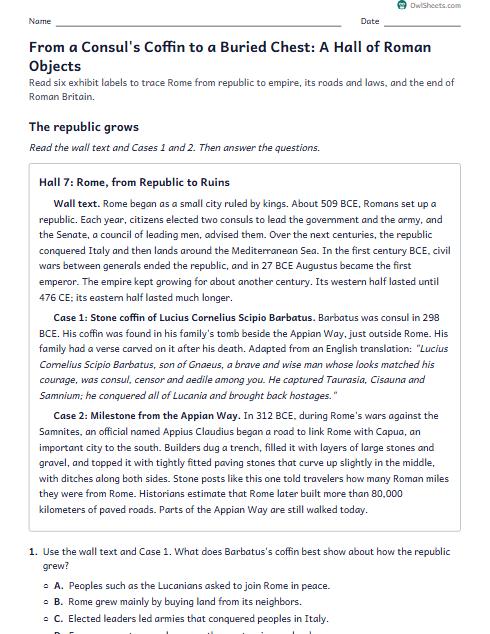
Preview
OwlSheets.com
From a Consul's Coffin to a Buried Chest: A Hall of Roman Objects
Read six exhibit labels to trace Rome from republic to empire, its roads and laws, and the end of Roman Britain.
The republic grows
Read the wall text and Cases 1 and 2. Then answer the questions.
Hall 7: Rome, from Republic to Ruins
Wall text. Rome began as a small city ruled by kings. About 509 BCE, Romans set up a republic. Each year, citizens elected two consuls to lead the government and the army, and the Senate, a council of leading men, advised them. Over the next centuries, the republic conquered Italy and then lands around the Mediterranean Sea. In the first century BCE, civil wars between generals ended the republic, and in 27 BCE Augustus became the first emperor. The empire kept growing for about another century. Its western half lasted until 476 CE; its eastern half lasted much longer.
Case 1: Stone coffin of Lucius Cornelius Scipio Barbatus. Barbatus was consul in 298 BCE. His coffin was found in his family's tomb beside the Appian Way, just outside Rome. His family had a verse carved on it after his death. Adapted from an English translation: "Lucius Cornelius Scipio Barbatus, son of Gnaeus, a brave and wise man whose looks matched his courage, was consul, censor and aedile among you. He captured Taurasia, Cisauna and Samnium; he conquered all of Lucania and brought back hostages."
Case 2: Milestone from the Appian Way. In 312 BCE, during Rome's wars against the Samnites, an official named Appius Claudius began a road to link Rome with Capua, an important city to the south. Builders dug a trench, filled it with layers of large stones and gravel, and topped it with tightly fitted paving stones that curve up slightly in the middle, with ditches along both sides. Stone posts like this one told travelers how many Roman miles they were from Rome. Historians estimate that Rome later built more than 80,000 kilometers of paved roads. Parts of the Appian Way are still walked today.
- A. Peoples such as the Lucanians asked to join Rome in peace.
- B. Rome grew mainly by buying land from its neighbors.
- C. Elected leaders led armies that conquered peoples in Italy.
- D. Emperors sent generals across the sea to win new lands.
- A. It was carved long after the Roman Empire had ended.
- B. It was found far away from the city of Rome.
- C. It was written in a language no one can read today.
- D. It was written by his family and gives only Rome's side.
The preview shows the first questions. Unlock the worksheet to see all of it.
Related worksheets
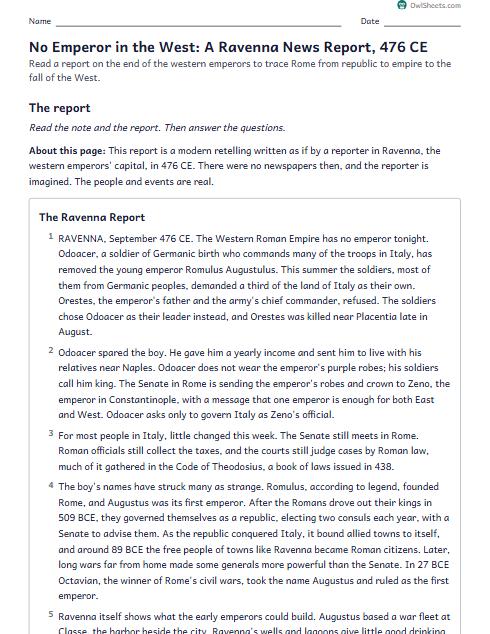
No Emperor in the West: A Ravenna News Report, 476 CE
Grade 6 · HIS.6.7
14 questionsPremium
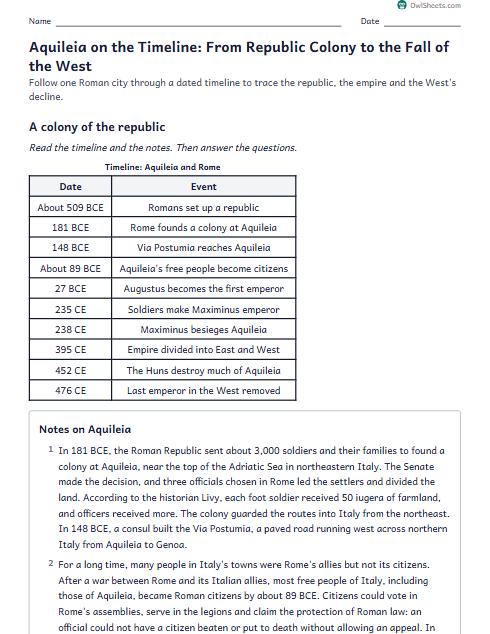
Aquileia on the Timeline: From Republic Colony to the Fall of the West
Grade 6 · HIS.6.7
15 questionsPremium
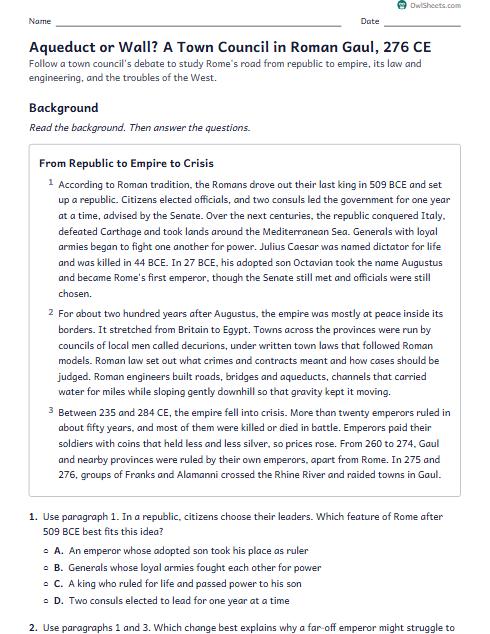
Aqueduct or Wall? A Town Council in Roman Gaul, 276 CE
Grade 6 · HIS.6.7
14 questionsPremium
Sailing Past Ruins: A Roman Noble's Coast Voyage, 416 CE
Grade 6 · HIS.6.7
14 questionsPremium
Three Voices from Rome: Polybius, Pliny and Jerome
Grade 6 · HIS.6.7
12 questionsPremium
Two Accounts of Augustus: The Ankara Inscription and Tacitus
Grade 6 · HIS.6.7
10 questionsFree