Grade 6 · Social StudiesHIS.6.7Premium
Sailing Past Ruins: A Roman Noble's Coast Voyage, 416 CE
Grade 6 ancient Rome: follow a described map and Rutilius's 416 CE voyage from Rome to Pisa to trace the republic, the empire and the West's decline.
Preview
OwlSheets.com
Sailing Past Ruins: A Roman Noble's Coast Voyage, 416 CE
Follow Rutilius Namatianus up the coast of Italy to trace Rome's rise, its law and engineering, and the decline of the West.
The map and the voyage
Read the map description, the background, the journey and the timeline. Then answer the questions.
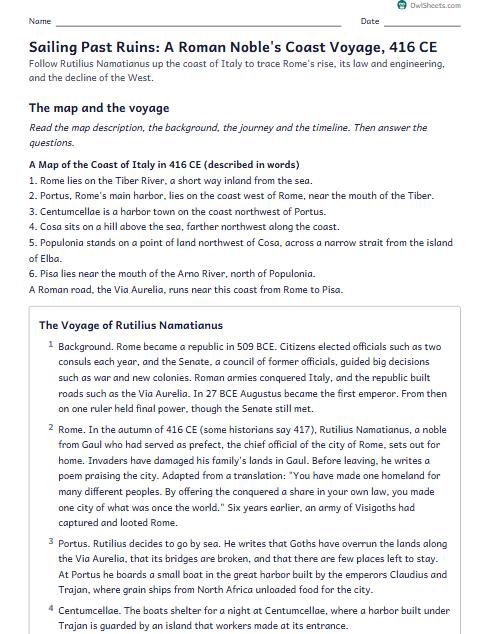
1. Rome lies on the Tiber River, a short way inland from the sea.
2. Portus, Rome's main harbor, lies on the coast west of Rome, near the mouth of the Tiber.
3. Centumcellae is a harbor town on the coast northwest of Portus.
4. Cosa sits on a hill above the sea, farther northwest along the coast.
5. Populonia stands on a point of land northwest of Cosa, across a narrow strait from the island of Elba.
6. Pisa lies near the mouth of the Arno River, north of Populonia.
A Roman road, the Via Aurelia, runs near this coast from Rome to Pisa.
The Voyage of Rutilius Namatianus
1Background. Rome became a republic in 509 BCE. Citizens elected officials such as two consuls each year, and the Senate, a council of former officials, guided big decisions such as war and new colonies. Roman armies conquered Italy, and the republic built roads such as the Via Aurelia. In 27 BCE Augustus became the first emperor. From then on one ruler held final power, though the Senate still met.
2Rome. In the autumn of 416 CE (some historians say 417), Rutilius Namatianus, a noble from Gaul who had served as prefect, the chief official of the city of Rome, sets out for home. Invaders have damaged his family's lands in Gaul. Before leaving, he writes a poem praising the city. Adapted from a translation: "You have made one homeland for many different peoples. By offering the conquered a share in your own law, you made one city of what was once the world." Six years earlier, an army of Visigoths had captured and looted Rome.
3Portus. Rutilius decides to go by sea. He writes that Goths have overrun the lands along the Via Aurelia, that its bridges are broken, and that there are few places left to stay. At Portus he boards a small boat in the great harbor built by the emperors Claudius and Trajan, where grain ships from North Africa unloaded food for the city.
4Centumcellae. The boats shelter for a night at Centumcellae, where a harbor built under Trajan is guarded by an island that workers made at its entrance.
5Cosa. Farther on, Rutilius passes the empty ruins of Cosa, its old walls broken. The republic founded Cosa in 273 BCE on land taken from an Etruscan city, and it sent settlers from Rome and its allies to live there. Historians think the town had been shrinking for centuries.
6Populonia. Etruscans and later Romans once melted iron ore from Elba here. Rutilius finds only broken walls and towers. He writes that we should not complain when human bodies die, since we can see that even cities can die.
7Pisa. At last he reaches Pisa, where he waits for better weather before sailing on toward Gaul.
| Date | Event |
|---|---|
| 509 BCE | Roman Republic begins |
| 273 BCE | Rome founds the colony of Cosa |
| 27 BCE | Augustus becomes first emperor |
| About 110 CE | Trajan builds harbor works |
| 395 CE | Empire splits into East and West |
| 410 CE | Visigoths capture and loot Rome |
| 416 CE | Rutilius sails from Portus |
| 439 CE | Vandals take Carthage in North Africa |
| 476 CE | Last emperor in the West removed |
The preview shows the first questions. Unlock the worksheet to see all of it.
Related worksheets
No Emperor in the West: A Ravenna News Report, 476 CE
Grade 6 · HIS.6.7
14 questionsPremium
Aquileia on the Timeline: From Republic Colony to the Fall of the West
Grade 6 · HIS.6.7
15 questionsPremium
Aqueduct or Wall? A Town Council in Roman Gaul, 276 CE
Grade 6 · HIS.6.7
14 questionsPremium
From a Consul's Coffin to a Buried Chest: A Hall of Roman Objects
Grade 6 · HIS.6.7
15 questionsPremium
Three Voices from Rome: Polybius, Pliny and Jerome
Grade 6 · HIS.6.7
12 questionsPremium
Two Accounts of Augustus: The Ankara Inscription and Tacitus
Grade 6 · HIS.6.7
10 questionsFree