Grade 6 · Social StudiesHIS.6.7Premium
Aqueduct or Wall? A Town Council in Roman Gaul, 276 CE
Grade 6 ancient Rome: weigh a Gallic town council's debate over repairing an aqueduct or building a wall in 276 CE to study the empire's rise, law and decline.
Preview
OwlSheets.com
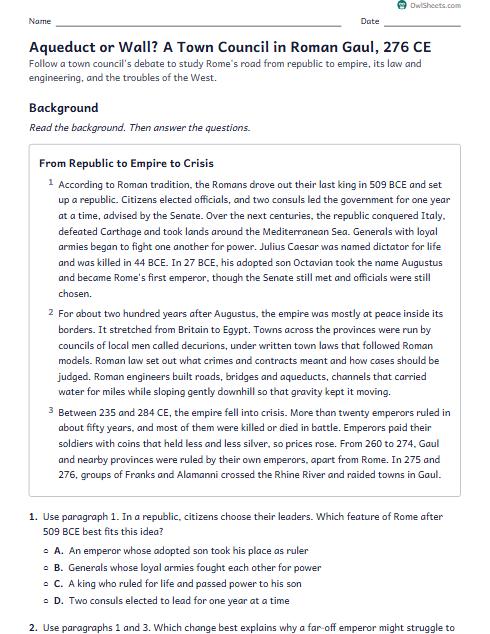
Aqueduct or Wall? A Town Council in Roman Gaul, 276 CE
Follow a town council's debate to study Rome's road from republic to empire, its law and engineering, and the troubles of the West.
Background
Read the background. Then answer the questions.
From Republic to Empire to Crisis
1According to Roman tradition, the Romans drove out their last king in 509 BCE and set up a republic. Citizens elected officials, and two consuls led the government for one year at a time, advised by the Senate. Over the next centuries, the republic conquered Italy, defeated Carthage and took lands around the Mediterranean Sea. Generals with loyal armies began to fight one another for power. Julius Caesar was named dictator for life and was killed in 44 BCE. In 27 BCE, his adopted son Octavian took the name Augustus and became Rome's first emperor, though the Senate still met and officials were still chosen.
2For about two hundred years after Augustus, the empire was mostly at peace inside its borders. It stretched from Britain to Egypt. Towns across the provinces were run by councils of local men called decurions, under written town laws that followed Roman models. Roman law set out what crimes and contracts meant and how cases should be judged. Roman engineers built roads, bridges and aqueducts, channels that carried water for miles while sloping gently downhill so that gravity kept it moving.
3Between 235 and 284 CE, the empire fell into crisis. More than twenty emperors ruled in about fifty years, and most of them were killed or died in battle. Emperors paid their soldiers with coins that held less and less silver, so prices rose. From 260 to 274, Gaul and nearby provinces were ruled by their own emperors, apart from Rome. In 275 and 276, groups of Franks and Alamanni crossed the Rhine River and raided towns in Gaul.
- A. An emperor whose adopted son took his place as ruler
- B. Generals whose loyal armies fought each other for power
- C. A king who ruled for life and passed power to his son
- D. Two consuls elected to lead for one year at a time
- A. Emperors were often fighting rivals and seldom ruled for long.
- B. The Senate had stopped meeting once Augustus became emperor.
- C. Rome had given Gaul back to Carthage after its long wars.
- D. Consuls now led each army for only a year before handing it on.
The preview shows the first questions. Unlock the worksheet to see all of it.
Related worksheets
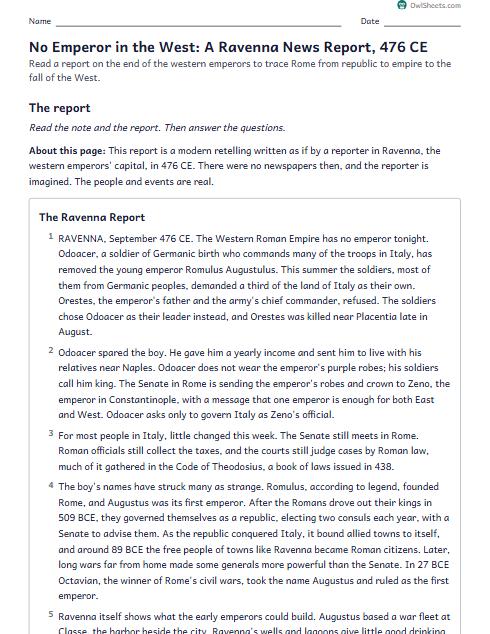
No Emperor in the West: A Ravenna News Report, 476 CE
Grade 6 · HIS.6.7
14 questionsPremium
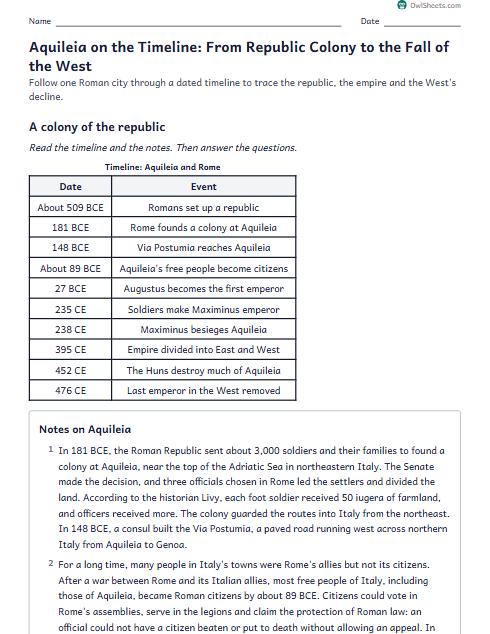
Aquileia on the Timeline: From Republic Colony to the Fall of the West
Grade 6 · HIS.6.7
15 questionsPremium
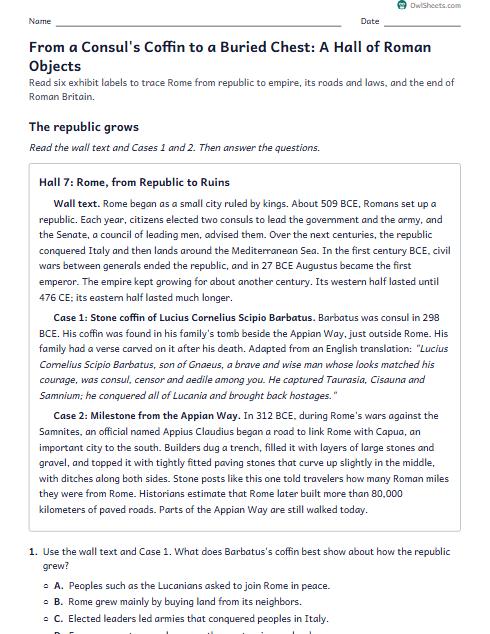
From a Consul's Coffin to a Buried Chest: A Hall of Roman Objects
Grade 6 · HIS.6.7
15 questionsPremium
Sailing Past Ruins: A Roman Noble's Coast Voyage, 416 CE
Grade 6 · HIS.6.7
14 questionsPremium
Three Voices from Rome: Polybius, Pliny and Jerome
Grade 6 · HIS.6.7
12 questionsPremium
Two Accounts of Augustus: The Ankara Inscription and Tacitus
Grade 6 · HIS.6.7
10 questionsFree