Grade 6 · Social StudiesHIS.6.7Premium
Aquileia on the Timeline: From Republic Colony to the Fall of the West
Grade 6 ancient Rome: trace Aquileia from a 181 BCE colony to its fall in 452 CE to study Rome's growth, law, roads and the decline of the West.
Preview
OwlSheets.com
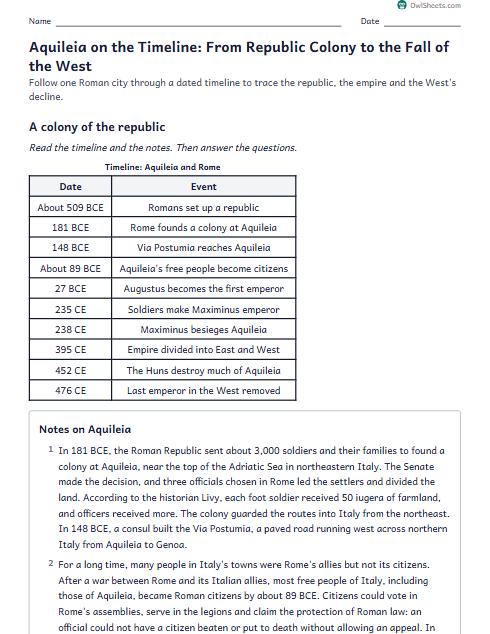
Aquileia on the Timeline: From Republic Colony to the Fall of the West
Follow one Roman city through a dated timeline to trace the republic, the empire and the West's decline.
A colony of the republic
Read the timeline and the notes. Then answer the questions.
| Date | Event |
|---|---|
| About 509 BCE | Romans set up a republic |
| 181 BCE | Rome founds a colony at Aquileia |
| 148 BCE | Via Postumia reaches Aquileia |
| About 89 BCE | Aquileia's free people become citizens |
| 27 BCE | Augustus becomes the first emperor |
| 235 CE | Soldiers make Maximinus emperor |
| 238 CE | Maximinus besieges Aquileia |
| 395 CE | Empire divided into East and West |
| 452 CE | The Huns destroy much of Aquileia |
| 476 CE | Last emperor in the West removed |
Notes on Aquileia
1In 181 BCE, the Roman Republic sent about 3,000 soldiers and their families to found a colony at Aquileia, near the top of the Adriatic Sea in northeastern Italy. The Senate made the decision, and three officials chosen in Rome led the settlers and divided the land. According to the historian Livy, each foot soldier received 50 iugera of farmland, and officers received more. The colony guarded the routes into Italy from the northeast. In 148 BCE, a consul built the Via Postumia, a paved road running west across northern Italy from Aquileia to Genoa.
2For a long time, many people in Italy's towns were Rome's allies but not its citizens. After a war between Rome and its Italian allies, most free people of Italy, including those of Aquileia, became Roman citizens by about 89 BCE. Citizens could vote in Rome's assemblies, serve in the legions and claim the protection of Roman law: an official could not have a citizen beaten or put to death without allowing an appeal. In the first two centuries after Augustus became emperor, the empire was mostly at peace, and Aquileia grew into one of the largest cities in Italy. Ships tied up at long stone docks along its river, and craftsmen carved amber, carried overland from the Baltic coast, into jewelry sold across the empire.
3In 235 CE, soldiers on the Rhine frontier declared their commander, Maximinus, emperor. The Senate later backed rivals against him, and in 238 CE he marched his army into Italy. Aquileia closed its gates, and its people defended the walls for weeks. Maximinus's own soldiers, hungry and tired of the siege, killed him in his camp outside the city. In the fifty years after 235 CE, more than twenty men claimed the title of emperor, and most of them died by violence.
4In 395 CE, the empire was divided for good into an eastern half, ruled from Constantinople, and a western half. The West had less money and fewer soldiers, and it relied more and more on hired fighters from Germanic peoples. In 452 CE, Attila, leader of the Huns, besieged Aquileia, captured it and destroyed much of the city. Many survivors fled to small islands in nearby lagoons. In 476 CE, a Germanic general named Odoacer removed the last emperor in the West. The eastern half of the empire lasted nearly a thousand more years.
Together they received iugera of farmland.
The preview shows the first questions. Unlock the worksheet to see all of it.
Related worksheets
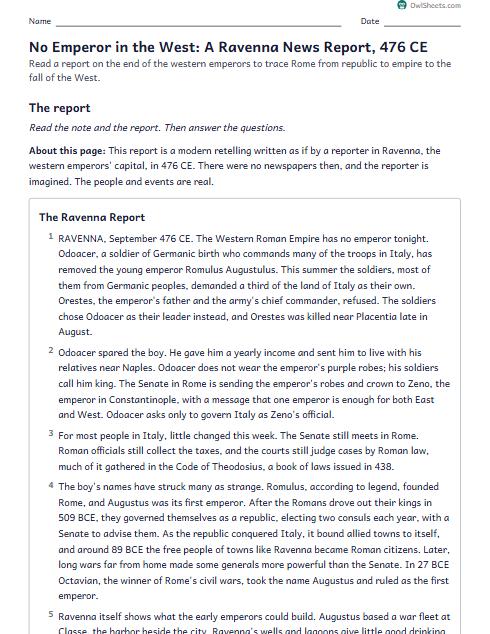
No Emperor in the West: A Ravenna News Report, 476 CE
Grade 6 · HIS.6.7
14 questionsPremium
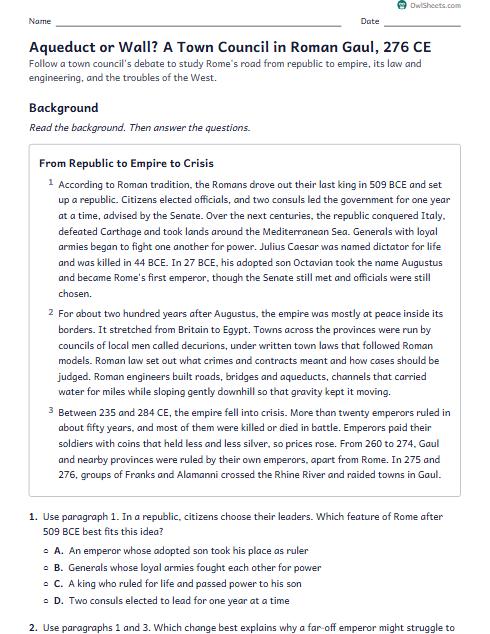
Aqueduct or Wall? A Town Council in Roman Gaul, 276 CE
Grade 6 · HIS.6.7
14 questionsPremium
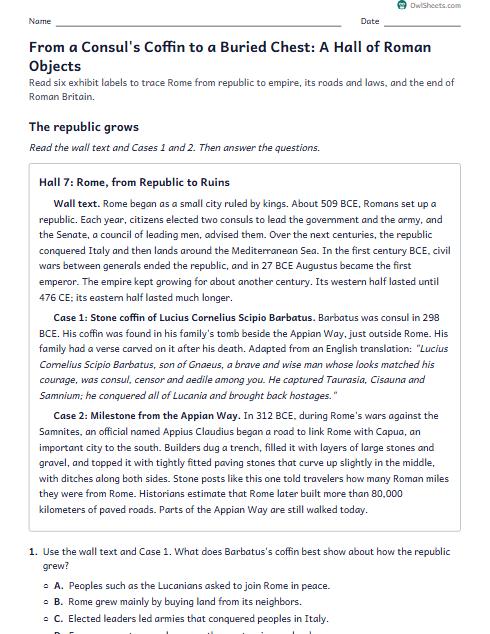
From a Consul's Coffin to a Buried Chest: A Hall of Roman Objects
Grade 6 · HIS.6.7
15 questionsPremium
Sailing Past Ruins: A Roman Noble's Coast Voyage, 416 CE
Grade 6 · HIS.6.7
14 questionsPremium
Three Voices from Rome: Polybius, Pliny and Jerome
Grade 6 · HIS.6.7
12 questionsPremium
Two Accounts of Augustus: The Ankara Inscription and Tacitus
Grade 6 · HIS.6.7
10 questionsFree