Grade 6 · Social StudiesCIV.6.1Premium
Three Speeches in Persia: Did the Debate Really Happen?
Grade 6 civics: weigh Herodotus's account of a Persian debate against a historian's doubts, then compare monarchy, oligarchy, Athens and Rome.
Preview
OwlSheets.com
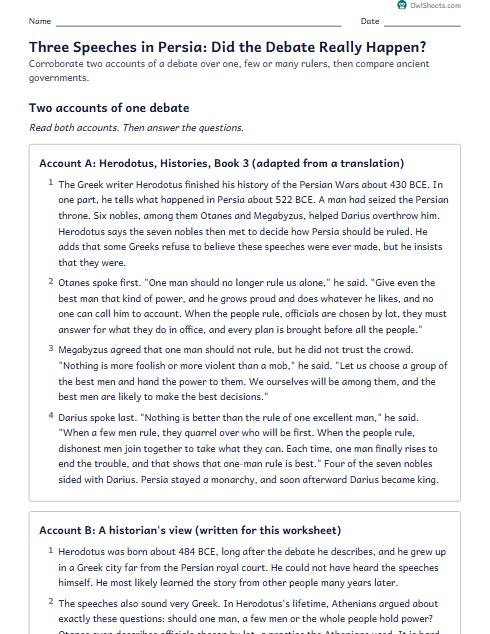
Three Speeches in Persia: Did the Debate Really Happen?
Corroborate two accounts of a debate over one, few or many rulers, then compare ancient governments.
Two accounts of one debate
Read both accounts. Then answer the questions.
Account A: Herodotus, Histories, Book 3 (adapted from a translation)
1The Greek writer Herodotus finished his history of the Persian Wars about 430 BCE. In one part, he tells what happened in Persia about 522 BCE. A man had seized the Persian throne. Six nobles, among them Otanes and Megabyzus, helped Darius overthrow him. Herodotus says the seven nobles then met to decide how Persia should be ruled. He adds that some Greeks refuse to believe these speeches were ever made, but he insists that they were.
2Otanes spoke first. "One man should no longer rule us alone," he said. "Give even the best man that kind of power, and he grows proud and does whatever he likes, and no one can call him to account. When the people rule, officials are chosen by lot, they must answer for what they do in office, and every plan is brought before all the people."
3Megabyzus agreed that one man should not rule, but he did not trust the crowd. "Nothing is more foolish or more violent than a mob," he said. "Let us choose a group of the best men and hand the power to them. We ourselves will be among them, and the best men are likely to make the best decisions."
4Darius spoke last. "Nothing is better than the rule of one excellent man," he said. "When a few men rule, they quarrel over who will be first. When the people rule, dishonest men join together to take what they can. Each time, one man finally rises to end the trouble, and that shows that one-man rule is best." Four of the seven nobles sided with Darius. Persia stayed a monarchy, and soon afterward Darius became king.
Account B: A historian's view (written for this worksheet)
1Herodotus was born about 484 BCE, long after the debate he describes, and he grew up in a Greek city far from the Persian royal court. He could not have heard the speeches himself. He most likely learned the story from other people many years later.
2The speeches also sound very Greek. In Herodotus's lifetime, Athenians argued about exactly these questions: should one man, a few men or the whole people hold power? Otanes even describes officials chosen by lot, a practice the Athenians used. It is hard to picture a Persian noble praising a system that was so typical of Athens.
3Darius, who became king, left his own account of how he took power. It was carved high on a cliff at Behistun, in what is now Iran, about 520 BCE, in three languages. It names six nobles who helped him, including Otanes and Megabyzus, but it says nothing about a debate over forms of government. Five of the six names match the list in Herodotus. Herodotus names one helper, Aspathines, whom the cliff leaves out; in his place, the cliff names a noble called Ardumanish.
4For these reasons, I think the speeches are mostly Herodotus's way of showing Greek arguments about government. Still, Herodotus also reports that in 492 BCE a Persian general named Mardonius removed the tyrants of several Greek cities in Ionia and let those cities set up democracies. So some Persians may have been more open to rule by the people than we might expect.
- Otanes
- Megabyzus
- Darius
- A. Rule by the whole people
- B. Rule by one man
- C. Rule by a small group of the best men
The preview shows the first questions. Unlock the worksheet to see all of it.
Related worksheets
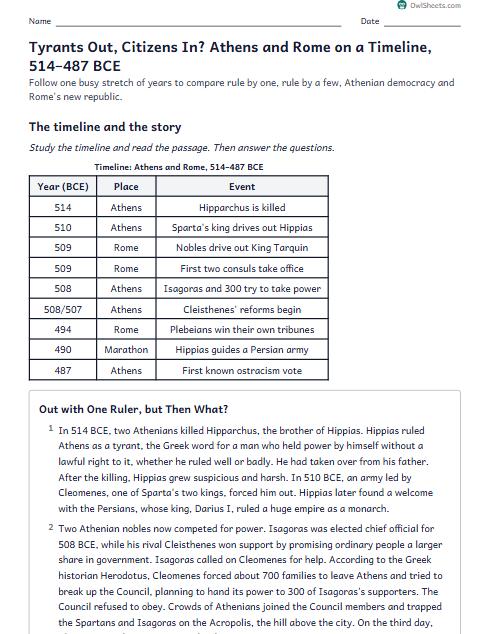
Tyrants Out, Citizens In? Athens and Rome on a Timeline, 514–487 BCE
Grade 6 · CIV.6.1
15 questionsPremium
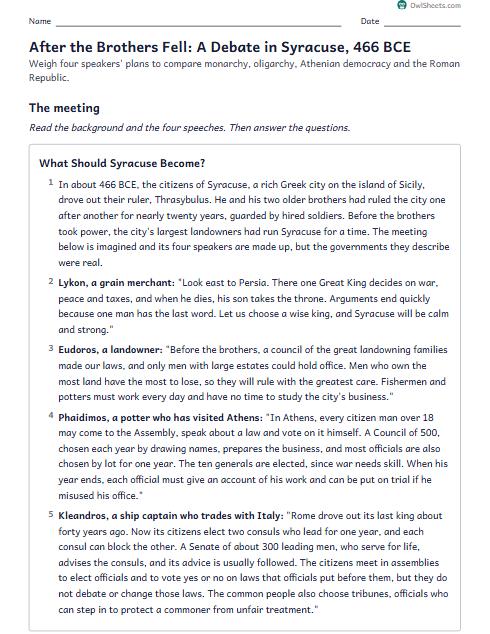
After the Brothers Fell: A Debate in Syracuse, 466 BCE
Grade 6 · CIV.6.1
14 questionsPremium
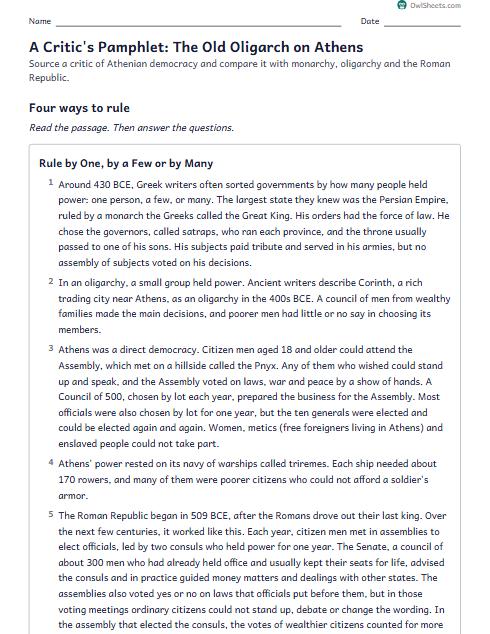
A Critic's Pamphlet: The Old Oligarch on Athens
Grade 6 · CIV.6.1
14 questionsPremium
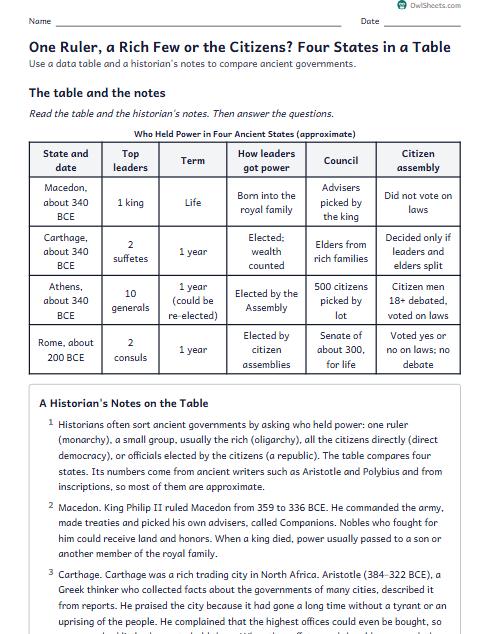
One Ruler, a Rich Few or the Citizens? Four States in a Table
Grade 6 · CIV.6.1
13 questionsPremium
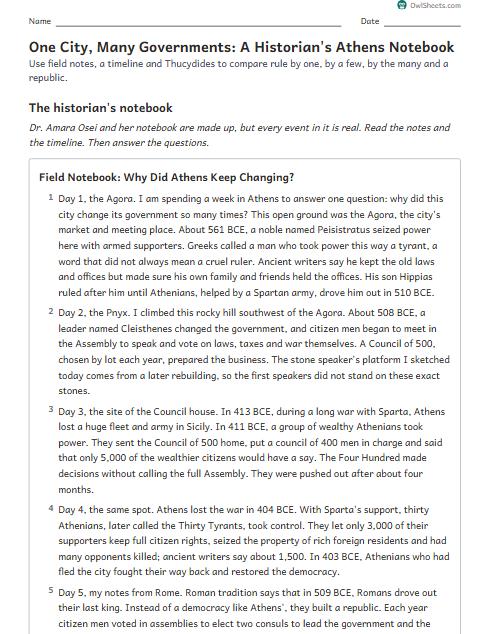
One City, Many Governments: A Historian's Athens Notebook
Grade 6 · CIV.6.1
12 questionsPremium
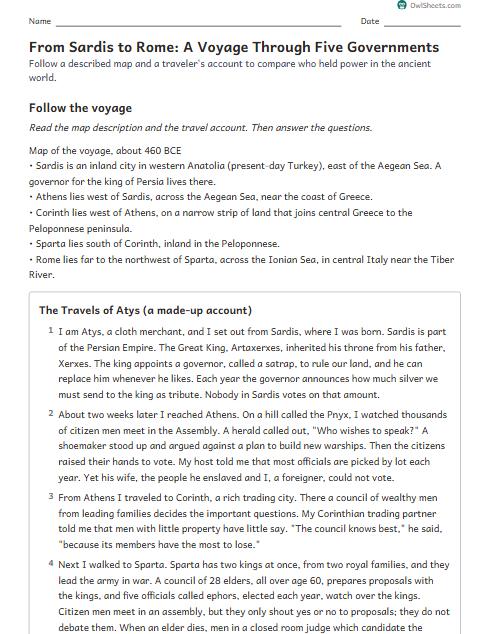
From Sardis to Rome: A Voyage Through Five Governments
Grade 6 · CIV.6.1
11 questionsPremium