Grade 6 · Social StudiesCIV.6.1Premium
One Ruler, a Rich Few or the Citizens? Four States in a Table
Grade 6 civics: use a data table on Macedon, Carthage, Athens and Rome to compare monarchy, oligarchy, Athenian direct democracy and the Roman Republic.
Preview
OwlSheets.com
One Ruler, a Rich Few or the Citizens? Four States in a Table
Use a data table and a historian's notes to compare ancient governments.
The table and the notes
Read the table and the historian's notes. Then answer the questions.
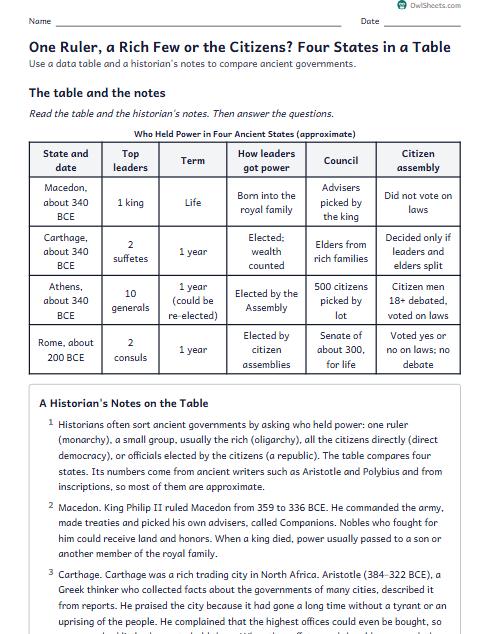
| State and date | Top leaders | Term | How leaders got power | Council | Citizen assembly |
|---|---|---|---|---|---|
| Macedon, about 340 BCE | 1 king | Life | Born into the royal family | Advisers picked by the king | Did not vote on laws |
| Carthage, about 340 BCE | 2 suffetes | 1 year | Elected; wealth counted | Elders from rich families | Decided only if leaders and elders split |
| Athens, about 340 BCE | 10 generals | 1 year (could be re-elected) | Elected by the Assembly | 500 citizens picked by lot | Citizen men 18+ debated, voted on laws |
| Rome, about 200 BCE | 2 consuls | 1 year | Elected by citizen assemblies | Senate of about 300, for life | Voted yes or no on laws; no debate |
A Historian's Notes on the Table
1Historians often sort ancient governments by asking who held power: one ruler (monarchy), a small group, usually the rich (oligarchy), all the citizens directly (direct democracy), or officials elected by the citizens (a republic). The table compares four states. Its numbers come from ancient writers such as Aristotle and Polybius and from inscriptions, so most of them are approximate.
2Macedon. King Philip II ruled Macedon from 359 to 336 BCE. He commanded the army, made treaties and picked his own advisers, called Companions. Nobles who fought for him could receive land and honors. When a king died, power usually passed to a son or another member of the royal family.
3Carthage. Carthage was a rich trading city in North Africa. Aristotle (384–322 BCE), a Greek thinker who collected facts about the governments of many cities, described it from reports. He praised the city because it had gone a long time without a tyrant or an uprising of the people. He complained that the highest offices could even be bought, so poor men had little chance to hold them. When the suffetes and the elders agreed, they settled a matter without the people. Rome destroyed Carthage in 146 BCE, and most of the city's own writings were lost.
4Athens. The Athenian Assembly met about 40 times a year on a hill called the Pnyx. Any citizen man 18 or older could speak for or against a proposal, and votes were usually counted by a show of hands. The Council of 500 prepared business for the Assembly. Its members were picked by lot from citizen men 30 or older, a new Council was picked every year, and no man could serve on it more than twice in his life. Women, foreign residents and enslaved people could not take part.
5Rome. Romans drove out their last king in about 509 BCE. Citizens met in assemblies to elect officials and to vote yes or no on laws, but only an official could propose a law, and no one debated it in the voting assembly. The Senate, made up mostly of former officials from wealthy families, advised the consuls and controlled public money and dealings with other states. Ten tribunes, elected by the plebeians (common citizens), could block an official's action that harmed a citizen.
- A. Rome
- B. Macedon
- C. Carthage
- D. Athens
The preview shows the first questions. Unlock the worksheet to see all of it.
Related worksheets
Tyrants Out, Citizens In? Athens and Rome on a Timeline, 514–487 BCE
Grade 6 · CIV.6.1
15 questionsPremium
After the Brothers Fell: A Debate in Syracuse, 466 BCE
Grade 6 · CIV.6.1
14 questionsPremium
A Critic's Pamphlet: The Old Oligarch on Athens
Grade 6 · CIV.6.1
14 questionsPremium
Three Speeches in Persia: Did the Debate Really Happen?
Grade 6 · CIV.6.1
14 questionsPremium
One City, Many Governments: A Historian's Athens Notebook
Grade 6 · CIV.6.1
12 questionsPremium
From Sardis to Rome: A Voyage Through Five Governments
Grade 6 · CIV.6.1
11 questionsPremium