Grade 6 · Social StudiesCIV.6.1Premium
A Critic's Pamphlet: The Old Oligarch on Athens
Grade 6 civics: source an adapted excerpt by the unknown critic called the Old Oligarch and compare Persia, Corinth, Athens and the Roman Republic.
Preview
OwlSheets.com
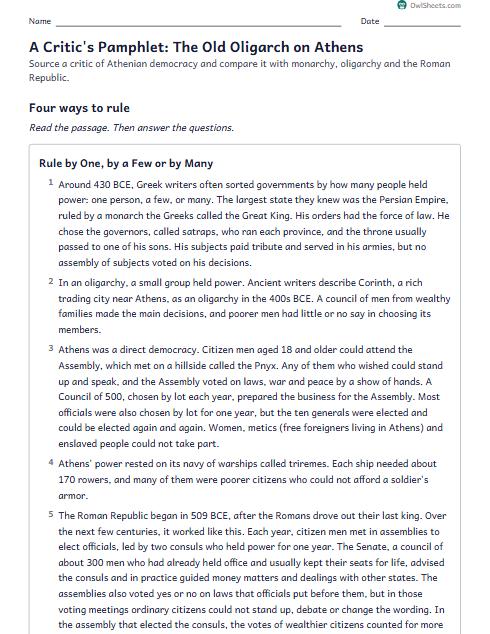
A Critic's Pamphlet: The Old Oligarch on Athens
Source a critic of Athenian democracy and compare it with monarchy, oligarchy and the Roman Republic.
Four ways to rule
Read the passage. Then answer the questions.
Rule by One, by a Few or by Many
1Around 430 BCE, Greek writers often sorted governments by how many people held power: one person, a few, or many. The largest state they knew was the Persian Empire, ruled by a monarch the Greeks called the Great King. His orders had the force of law. He chose the governors, called satraps, who ran each province, and the throne usually passed to one of his sons. His subjects paid tribute and served in his armies, but no assembly of subjects voted on his decisions.
2In an oligarchy, a small group held power. Ancient writers describe Corinth, a rich trading city near Athens, as an oligarchy in the 400s BCE. A council of men from wealthy families made the main decisions, and poorer men had little or no say in choosing its members.
3Athens was a direct democracy. Citizen men aged 18 and older could attend the Assembly, which met on a hillside called the Pnyx. Any of them who wished could stand up and speak, and the Assembly voted on laws, war and peace by a show of hands. A Council of 500, chosen by lot each year, prepared the business for the Assembly. Most officials were also chosen by lot for one year, but the ten generals were elected and could be elected again and again. Women, metics (free foreigners living in Athens) and enslaved people could not take part.
4Athens' power rested on its navy of warships called triremes. Each ship needed about 170 rowers, and many of them were poorer citizens who could not afford a soldier's armor.
5The Roman Republic began in 509 BCE, after the Romans drove out their last king. Over the next few centuries, it worked like this. Each year, citizen men met in assemblies to elect officials, led by two consuls who held power for one year. The Senate, a council of about 300 men who had already held office and usually kept their seats for life, advised the consuls and in practice guided money matters and dealings with other states. The assemblies also voted yes or no on laws that officials put before them, but in those voting meetings ordinary citizens could not stand up, debate or change the wording. In the assembly that elected the consuls, the votes of wealthier citizens counted for more than the votes of the poor.
- A. In Persia the Great King decided; in Athens citizen men voted in the Assembly.
- B. In Persia the satraps voted together; in Athens the ten generals decided alone.
- C. In Persia an assembly of subjects voted; in Athens the Council of 500 decided.
- D. In both, a council chosen by lot each year voted on whether to go to war.
Each year, citizen men met in assemblies to elect officials, led by two consuls who held power for one year.The Senate, a council of about 300 men who had already held office and usually kept their seats for life, advised the consuls and in practice guided money matters and dealings with other states.The assemblies also voted yes or no on laws that officials put before them, but in those voting meetings ordinary citizens could not stand up, debate or change the wording.In the assembly that elected the consuls, the votes of wealthier citizens counted for more than the votes of the poor.
The preview shows the first questions. Unlock the worksheet to see all of it.
Related worksheets
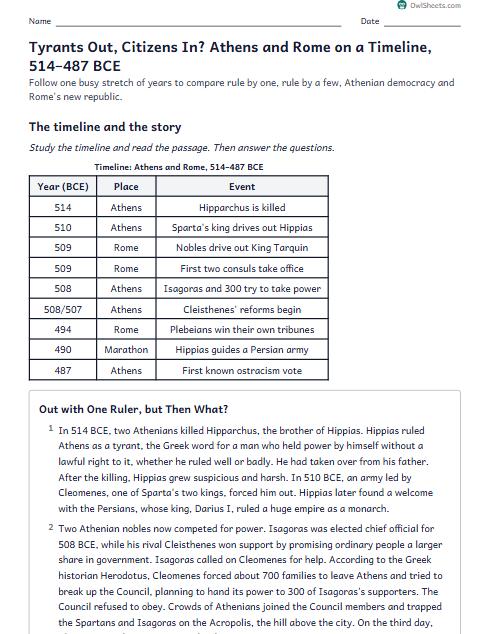
Tyrants Out, Citizens In? Athens and Rome on a Timeline, 514–487 BCE
Grade 6 · CIV.6.1
15 questionsPremium
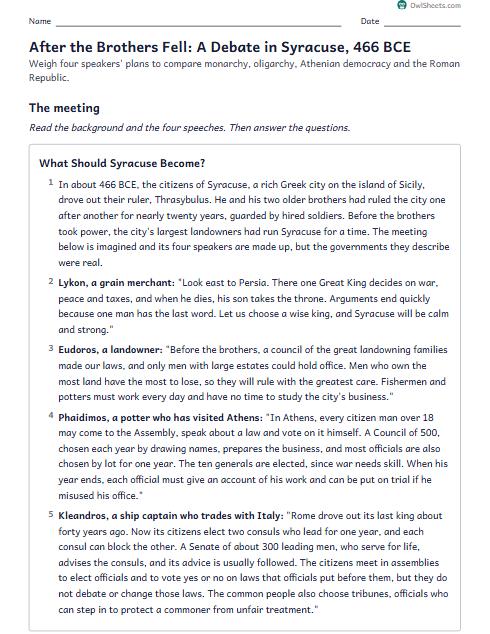
After the Brothers Fell: A Debate in Syracuse, 466 BCE
Grade 6 · CIV.6.1
14 questionsPremium
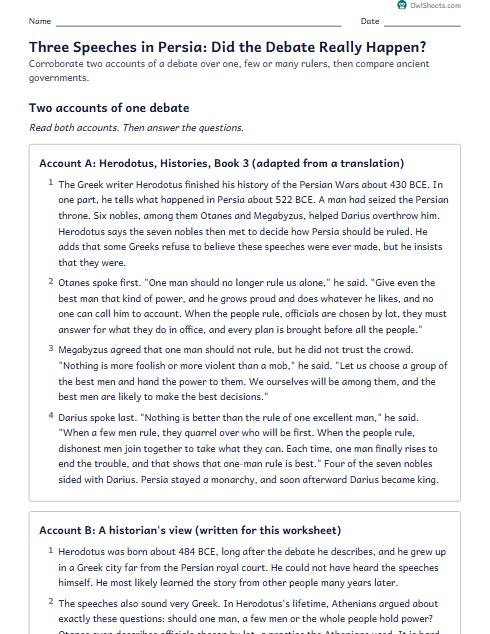
Three Speeches in Persia: Did the Debate Really Happen?
Grade 6 · CIV.6.1
14 questionsPremium
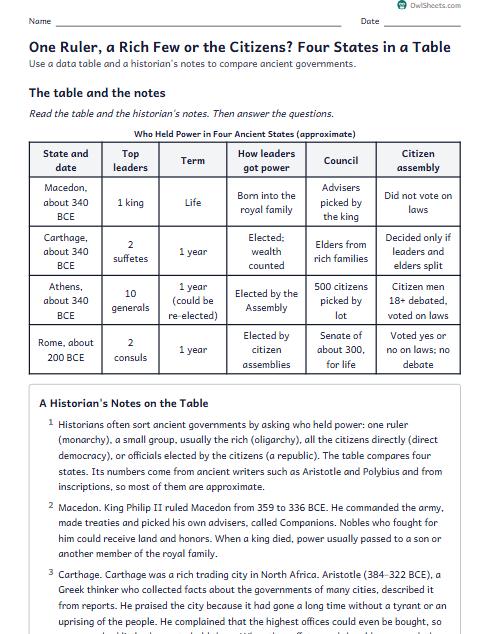
One Ruler, a Rich Few or the Citizens? Four States in a Table
Grade 6 · CIV.6.1
13 questionsPremium
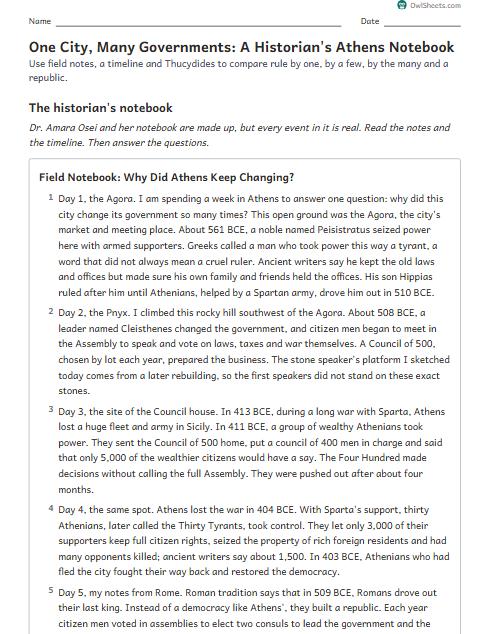
One City, Many Governments: A Historian's Athens Notebook
Grade 6 · CIV.6.1
12 questionsPremium
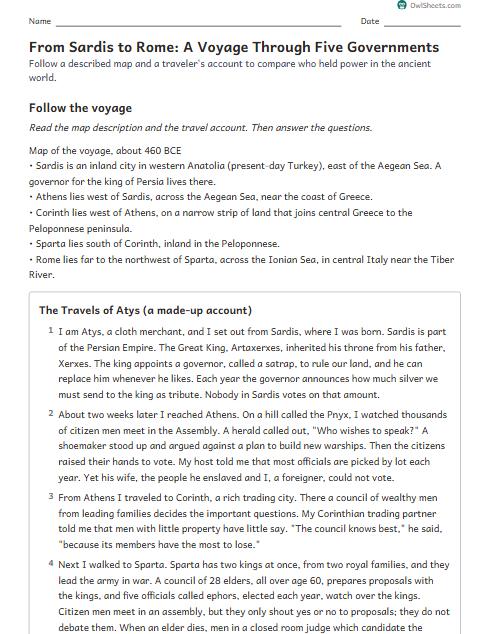
From Sardis to Rome: A Voyage Through Five Governments
Grade 6 · CIV.6.1
11 questionsPremium