Grade 6 · Social StudiesCIV.6.1Premium
Tyrants Out, Citizens In? Athens and Rome on a Timeline, 514–487 BCE
Grade 6 civics: a timeline from Hippias to Rome's first consuls compares monarchy, oligarchy, Athenian democracy and the Roman Republic.
Preview
OwlSheets.com
Tyrants Out, Citizens In? Athens and Rome on a Timeline, 514–487 BCE
Follow one busy stretch of years to compare rule by one, rule by a few, Athenian democracy and Rome's new republic.
The timeline and the story
Study the timeline and read the passage. Then answer the questions.
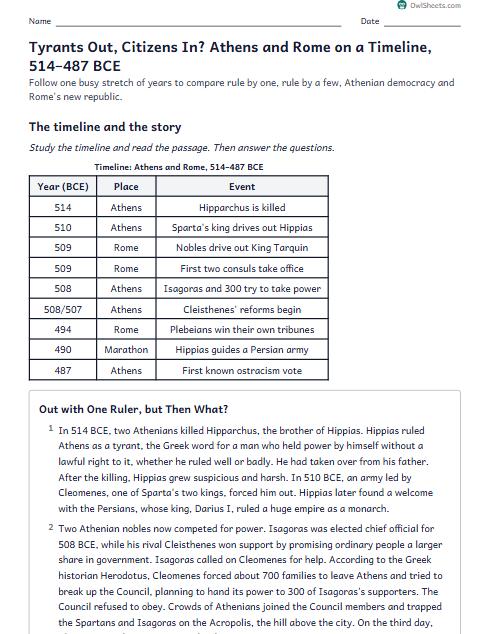
| Year (BCE) | Place | Event |
|---|---|---|
| 514 | Athens | Hipparchus is killed |
| 510 | Athens | Sparta's king drives out Hippias |
| 509 | Rome | Nobles drive out King Tarquin |
| 509 | Rome | First two consuls take office |
| 508 | Athens | Isagoras and 300 try to take power |
| 508/507 | Athens | Cleisthenes' reforms begin |
| 494 | Rome | Plebeians win their own tribunes |
| 490 | Marathon | Hippias guides a Persian army |
| 487 | Athens | First known ostracism vote |
Out with One Ruler, but Then What?
1In 514 BCE, two Athenians killed Hipparchus, the brother of Hippias. Hippias ruled Athens as a tyrant, the Greek word for a man who held power by himself without a lawful right to it, whether he ruled well or badly. He had taken over from his father. After the killing, Hippias grew suspicious and harsh. In 510 BCE, an army led by Cleomenes, one of Sparta's two kings, forced him out. Hippias later found a welcome with the Persians, whose king, Darius I, ruled a huge empire as a monarch.
2Two Athenian nobles now competed for power. Isagoras was elected chief official for 508 BCE, while his rival Cleisthenes won support by promising ordinary people a larger share in government. Isagoras called on Cleomenes for help. According to the Greek historian Herodotus, Cleomenes forced about 700 families to leave Athens and tried to break up the Council, planning to hand its power to 300 of Isagoras's supporters. The Council refused to obey. Crowds of Athenians joined the Council members and trapped the Spartans and Isagoras on the Acropolis, the hill above the city. On the third day, Cleomenes and Isagoras agreed to leave.
3Cleisthenes returned, and his reforms reshaped Athens. He divided citizens into ten new tribes that mixed people from the city, the coast and the countryside. A Council of 500, with 50 men from each tribe, prepared business for the Assembly. There, any citizen man could speak, suggest changes and vote on laws, war and peace himself. Women, foreign-born residents and enslaved people could not vote. Athenians also created ostracism: each year, citizens could vote to send one man away for ten years.
4Livy, a Roman historian who wrote nearly 500 years later, and other Roman writers say that in 509 BCE nobles drove out Rome's last king, Tarquin the Proud. The Romans set up a republic. Each year, citizens elected two consuls to lead for one year, and each consul could block the other. A Senate of leading men, most from rich patrician families, advised the consuls for life. Citizens met in assemblies to elect officials and vote yes or no on laws, but they could not debate or change a law at the voting meeting. In 494 BCE, many plebeians, the ordinary citizens, left the city and refused to serve as soldiers until they could choose their own officials, the tribunes, who could protect plebeians from unfair acts by officials.
5In 490 BCE, a Persian army landed at Marathon, near Athens. Hippias, now an old man, guided the Persians there, hoping that Darius would make him ruler of Athens again. Athenian citizen soldiers defeated the Persian force.
| Rule by one (monarchy or tyranny) | Rule by a few (oligarchy) | Athenian direct democracy | Roman Republic |
|---|---|---|---|
The preview shows the first questions. Unlock the worksheet to see all of it.
Related worksheets
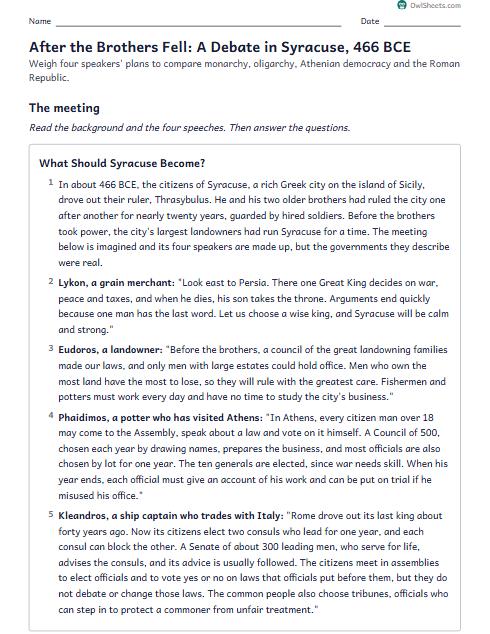
After the Brothers Fell: A Debate in Syracuse, 466 BCE
Grade 6 · CIV.6.1
14 questionsPremium
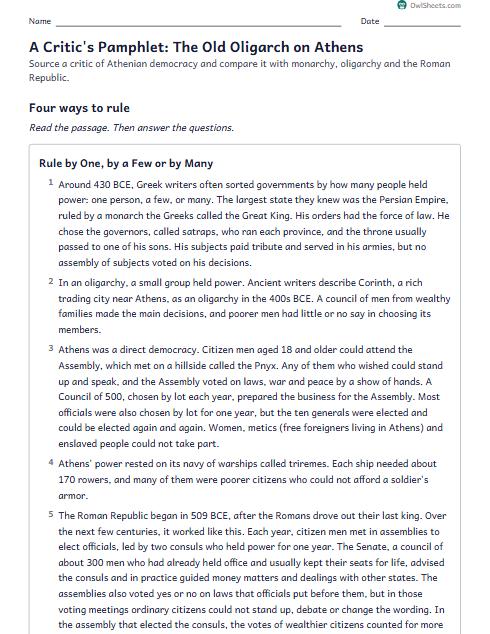
A Critic's Pamphlet: The Old Oligarch on Athens
Grade 6 · CIV.6.1
14 questionsPremium
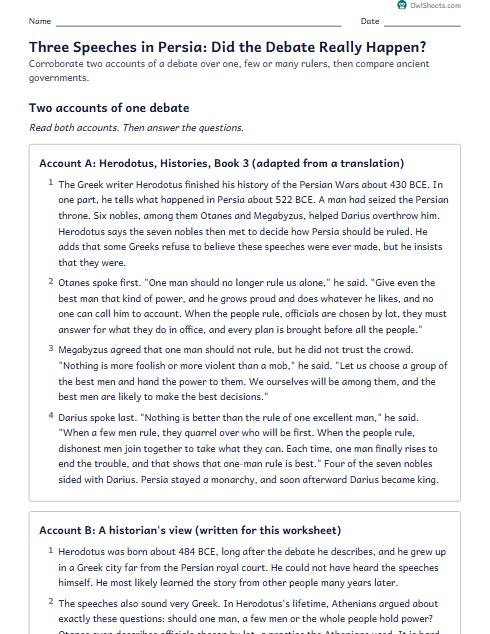
Three Speeches in Persia: Did the Debate Really Happen?
Grade 6 · CIV.6.1
14 questionsPremium
One Ruler, a Rich Few or the Citizens? Four States in a Table
Grade 6 · CIV.6.1
13 questionsPremium
One City, Many Governments: A Historian's Athens Notebook
Grade 6 · CIV.6.1
12 questionsPremium
From Sardis to Rome: A Voyage Through Five Governments
Grade 6 · CIV.6.1
11 questionsPremium