Grade 5 · Social StudiesHIS.5.3Premium
Repeal, Rights, and the Road to 1775
Investigate a Revolution timeline to explain why repealed taxes, disputed authority, protests, and military action did not bring lasting peace.
Preview
OwlSheets.com
Repeal, Rights, and the Road to 1775
Use a timeline to investigate why a tax repeal did not settle the conflict.
Investigate the timeline
Read the account and timeline. Circle one answer for each multiple-choice question.
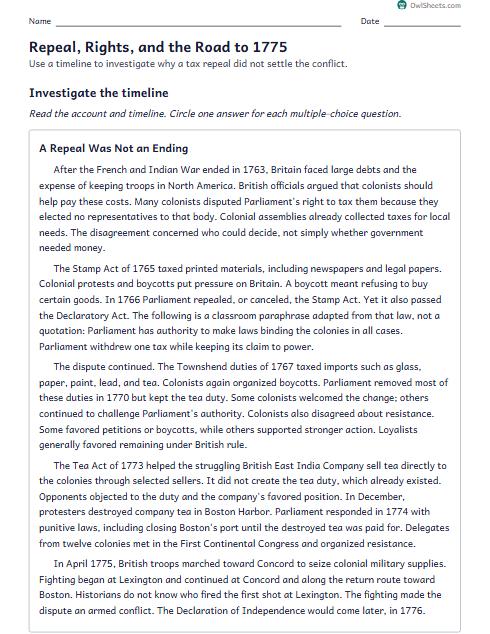
A Repeal Was Not an Ending
After the French and Indian War ended in 1763, Britain faced large debts and the expense of keeping troops in North America. British officials argued that colonists should help pay these costs. Many colonists disputed Parliament's right to tax them because they elected no representatives to that body. Colonial assemblies already collected taxes for local needs. The disagreement concerned who could decide, not simply whether government needed money.
The Stamp Act of 1765 taxed printed materials, including newspapers and legal papers. Colonial protests and boycotts put pressure on Britain. A boycott meant refusing to buy certain goods. In 1766 Parliament repealed, or canceled, the Stamp Act. Yet it also passed the Declaratory Act. The following is a classroom paraphrase adapted from that law, not a quotation: Parliament has authority to make laws binding the colonies in all cases. Parliament withdrew one tax while keeping its claim to power.
The dispute continued. The Townshend duties of 1767 taxed imports such as glass, paper, paint, lead, and tea. Colonists again organized boycotts. Parliament removed most of these duties in 1770 but kept the tea duty. Some colonists welcomed the change; others continued to challenge Parliament's authority. Colonists also disagreed about resistance. Some favored petitions or boycotts, while others supported stronger action. Loyalists generally favored remaining under British rule.
The Tea Act of 1773 helped the struggling British East India Company sell tea directly to the colonies through selected sellers. It did not create the tea duty, which already existed. Opponents objected to the duty and the company's favored position. In December, protesters destroyed company tea in Boston Harbor. Parliament responded in 1774 with punitive laws, including closing Boston's port until the destroyed tea was paid for. Delegates from twelve colonies met in the First Continental Congress and organized resistance.
In April 1775, British troops marched toward Concord to seize colonial military supplies. Fighting began at Lexington and continued at Concord and along the return route toward Boston. Historians do not know who fired the first shot at Lexington. The fighting made the dispute an armed conflict. The Declaration of Independence would come later, in 1776.
| Date | Event | Detail |
|---|---|---|
| 1763 | War ends | Britain faces war debts and troop costs. |
| 1765 | Stamp Act | Printed-material tax sparks protests. |
| 1766 | Repeal and new claim | Tax ends; authority claim remains. |
| 1767 | Townshend duties | Import taxes bring renewed boycotts. |
| 1770 | Partial repeal | Most duties end; tea duty remains. |
| 1773, May | Tea Act | Company favored; tea duty stays. |
| 1773, December | Boston Tea Party | Protesters destroy company tea. |
| 1774 | Punishment and meeting | Port closes; colonial delegates meet. |
| 1775, April | Lexington and Concord | Supply-seizing march leads to fighting. |
- A. Parliament grants colonial assemblies seats in Britain.
- B. Parliament ends import duties and closes Boston's port.
- C. Parliament cancels a tax but claims continued authority.
- D. Parliament keeps the stamp tax but reduces troop costs.
The preview shows the first questions. Unlock the worksheet to see all of it.
Related worksheets
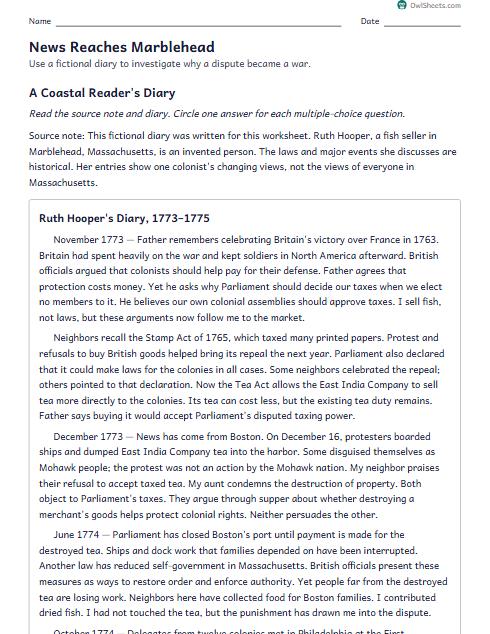
News Reaches Marblehead
Grade 5 · HIS.5.3
13 questionsFree
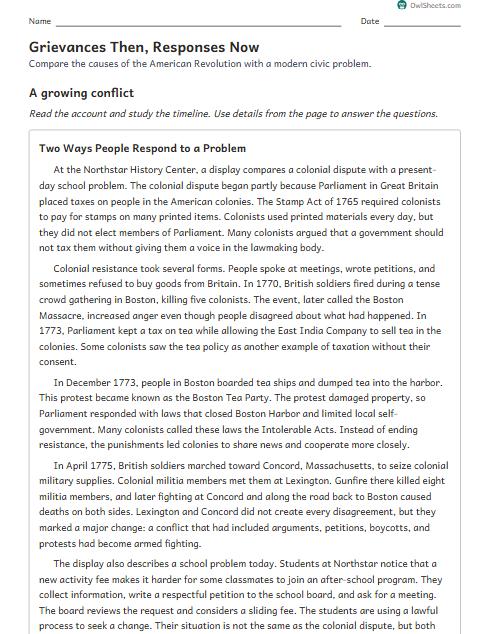
Grievances Then, Responses Now
Grade 5 · HIS.5.3
15 questionsPremium
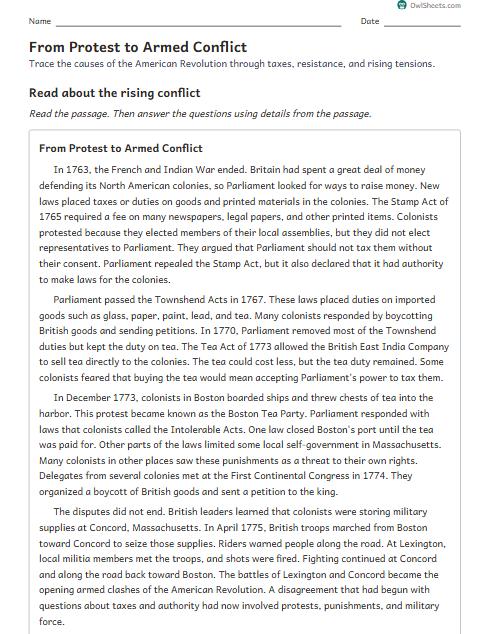
From Protest to Armed Conflict
Grade 5 · HIS.5.3
13 questionsPremium
Calla's Colony Travel Journal
Grade 5 · HIS.5.2
14 questionsPremium
The Same River: 1609 and Today
Grade 5 · HIS.5.1
13 questionsPremium
Winning Without Winning Every Battle
Grade 5 · HIS.5.4
13 questionsFree