Grade 5 · Social StudiesHIS.5.4
Winning Without Winning Every Battle
Explore how Nathanael Greene, Daniel Morgan, and the southern campaign helped the Americans win independence through strategy and endurance.
Preview
OwlSheets.com
Winning Without Winning Every Battle
Read how the southern campaign helped the American cause.
The Southern Campaign
Read the passage. Use its details to answer the questions.
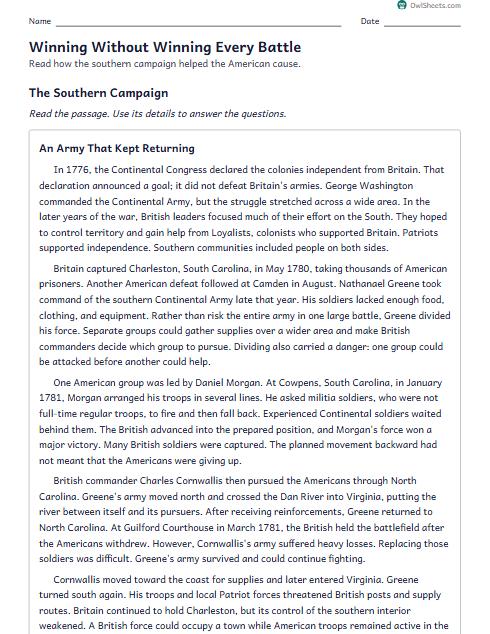
An Army That Kept Returning
In 1776, the Continental Congress declared the colonies independent from Britain. That declaration announced a goal; it did not defeat Britain's armies. George Washington commanded the Continental Army, but the struggle stretched across a wide area. In the later years of the war, British leaders focused much of their effort on the South. They hoped to control territory and gain help from Loyalists, colonists who supported Britain. Patriots supported independence. Southern communities included people on both sides.
Britain captured Charleston, South Carolina, in May 1780, taking thousands of American prisoners. Another American defeat followed at Camden in August. Nathanael Greene took command of the southern Continental Army late that year. His soldiers lacked enough food, clothing, and equipment. Rather than risk the entire army in one large battle, Greene divided his force. Separate groups could gather supplies over a wider area and make British commanders decide which group to pursue. Dividing also carried a danger: one group could be attacked before another could help.
One American group was led by Daniel Morgan. At Cowpens, South Carolina, in January 1781, Morgan arranged his troops in several lines. He asked militia soldiers, who were not full-time regular troops, to fire and then fall back. Experienced Continental soldiers waited behind them. The British advanced into the prepared position, and Morgan's force won a major victory. Many British soldiers were captured. The planned movement backward had not meant that the Americans were giving up.
British commander Charles Cornwallis then pursued the Americans through North Carolina. Greene's army moved north and crossed the Dan River into Virginia, putting the river between itself and its pursuers. After receiving reinforcements, Greene returned to North Carolina. At Guilford Courthouse in March 1781, the British held the battlefield after the Americans withdrew. However, Cornwallis's army suffered heavy losses. Replacing those soldiers was difficult. Greene's army survived and could continue fighting.
Cornwallis moved toward the coast for supplies and later entered Virginia. Greene turned south again. His troops and local Patriot forces threatened British posts and supply routes. Britain continued to hold Charleston, but its control of the southern interior weakened. A British force could occupy a town while American troops remained active in the surrounding countryside. These campaigns made holding territory costly and difficult.
The war was not decided in the South alone. France supplied money, troops, and ships to the American cause. At Yorktown, Virginia, in October 1781, American and French land forces trapped Cornwallis while a French fleet blocked help by sea. Cornwallis surrendered his army. Peace negotiations followed, and Britain recognized United States independence in the Treaty of Paris in 1783. Greene's campaigns had helped sustain resistance and wear down British forces before that final result.
- A. He planned to leave southern towns under British rule.
- B. He needed to preserve a force that lacked supplies.
- C. He wanted his troops to wait for Cornwallis in Charleston.
- D. He expected the declaration to end the fighting soon.
- A. Finding supplies became easier, but separated groups were more vulnerable.
- B. Holding towns became easier, but British soldiers gained more supplies.
- C. Finding supplies became harder, but separated groups could defend each other faster.
- D. Holding towns became harder, but American soldiers needed less equipment.
- A. The militia were leaving to gather supplies for Greene.
- B. The militia were moving toward a river crossing in Virginia.
- C. The militia had been ordered to surrender to the British.
- D. The militia's withdrawal was part of Morgan's arrangement.
Cornwallis pursued the Americans through North Carolina.At Guilford Courthouse, British losses were heavy and the soldiers were difficult to replace.Greene returned to North Carolina after receiving reinforcements.The Americans withdrew from the battlefield at Guilford Courthouse.
- A. It placed a physical barrier between the Americans and their pursuers.
- B. It placed the Americans inside the captured city of Charleston.
- C. It brought the Americans behind Morgan's lines at Cowpens.
- D. It brought the Americans to the fleet blocking Yorktown.
| Strengthened Britain's position | Weakened Britain's position |
|---|---|
Test the Explanations
Use the passage to evaluate claims and apply what you learned.
- A. Did Congress declare independence before the town was occupied?
- B. Did the troops enter the town after crossing a river?
- C. Do Patriot troops still threaten roads and nearby supply routes?
- D. Are there experienced soldiers stationed inside the town?
- A. Defend the position because occupying ground matters more than preserving troops.
- B. Defend the position because a withdrawal would end the struggle for independence.
- C. Withdraw because moving away would make the enemy recognize independence.
- D. Withdraw because keeping an army active can support the longer struggle.
- A. Morgan gathered French ships, while Greene commanded militia at Yorktown.
- B. Morgan defended Charleston, while Greene captured Cornwallis at Cowpens.
- C. Morgan planned a battlefield trap, while Greene directed a wider campaign.
- D. Morgan negotiated recognition, while Greene drafted the declaration.
- A. British leaders expected Greene's troops to support their control of the South.
- B. British leaders expected help from Loyalists among the southern colonists.
- C. British leaders expected help from the French soldiers living in southern towns.
- D. British leaders expected Congress to withdraw its declaration after Charleston.
After the defeats at Charleston and Camden, Greene took command of the southern Continental Army.Congress declared independence in 1776.The British hoped Loyalists would help them control territory.After withdrawing at Guilford Courthouse, Greene's surviving army continued its campaign.The Treaty of Paris recognized United States independence in 1783.
Related worksheets
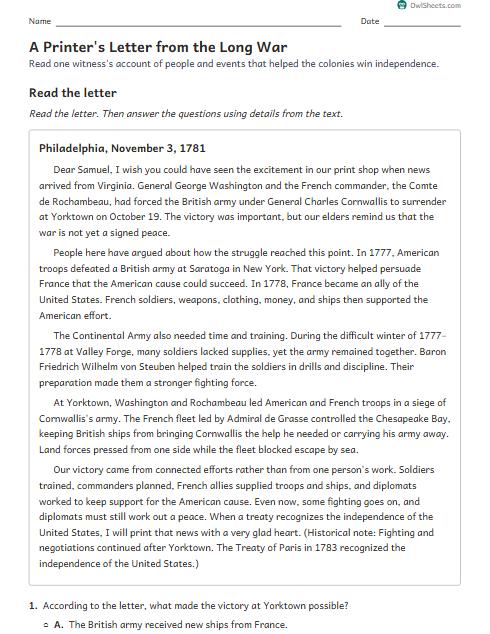
A Printer's Letter from the Long War
Grade 5 · HIS.5.4
15 questionsPremium
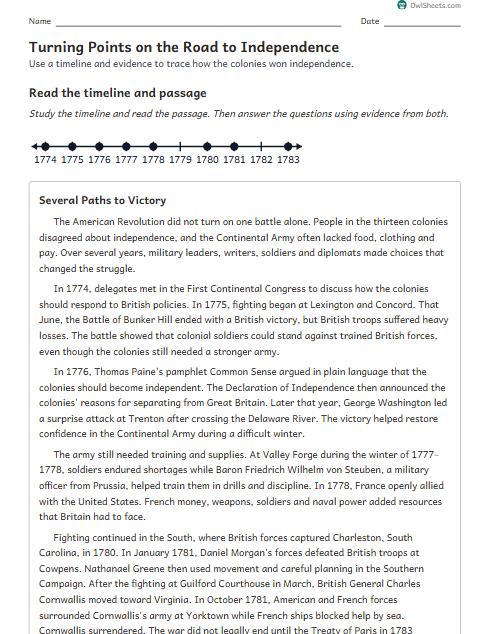
Turning Points on the Road to Independence
Grade 5 · HIS.5.4
15 questionsPremium
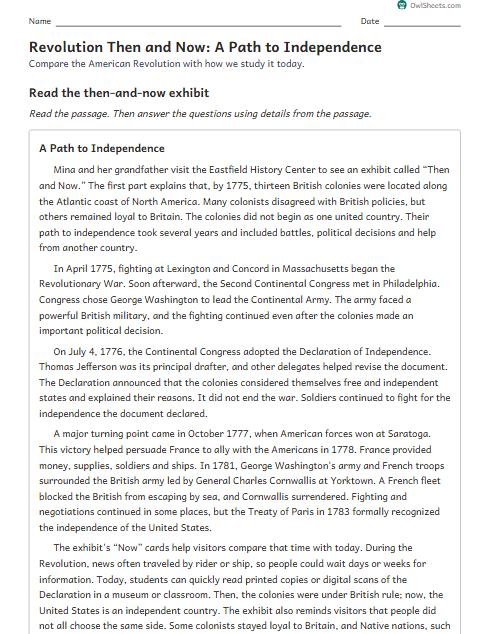
Revolution Then and Now: A Path to Independence
Grade 5 · HIS.5.4
15 questionsPremium
Calla's Colony Travel Journal
Grade 5 · HIS.5.2
14 questionsPremium
The Same River: 1609 and Today
Grade 5 · HIS.5.1
13 questionsPremium
News Reaches Marblehead
Grade 5 · HIS.5.3
13 questionsFree