Grade 5 · Social StudiesHIS.5.2Premium
Calla's Colony Travel Journal
A student's travel journal compares Jamestown and Plymouth today with their founding and early daily life, using a then-and-now chart.
Preview
OwlSheets.com
Calla's Colony Travel Journal
A summer trip compares Jamestown and Plymouth today with how they began.
Read the journal
Read Calla's journal entries. Then answer the questions.
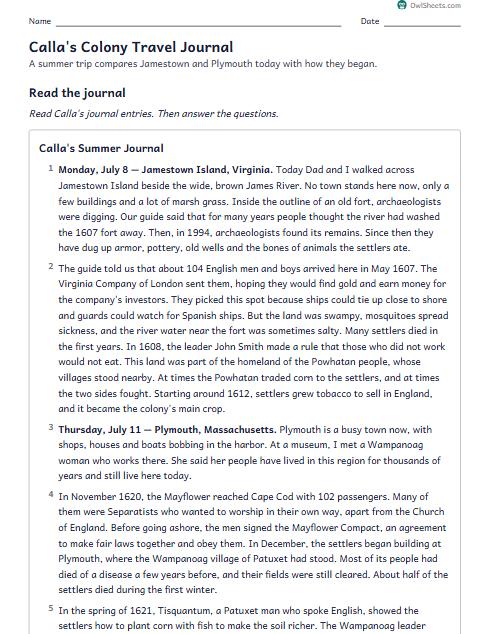
Calla's Summer Journal
1Monday, July 8 — Jamestown Island, Virginia. Today Dad and I walked across Jamestown Island beside the wide, brown James River. No town stands here now, only a few buildings and a lot of marsh grass. Inside the outline of an old fort, archaeologists were digging. Our guide said that for many years people thought the river had washed the 1607 fort away. Then, in 1994, archaeologists found its remains. Since then they have dug up armor, pottery, old wells and the bones of animals the settlers ate.
2The guide told us that about 104 English men and boys arrived here in May 1607. The Virginia Company of London sent them, hoping they would find gold and earn money for the company's investors. They picked this spot because ships could tie up close to shore and guards could watch for Spanish ships. But the land was swampy, mosquitoes spread sickness, and the river water near the fort was sometimes salty. Many settlers died in the first years. In 1608, the leader John Smith made a rule that those who did not work would not eat. This land was part of the homeland of the Powhatan people, whose villages stood nearby. At times the Powhatan traded corn to the settlers, and at times the two sides fought. Starting around 1612, settlers grew tobacco to sell in England, and it became the colony's main crop.
3Thursday, July 11 — Plymouth, Massachusetts. Plymouth is a busy town now, with shops, houses and boats bobbing in the harbor. At a museum, I met a Wampanoag woman who works there. She said her people have lived in this region for thousands of years and still live here today.
4In November 1620, the Mayflower reached Cape Cod with 102 passengers. Many of them were Separatists who wanted to worship in their own way, apart from the Church of England. Before going ashore, the men signed the Mayflower Compact, an agreement to make fair laws together and obey them. In December, the settlers began building at Plymouth, where the Wampanoag village of Patuxet had stood. Most of its people had died of a disease a few years before, and their fields were still cleared. About half of the settlers died during the first winter.
5In the spring of 1621, Tisquantum, a Patuxet man who spoke English, showed the settlers how to plant corn with fish to make the soil richer. The Wampanoag leader Massasoit made an agreement with the settlers to defend each other. Settlers lived in small wooden houses with roofs of thatch, or dried grass. Women cooked over open fires and made clothes. Men cleared fields, built houses, hunted and fished. Children carried water from a spring and gathered firewood.
- A. Both settlements were founded mainly to search for gold.
- B. Jamestown was founded to earn money, and many at Plymouth came to worship their way.
- C. Jamestown was founded to worship freely, and Plymouth to find gold.
- D. Both settlements were founded to escape a war with Spain.
Ships could tie up close to shore.Tobacco became the colony's main crop.Mosquitoes spread sickness.Archaeologists found the fort in 1994.
The preview shows the first questions. Unlock the worksheet to see all of it.
Related worksheets
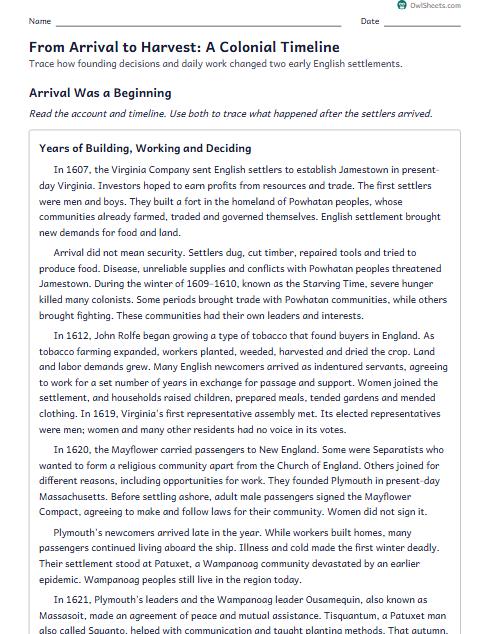
From Arrival to Harvest: A Colonial Timeline
Grade 5 · HIS.5.2
14 questionsPremium
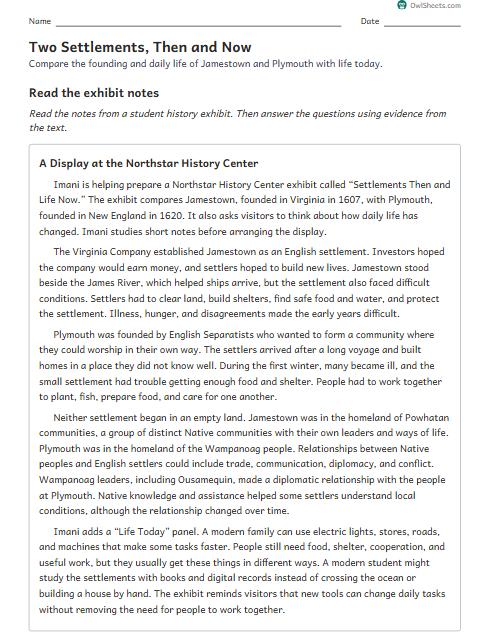
Two Settlements, Then and Now
Grade 5 · HIS.5.2
15 questionsFree
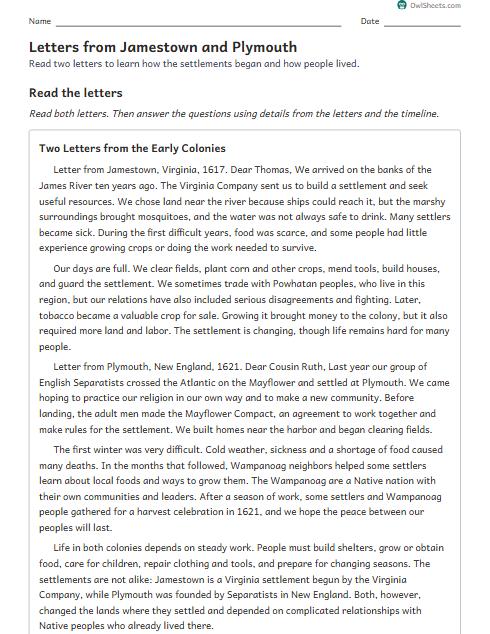
Letters from Jamestown and Plymouth
Grade 5 · HIS.5.2
15 questionsPremium
The Same River: 1609 and Today
Grade 5 · HIS.5.1
13 questionsPremium
News Reaches Marblehead
Grade 5 · HIS.5.3
13 questionsFree
Winning Without Winning Every Battle
Grade 5 · HIS.5.4
13 questionsFree