Grade 5 · Social StudiesHIS.5.3
News Reaches Marblehead
Analyze a historically grounded fictional diary to explain how taxes, tea protests, port punishment, and fighting deepened the revolutionary crisis.
Preview
OwlSheets.com
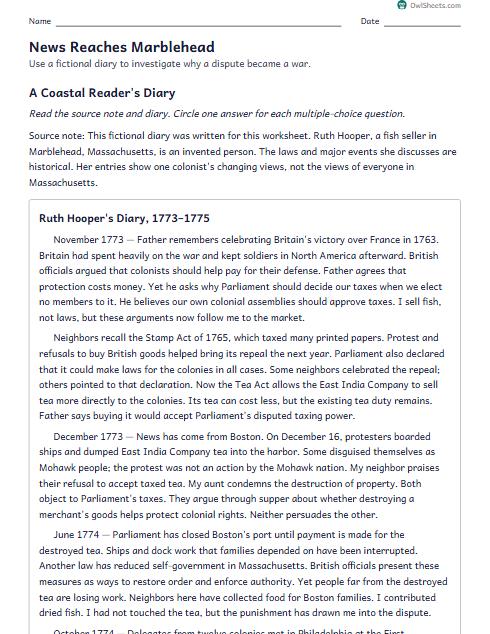
News Reaches Marblehead
Use a fictional diary to investigate why a dispute became a war.
A Coastal Reader's Diary
Read the source note and diary. Circle one answer for each multiple-choice question.
Ruth Hooper's Diary, 1773–1775
November 1773 — Father remembers celebrating Britain's victory over France in 1763. Britain had spent heavily on the war and kept soldiers in North America afterward. British officials argued that colonists should help pay for their defense. Father agrees that protection costs money. Yet he asks why Parliament should decide our taxes when we elect no members to it. He believes our own colonial assemblies should approve taxes. I sell fish, not laws, but these arguments now follow me to the market.
Neighbors recall the Stamp Act of 1765, which taxed many printed papers. Protest and refusals to buy British goods helped bring its repeal the next year. Parliament also declared that it could make laws for the colonies in all cases. Some neighbors celebrated the repeal; others pointed to that declaration. Now the Tea Act allows the East India Company to sell tea more directly to the colonies. Its tea can cost less, but the existing tea duty remains. Father says buying it would accept Parliament's disputed taxing power.
December 1773 — News has come from Boston. On December 16, protesters boarded ships and dumped East India Company tea into the harbor. Some disguised themselves as Mohawk people; the protest was not an action by the Mohawk nation. My neighbor praises their refusal to accept taxed tea. My aunt condemns the destruction of property. Both object to Parliament's taxes. They argue through supper about whether destroying a merchant's goods helps protect colonial rights. Neither persuades the other.
June 1774 — Parliament has closed Boston's port until payment is made for the destroyed tea. Ships and dock work that families depended on have been interrupted. Another law has reduced self-government in Massachusetts. British officials present these measures as ways to restore order and enforce authority. Yet people far from the destroyed tea are losing work. Neighbors here have collected food for Boston families. I contributed dried fish. I had not touched the tea, but the punishment has drawn me into the dispute.
October 1774 — Delegates from twelve colonies met in Philadelphia at the First Continental Congress. They agreed on a plan to stop importing British goods and petitioned the king about colonial grievances. At our market, a buyer chose locally made cloth instead of imported cloth. Such choices can cost British merchants sales without wrecking their cargo. My aunt supports this method. A neighbor still loyal to Britain fears that resistance will weaken lawful government. We share crowded streets, but not one opinion about what should happen next.
April 1775 — Travelers bring reports of fighting on April 19. British troops marched toward Concord to seize colonial military supplies. Colonial militia gathered, and shots were fired at Lexington. No one has settled who fired first there. Fighting followed at Concord's North Bridge and along the British return toward Boston. I was in Marblehead, not beside either battlefield. Last autumn we discussed petitions and purchases. Today neighbors speak of wounded men, militia, and weapons. I fear what the next report will bring.
- A. Should Britain continue trading with France?
- B. Who has the right to approve colonial taxes?
- C. Who should receive money from fish sales?
- D. Should colonial markets sell imported goods?
- A. Parliament still claimed authority to legislate for the colonies.
- B. The Stamp Act placed a tax on many printed papers.
- C. Britain had spent heavily during its war with France.
- D. Colonists had refused to purchase some British goods.
- A. The lower price would increase the cost of printed papers.
- B. The company planned to stop selling tea in the colonies.
- C. The colonial assemblies had already approved the tea duty.
- D. The purchase would still include a tax whose authority was disputed.
- A. Opponents of the taxes could disagree about methods of protest.
- B. Opponents of the taxes agreed about using property destruction.
- C. Supporters of Parliament wanted colonial assemblies to set taxes.
- D. Supporters of the tea duty organized the destruction of the tea.
Boston families lost work connected to ships and docks.British officials said they wanted to restore order.Ruth contributed dried fish despite not taking part in the tea destruction.Protesters dumped East India Company tea into Boston Harbor.
| British officials' justification | Colonial opponents' objection |
|---|---|
Test Explanations
Use the diary to evaluate new cases and historical claims. Support your final explanation with evidence.
- A. It would repay the company for its destroyed tea.
- B. It would deliver a petition directly to the king.
- C. It would reduce a sale of imported British goods.
- D. It would give the household a seat in Parliament.
- A. He could conclude that payment for the tea had already reopened the port.
- B. He could resent punishment that harmed people who had not destroyed tea.
- C. He could blame the closure on the king's acceptance of the petition.
- D. He could welcome the closure because it increased shipping work.
- A. Troops carried petitions while militia collected food for Boston.
- B. Troops sought tea cargo while militia guarded imported cloth.
- C. Troops delivered tax refunds while militia reopened Boston's docks.
- D. Troops sought military supplies while militia assembled to resist.
- A. Congress met after Concord to arrange payment for the destroyed tea.
- B. Congress met after Lexington but before the fighting at Concord.
- C. Congress met before Lexington, during the dispute over British policies.
- D. Congress met before the Tea Party to organize destruction of the tea.
- A. How did one Marblehead resident describe her growing involvement?
- B. What did every Massachusetts colonist think about destroying tea?
- C. Which person fired the first shot on Lexington's green?
- D. What orders did British commanders give at Concord's North Bridge?
- A. A 1773 account showing how the East India Company packed tea
- B. A 1774 letter explaining why resistance threatened lawful government
- C. A 1775 map showing roads between Lexington and Concord
- D. A 1774 list recording the kinds of fish sold at Marblehead's market
Related worksheets
Repeal, Rights, and the Road to 1775
Grade 5 · HIS.5.3
13 questionsPremium
Grievances Then, Responses Now
Grade 5 · HIS.5.3
15 questionsPremium
From Protest to Armed Conflict
Grade 5 · HIS.5.3
13 questionsPremium
Calla's Colony Travel Journal
Grade 5 · HIS.5.2
14 questionsPremium
The Same River: 1609 and Today
Grade 5 · HIS.5.1
13 questionsPremium
Winning Without Winning Every Battle
Grade 5 · HIS.5.4
13 questionsFree