Grade 5 · Social StudiesHIS.5.1Premium
The Same River: 1609 and Today
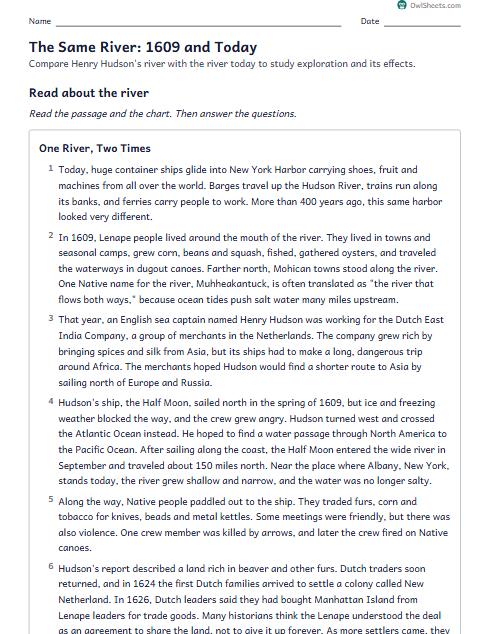
Compare the Hudson River in 1609 and today to explain why Henry Hudson explored, the route he took, and how his voyage affected the Lenape.
Preview
OwlSheets.com
The Same River: 1609 and Today
Compare Henry Hudson's river with the river today to study exploration and its effects.
Read about the river
Read the passage and the chart. Then answer the questions.
One River, Two Times
1Today, huge container ships glide into New York Harbor carrying shoes, fruit and machines from all over the world. Barges travel up the Hudson River, trains run along its banks, and ferries carry people to work. More than 400 years ago, this same harbor looked very different.
2In 1609, Lenape people lived around the mouth of the river. They lived in towns and seasonal camps, grew corn, beans and squash, fished, gathered oysters, and traveled the waterways in dugout canoes. Farther north, Mohican towns stood along the river. One Native name for the river, Muhheakantuck, is often translated as "the river that flows both ways," because ocean tides push salt water many miles upstream.
3That year, an English sea captain named Henry Hudson was working for the Dutch East India Company, a group of merchants in the Netherlands. The company grew rich by bringing spices and silk from Asia, but its ships had to make a long, dangerous trip around Africa. The merchants hoped Hudson would find a shorter route to Asia by sailing north of Europe and Russia.
4Hudson's ship, the Half Moon, sailed north in the spring of 1609, but ice and freezing weather blocked the way, and the crew grew angry. Hudson turned west and crossed the Atlantic Ocean instead. He hoped to find a water passage through North America to the Pacific Ocean. After sailing along the coast, the Half Moon entered the wide river in September and traveled about 150 miles north. Near the place where Albany, New York, stands today, the river grew shallow and narrow, and the water was no longer salty.
5Along the way, Native people paddled out to the ship. They traded furs, corn and tobacco for knives, beads and metal kettles. Some meetings were friendly, but there was also violence. One crew member was killed by arrows, and later the crew fired on Native canoes.
6Hudson's report described a land rich in beaver and other furs. Dutch traders soon returned, and in 1624 the first Dutch families arrived to settle a colony called New Netherland. In 1626, Dutch leaders said they had bought Manhattan Island from Lenape leaders for trade goods. Many historians think the Lenape understood the deal as an agreement to share the land, not to give it up forever. As more settlers came, they took over farmland and hunting grounds. Smallpox, a disease Europeans carried, killed many Native people in the 1630s. Some Lenape fought back when settlers attacked them or took their land, and over the next century many Lenape moved west.
7Today, the river carries Hudson's name. The Lenape are living peoples. Many Lenape and Mohican descendants belong to nations in Oklahoma, Wisconsin and Ontario, Canada, and some return to their homeland to teach visitors about their language and history.
| Topic | 1609 | Today |
|---|---|---|
| People at the river's mouth | Lenape towns and camps | Millions of New Yorkers |
| Boats on the river | Dugout canoes and the Half Moon | Container ships, barges and ferries |
| Goods traded | Furs, corn, knives and kettles | Goods from around the world |
| Name of the river | Muhheakantuck (one Native name) | Hudson River |
- A. To find a shorter sea route to trade in Asia
- B. To bring Lenape traders back to the Netherlands
- C. To build a colony for Dutch families in North America
- D. To map the coast of Africa for other sailors
The preview shows the first questions. Unlock the worksheet to see all of it.
Related worksheets
The Route That Bent West
Grade 5 · HIS.5.1
15 questionsPremium
Sea Lanes and First Encounters
Grade 5 · HIS.5.1
15 questionsFree
Across the Ocean: Explorers, Routes, and Change
Grade 5 · HIS.5.1
15 questionsPremium
Calla's Colony Travel Journal
Grade 5 · HIS.5.2
14 questionsPremium
News Reaches Marblehead
Grade 5 · HIS.5.3
13 questionsFree
Winning Without Winning Every Battle
Grade 5 · HIS.5.4
13 questionsFree