Grade 4 · Social StudiesHIS.4.1Premium
Wild Rice and Salmon: Two Nations Then and Now
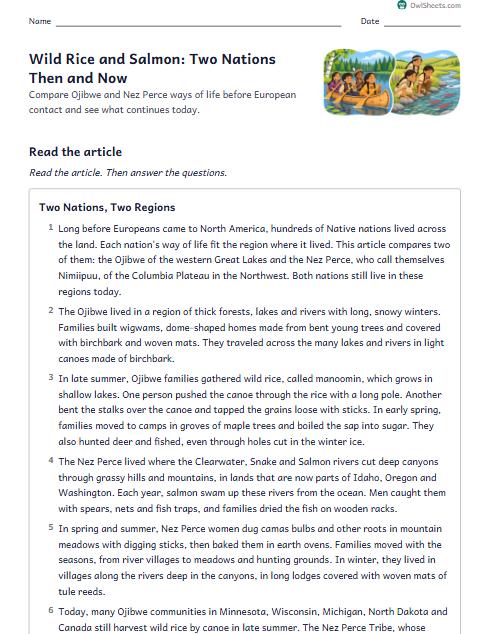
Compare Ojibwe life near the Great Lakes with Nez Perce life on the Columbia Plateau before European contact, then see which practices continue today.
Preview
OwlSheets.com
Wild Rice and Salmon: Two Nations Then and Now
Compare Ojibwe and Nez Perce ways of life before European contact and see what continues today.
Read the article
Read the article. Then answer the questions.
Two Nations, Two Regions
1Long before Europeans came to North America, hundreds of Native nations lived across the land. Each nation's way of life fit the region where it lived. This article compares two of them: the Ojibwe of the western Great Lakes and the Nez Perce, who call themselves Nimiipuu, of the Columbia Plateau in the Northwest. Both nations still live in these regions today.
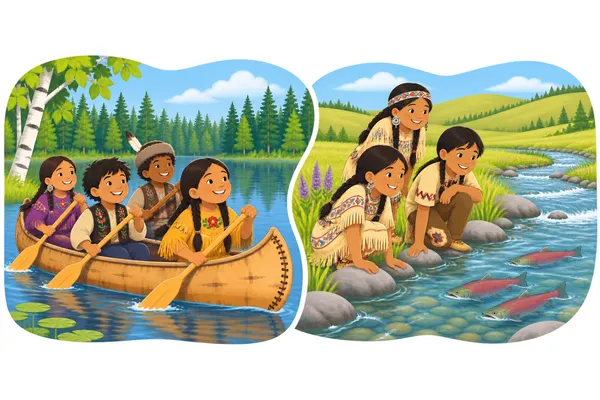
2The Ojibwe lived in a region of thick forests, lakes and rivers with long, snowy winters. Families built wigwams, dome-shaped homes made from bent young trees and covered with birchbark and woven mats. They traveled across the many lakes and rivers in light canoes made of birchbark.
3In late summer, Ojibwe families gathered wild rice, called manoomin, which grows in shallow lakes. One person pushed the canoe through the rice with a long pole. Another bent the stalks over the canoe and tapped the grains loose with sticks. In early spring, families moved to camps in groves of maple trees and boiled the sap into sugar. They also hunted deer and fished, even through holes cut in the winter ice.
4The Nez Perce lived where the Clearwater, Snake and Salmon rivers cut deep canyons through grassy hills and mountains, in lands that are now parts of Idaho, Oregon and Washington. Each year, salmon swam up these rivers from the ocean. Men caught them with spears, nets and fish traps, and families dried the fish on wooden racks.
5In spring and summer, Nez Perce women dug camas bulbs and other roots in mountain meadows with digging sticks, then baked them in earth ovens. Families moved with the seasons, from river villages to meadows and hunting grounds. In winter, they lived in villages along the rivers deep in the canyons, in long lodges covered with woven mats of tule reeds.
6Today, many Ojibwe communities in Minnesota, Wisconsin, Michigan, North Dakota and Canada still harvest wild rice by canoe in late summer. The Nez Perce Tribe, whose reservation is in Idaho, still fishes for salmon. The tribe also runs fish hatcheries that raise young salmon and release them into the rivers. Both nations work to teach their languages to young people.
- A. The two nations chose foods by trading with each other.
- B. The Nez Perce had already met many Europeans.
- C. One nation was more skilled at making tools than the other.
- D. The two nations lived in regions with different land and water.
| Ojibwe | Nez Perce | Both nations |
|---|---|---|
The preview shows the first questions. Unlock the worksheet to see all of it.
Related worksheets
Mulberry Loop: Comparing Two Homelands
Grade 4 · HIS.4.1
14 questionsPremium
Canal-Side Signs: Desert and Wetland
Grade 4 · HIS.4.1
14 questionsPremium
Cedar Coast and Grassland Choices
Grade 4 · HIS.4.1
15 questionsPremium
Diary Pages from River and Coast
Grade 4 · HIS.4.1
15 questionsFree
Two Regions, Many Ways of Life
Grade 4 · HIS.4.1
14 questionsPremium
The Hearthspan Crossing Report
Grade 4 · HIS.4.2
13 questionsPremium