Grade 4 · Social StudiesHIS.4.1Premium
Canal-Side Signs: Desert and Wetland
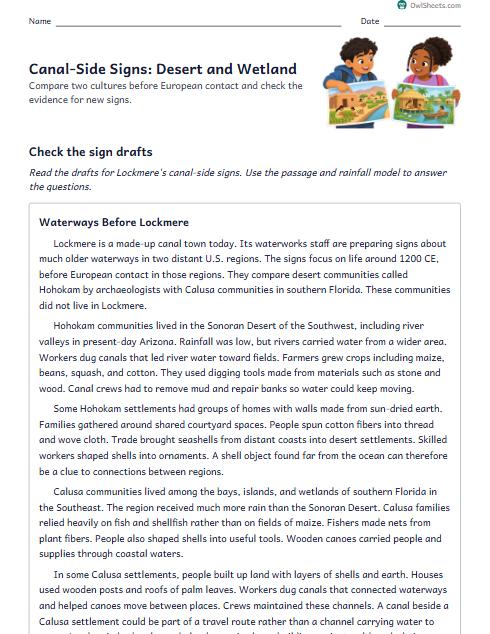
Compare Hohokam and Calusa cultures using canal-side sign drafts and a rainfall model, with questions about food, materials, trade, and water.
Preview
OwlSheets.com
Canal-Side Signs: Desert and Wetland
Compare two cultures before European contact and check the evidence for new signs.
Check the sign drafts
Read the drafts for Lockmere's canal-side signs. Use the passage and rainfall model to answer the questions.
Waterways Before Lockmere
Lockmere is a made-up canal town today. Its waterworks staff are preparing signs about much older waterways in two distant U.S. regions. The signs focus on life around 1200 CE, before European contact in those regions. They compare desert communities called Hohokam by archaeologists with Calusa communities in southern Florida. These communities did not live in Lockmere.
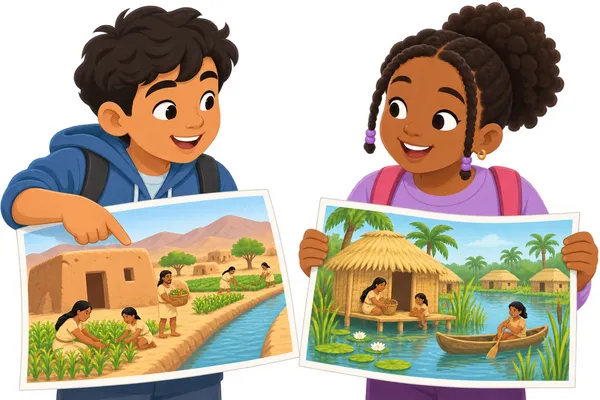
Hohokam communities lived in the Sonoran Desert of the Southwest, including river valleys in present-day Arizona. Rainfall was low, but rivers carried water from a wider area. Workers dug canals that led river water toward fields. Farmers grew crops including maize, beans, squash, and cotton. They used digging tools made from materials such as stone and wood. Canal crews had to remove mud and repair banks so water could keep moving.
Some Hohokam settlements had groups of homes with walls made from sun-dried earth. Families gathered around shared courtyard spaces. People spun cotton fibers into thread and wove cloth. Trade brought seashells from distant coasts into desert settlements. Skilled workers shaped shells into ornaments. A shell object found far from the ocean can therefore be a clue to connections between regions.
Calusa communities lived among the bays, islands, and wetlands of southern Florida in the Southeast. The region received much more rain than the Sonoran Desert. Calusa families relied heavily on fish and shellfish rather than on fields of maize. Fishers made nets from plant fibers. People also shaped shells into useful tools. Wooden canoes carried people and supplies through coastal waters.
In some Calusa settlements, people built up land with layers of shells and earth. Houses used wooden posts and roofs of palm leaves. Workers dug canals that connected waterways and helped canoes move between places. Crews maintained these channels. A canal beside a Calusa settlement could be part of a travel route rather than a channel carrying water to crops. Leaders in both cultures helped organize large building projects, although their communities were not organized in exactly the same way.
These examples do not describe every Native community in either region. Homes, tools, and customs varied among settlements and changed over time. Many O'odham people today identify Hohokam communities as ancestors. Native peoples continue to live in both the Southwest and southern Florida. The signs describe part of a long history, not peoples who belong only to the past.
The preview shows the first questions. Unlock the worksheet to see all of it.
Related worksheets
Mulberry Loop: Comparing Two Homelands
Grade 4 · HIS.4.1
14 questionsPremium
Wild Rice and Salmon: Two Nations Then and Now
Grade 4 · HIS.4.1
13 questionsPremium
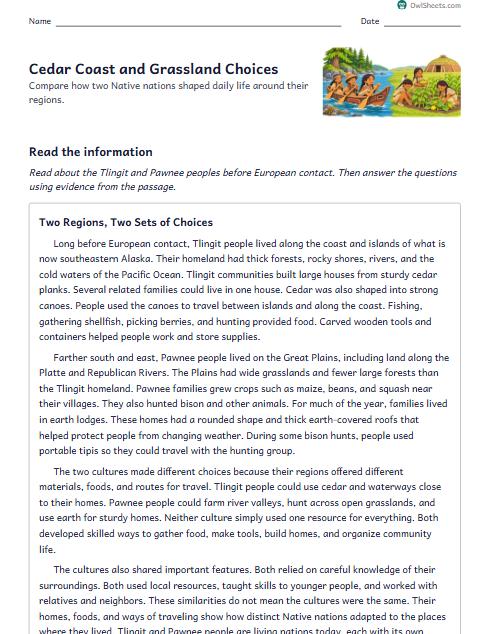
Cedar Coast and Grassland Choices
Grade 4 · HIS.4.1
15 questionsPremium
Diary Pages from River and Coast
Grade 4 · HIS.4.1
15 questionsFree
Two Regions, Many Ways of Life
Grade 4 · HIS.4.1
14 questionsPremium
The Hearthspan Crossing Report
Grade 4 · HIS.4.2
13 questionsPremium