Grade 4 · Social StudiesHIS.4.1Premium
Mulberry Loop: Comparing Two Homelands
Use a city park's described learning-trail map to compare Iñupiat and Lenape homes, boats, clothing, food, and community work before European contact.
Preview
OwlSheets.com
Mulberry Loop: Comparing Two Homelands
Follow a park learning trail to compare Native American cultures before European contact.
Explore the Learning Loop
Read the map and station notes. Choose answers supported by the information on the page.
A Trail Through Two Homelands
Mulberry Loop is a learning trail in a city park. Its models compare Iñupiat communities of Arctic Alaska with Lenape communities of the Eastern Woodlands before European contact. Lenape homelands included what are now New Jersey, Delaware, eastern Pennsylvania, and nearby areas. The park models are teaching displays, not remains of ancient settlements.
Map in words: Meeting Circle is at the center. Homes Stop is directly north of it. Boats Stop is directly east, Food Stop is directly south, and Clothing Stop is directly west. Straight paths connect the circle to each stop. A loop path joins neighboring stops. These positions organize the park displays; they do not show the cultures' homeland locations.
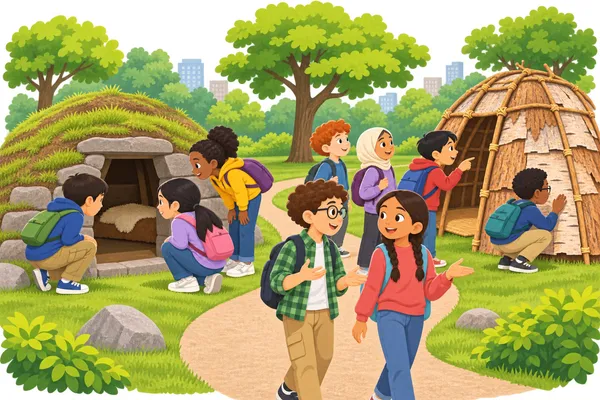
Homes Stop: Arctic winters were long, and large trees were scarce. Many Iñupiat winter houses were partly underground, with sod covering frames made from materials such as driftwood and whalebone. Entrance tunnels helped hold warmth inside. Lenape families lived in wooded country. They bent saplings into frames and covered them with bark or mats. Both peoples used building knowledge passed between generations.
Boats Stop: Iñupiat boatmakers stretched animal skins over frames. Large open boats called umiaks could carry people and equipment; whaling crews worked together in them. Smaller kayaks served individual hunters. Lenape boatmakers shaped dugout canoes by hollowing large tree trunks. Their rivers connected communities and provided places to fish.
Food Stop: Short, cold Arctic growing seasons did not support maize fields. Iñupiat families obtained foods including seals, whales, caribou, fish, and berries. They preserved foods by methods including drying and freezing. Lenape communities grew maize, beans, and squash. Families shared work in preparing and tending fields. They also hunted deer, fished, and gathered nuts and berries. Dried maize could be saved for winter. A poor harvest did not erase their knowledge of fishing, hunting, and gathering.
Clothing Stop: Iñupiat makers sewed fitted parkas, pants, and boots from animal skins. Caribou fur provided insulation, while sealskin was useful for water-resistant clothing. Lenape makers used deerskin for garments and footwear, including moccasins. Clothing styles and layers suited different seasons. Both cultures required skill in preparing hides and sewing, but their clothing was not identical.
These notes describe selected practices, not every family or community. Iñupiat and Lenape peoples are living peoples today. Their communities maintain cultural knowledge while also using modern homes, clothing, boats, and tools.
- A. East and west
- B. North and east
- C. South and west
- D. North and south
- A. Iñupiat builders had tall local forests; Lenape builders had few trees.
- B. Both groups built underground because both regions lacked trees.
- C. Iñupiat builders used scarce wood carefully; Lenape builders used woodland materials.
- D. Both groups chose bark because their winters had similar conditions.
The preview shows the first questions. Unlock the worksheet to see all of it.
Related worksheets
Canal-Side Signs: Desert and Wetland
Grade 4 · HIS.4.1
14 questionsPremium
Wild Rice and Salmon: Two Nations Then and Now
Grade 4 · HIS.4.1
13 questionsPremium
Cedar Coast and Grassland Choices
Grade 4 · HIS.4.1
15 questionsPremium
Diary Pages from River and Coast
Grade 4 · HIS.4.1
15 questionsFree
Two Regions, Many Ways of Life
Grade 4 · HIS.4.1
14 questionsPremium
The Hearthspan Crossing Report
Grade 4 · HIS.4.2
13 questionsPremium