Grade 4 · Social StudiesHIS.4.2Premium
The Hearthspan Crossing Report
Use a covered bridge town's newspaper briefing and travel graph to explain the Louisiana Purchase, Lewis and Clark, and pioneer challenges.
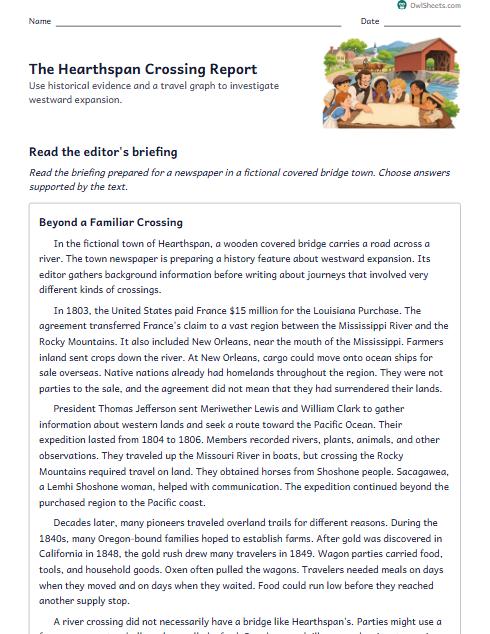
Preview
OwlSheets.com
The Hearthspan Crossing Report
Use historical evidence and a travel graph to investigate westward expansion.
Read the editor's briefing
Read the briefing prepared for a newspaper in a fictional covered bridge town. Choose answers supported by the text.
Beyond a Familiar Crossing
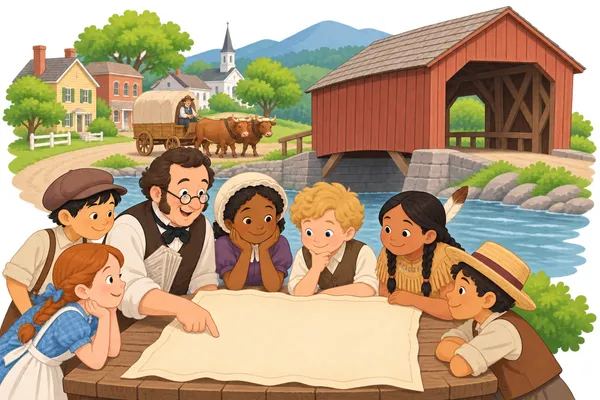
In the fictional town of Hearthspan, a wooden covered bridge carries a road across a river. The town newspaper is preparing a history feature about westward expansion. Its editor gathers background information before writing about journeys that involved very different kinds of crossings.
In 1803, the United States paid France $15 million for the Louisiana Purchase. The agreement transferred France's claim to a vast region between the Mississippi River and the Rocky Mountains. It also included New Orleans, near the mouth of the Mississippi. Farmers inland sent crops down the river. At New Orleans, cargo could move onto ocean ships for sale overseas. Native nations already had homelands throughout the region. They were not parties to the sale, and the agreement did not mean that they had surrendered their lands.
President Thomas Jefferson sent Meriwether Lewis and William Clark to gather information about western lands and seek a route toward the Pacific Ocean. Their expedition lasted from 1804 to 1806. Members recorded rivers, plants, animals, and other observations. They traveled up the Missouri River in boats, but crossing the Rocky Mountains required travel on land. They obtained horses from Shoshone people. Sacagawea, a Lemhi Shoshone woman, helped with communication. The expedition continued beyond the purchased region to the Pacific coast.
Decades later, many pioneers traveled overland trails for different reasons. During the 1840s, many Oregon-bound families hoped to establish farms. After gold was discovered in California in 1848, the gold rush drew many travelers in 1849. Wagon parties carried food, tools, and household goods. Oxen often pulled the wagons. Travelers needed meals on days when they moved and on days when they waited. Food could run low before they reached another supply stop.
A river crossing did not necessarily have a bridge like Hearthspan's. Parties might use a ferry or cross at a shallow place called a ford. Rough ground, illness, and waits at crossings could slow their progress. On parts of the Plains trails, travelers' livestock grazed near water. Growing traffic and settlement put pressure on the grass, bison herds, and homelands used by Lakota communities. Settlers' hopes for new homes were not the whole story of the land. Lakota and Shoshone peoples have living communities today.
- A. Whether France would restrict use of the shipping port
- B. Whether mountain snow would block a wagon road
- C. Whether river currents would make upstream travel difficult
- D. Whether enough grass would grow along the Oregon Trail
The United States paid France $15 million.Farmers shipped crops downstream on the Mississippi.The expedition recorded plants and animals.Cargo at New Orleans could be loaded onto ocean ships.
The preview shows the first questions. Unlock the worksheet to see all of it.
Related worksheets
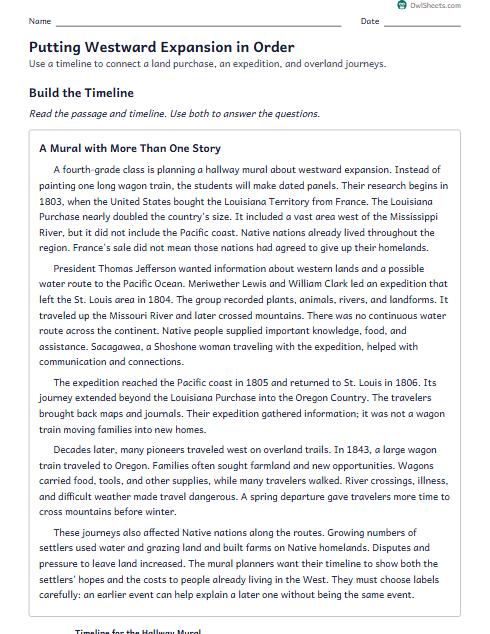
Putting Westward Expansion in Order
Grade 4 · HIS.4.2
14 questionsPremium
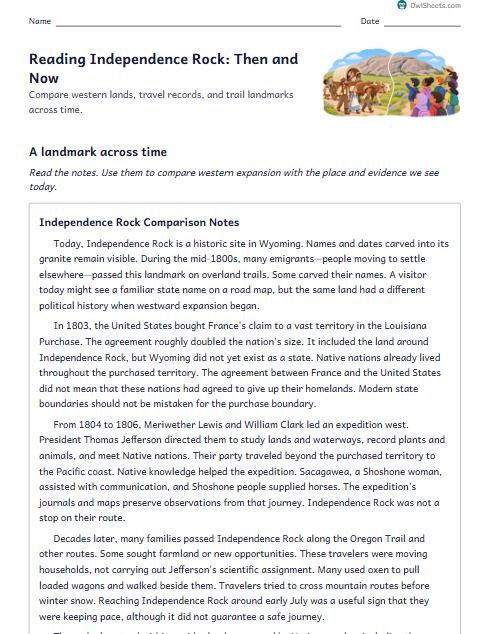
Reading Independence Rock: Then and Now
Grade 4 · HIS.4.2
14 questionsFree
Stories of Westward Expansion
Grade 4 · HIS.4.2
14 questionsPremium
Across the Prairie: Routes Then and Now
Grade 4 · HIS.4.2
15 questionsPremium
Mulberry Loop: Comparing Two Homelands
Grade 4 · HIS.4.1
14 questionsPremium
Canal-Side Signs: Desert and Wetland
Grade 4 · HIS.4.1
14 questionsPremium