Grade 4 · Social StudiesHIS.4.2Premium
Putting Westward Expansion in Order
Use a timeline to explain the Louisiana Purchase, Lewis and Clark's expedition, and pioneer travel while considering Native homelands.
Preview
OwlSheets.com
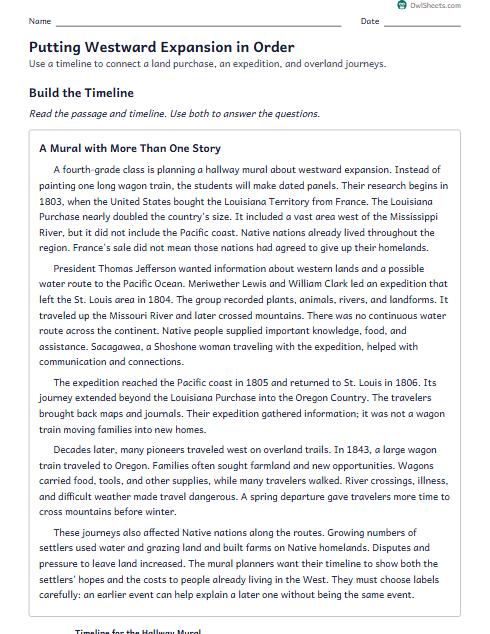
Putting Westward Expansion in Order
Use a timeline to connect a land purchase, an expedition, and overland journeys.
Build the Timeline
Read the passage and timeline. Use both to answer the questions.
A Mural with More Than One Story
A fourth-grade class is planning a hallway mural about westward expansion. Instead of painting one long wagon train, the students will make dated panels. Their research begins in 1803, when the United States bought the Louisiana Territory from France. The Louisiana Purchase nearly doubled the country's size. It included a vast area west of the Mississippi River, but it did not include the Pacific coast. Native nations already lived throughout the region. France's sale did not mean those nations had agreed to give up their homelands.
President Thomas Jefferson wanted information about western lands and a possible water route to the Pacific Ocean. Meriwether Lewis and William Clark led an expedition that left the St. Louis area in 1804. The group recorded plants, animals, rivers, and landforms. It traveled up the Missouri River and later crossed mountains. There was no continuous water route across the continent. Native people supplied important knowledge, food, and assistance. Sacagawea, a Shoshone woman traveling with the expedition, helped with communication and connections.
The expedition reached the Pacific coast in 1805 and returned to St. Louis in 1806. Its journey extended beyond the Louisiana Purchase into the Oregon Country. The travelers brought back maps and journals. Their expedition gathered information; it was not a wagon train moving families into new homes.
Decades later, many pioneers traveled west on overland trails. In 1843, a large wagon train traveled to Oregon. Families often sought farmland and new opportunities. Wagons carried food, tools, and other supplies, while many travelers walked. River crossings, illness, and difficult weather made travel dangerous. A spring departure gave travelers more time to cross mountains before winter.
These journeys also affected Native nations along the routes. Growing numbers of settlers used water and grazing land and built farms on Native homelands. Disputes and pressure to leave land increased. The mural planners want their timeline to show both the settlers' hopes and the costs to people already living in the West. They must choose labels carefully: an earlier event can help explain a later one without being the same event.
| Date | Event |
|---|---|
| 1803 | U.S. buys Louisiana from France. |
| 1804 | Expedition leaves St. Louis area. |
| 1805 | Expedition reaches Pacific coast. |
| 1806 | Expedition returns to St. Louis. |
| 1843 | Large wagon train travels to Oregon. |
- A. Land purchase → expedition → large wagon train
- B. Expedition → land purchase → large wagon train
- C. Land purchase → large wagon train → expedition
- D. Large wagon train → expedition → land purchase
The preview shows the first questions. Unlock the worksheet to see all of it.
Related worksheets
The Hearthspan Crossing Report
Grade 4 · HIS.4.2
13 questionsPremium
Reading Independence Rock: Then and Now
Grade 4 · HIS.4.2
14 questionsFree
Stories of Westward Expansion
Grade 4 · HIS.4.2
14 questionsPremium
Across the Prairie: Routes Then and Now
Grade 4 · HIS.4.2
15 questionsPremium
Mulberry Loop: Comparing Two Homelands
Grade 4 · HIS.4.1
14 questionsPremium
Canal-Side Signs: Desert and Wetland
Grade 4 · HIS.4.1
14 questionsPremium