
Worksheet
Kiri's Sewing Lesson: Turning Talk into a How-To Card
Read how Kiri turns her aunt's spoken sewing tips into a written how-to card, then compare spoken English with standard written English.
Grade 3ELAInteractive · Printable
Aligned toL.3.3.b
What’s included
- Single worksheet
- Auto-graded online
- 1 Common Core standard
- Printable answer key
- 8 questions
- Classroom-ready
Details
- Format
- Interactive · Printable
- Grade
- Grade 3
- Subject
- ELA
- Question types
- Fill in the blank, Multiple choice, Matching, Circle the answer, Sorting, Short answer
About this worksheet
What students practice
- Students compare spoken directions with standard written directions.
- Students replace spoken short forms, chatty words and pointing words with clear written English.
How to use
Read Auntie's words aloud in a chatty voice and Kiri's card in a clear voice, then talk about what changed before students answer on their own.
Curriculum
Common Core standard covered
Recognize and observe the differences between the conventions of spoken and written standard English.
Preview
OwlSheets.com
Kiri's Sewing Lesson: Turning Talk into a How-To Card
See how spoken directions change when you write them down.
Read the story and the card
Kiri's Sewing Lesson
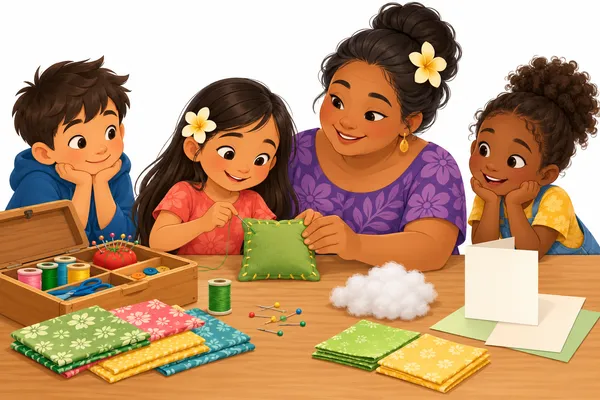
1Kiri wanted to sew a small pillow for the hobby share at school. On Saturday, Auntie Mele set her sewing box on the kitchen table and showed Kiri what to do.
2"Okay, so first, grab two of these," Auntie said, holding up two squares of soft green cloth. "Pin 'em together like this. Yep, just like that."
3"Now ya sew around the edges. Go slow, 'kay? Leave a little gap over here." She tapped one corner with her thimble.
4"Then flip it, stuff it, and sew the gap shut. Done! Pretty easy, huh?"
5Kiri's pillow turned out lumpy but cozy. On Monday, she wrote a how-to card to set beside it. She knew her classmates could not hear Auntie's voice or see her point, so she chose her words with care.
How to Sew a Simple Pillow
1Pin two squares of cloth together with the good sides facing in.
2Sew around all four edges slowly. Leave a small gap on one side.
3Turn the pillow right side out through the gap.
4Fill the pillow with stuffing.
5Sew the gap closed.
Spoken words and written words
Use the story and the card to answer each question.
- "grab two of these"
- "Go slow, 'kay?"
- "over here"
- "flip it"
- A. on one side
- B. turn the pillow right side out
- C. two squares of cloth
- D. sew around all four edges slowly
Nowyasewaroundtheedges,'kay?
ya =
'kay =
'em =
yep =
- A. They are the most important step of all.
- B. They have words that are hard to spell.
- C. They are friendly talk, not a step to follow.
- D. They were said by Kiri, not by Auntie.
- A. Her teacher wanted the card to rhyme.
- B. Her classmates would have only the card.
- C. Auntie asked her to write very fast.
- D. The card had room for only five words.
Write it like Kiri
Choose or write standard written English for a how-to card.
| Sounds like talking | Written for a how-to card |
|---|---|
- A. Then ya snip the thread, 'kay?
- B. Cut it right here, like this.
- C. snip the thread at the end
- D. Cut the thread when you finish.
Related worksheets
 Worksheet
Grade 3
Brick Club Plans: What We Said and What We Wrote
Language · L.3.3.b
Premium9 questions
 Worksheet
Grade 3
Robot Club: Talking and Writing
Language · L.3.3.b
Premium10 questions
 Worksheet
Grade 3
Saplings and Shovels at the Tree Nursery
Language · L.3.6
Premium11 questions
 Worksheet
Grade 3
The Teddy Clinic: Plural Nouns
Language · L.3.1.b
Premium12 questions
 Worksheet
Grade 3
A Tapir Calf Named Pepita: Root Word Clues
Language · L.3.4.c
Premium9 questions
 Worksheet
Grade 3
Shearing Day at the Wool Barn: What Words Do
Language · L.3.1.a
Premium12 questions