
Worksheet
A Growing Station for the Zoo
Use a zoo's lettuce-growing tests to investigate sunlight and water, compare evidence, and improve a growing-station design.
Grade 2ScienceInteractive · Printable
Aligned to2-LS2-1
What’s included
- Single worksheet
- Auto-graded online
- 1 NGSS standard
- Printable answer key
- 13 questions
- Classroom-ready
Details
- Format
- Interactive · Printable
- Grade
- Grade 2
- Subject
- Science
- Question types
- Fill in the blank, Multiple choice, Circle the answer, Sorting, Short answer
About this worksheet
What students practice
- Students use plant-growth data to investigate the effects of sunlight and water.
- Students identify fair comparisons that test sunlight or water.
- Students use evidence to judge and improve plant-growing designs.
How to use
Read the zoo test notes together and review the graph scale. Have students use the records to judge designs and explain their final choice.
Curriculum
NGSS standard covered
Investigate whether plants need sunlight and water to grow.
Preview
OwlSheets.com
A Growing Station for the Zoo
Use plant tests to judge designs for a lettuce-growing station.
Study the Zoo's Test
Read the test notes. Use the notes and graph to answer the questions.
Lettuce for the Tortoises
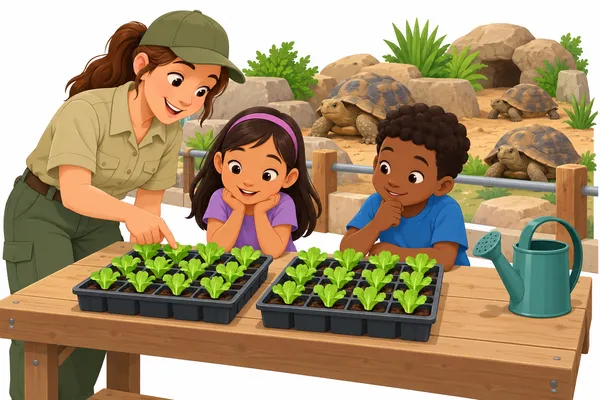
A zoo keeper wants a growing station for lettuce that the tortoises can eat. Before building it, the keeper tests three tray designs for 14 days. Each tray holds three young lettuce plants. The plants start about the same size, with the same number of leaves. They have the same kinds of pots and soil.
Tray A gets sunlight and water. Tray B gets no sunlight but gets the same measured amount of water as A each day. Tray C gets sunlight beside A but gets no water. The keeper checks that all three places have the same room temperature and enough air.
The keeper counts each plant's leaves at the start. At the end, the keeper counts how many new leaves have grown. The graph shows the total new leaves for the three plants in each tray. Leaves that were there at the start are not included.
- A. Tray C grew more new leaves than Tray B.
- B. Tray A grew more new leaves than Tray B.
- C. Tray B grew as many new leaves as Tray A.
- D. Tray C grew as many new leaves as Tray A.
- A. To make every plant grow at the same speed.
- B. To make the plants need less sunlight.
- C. To make watering the plants unnecessary.
- D. To make the tray designs fairer to compare.
How many more new leaves grew in Tray A than in Tray B? new leaves
- A. Tray A and Tray C
- B. Tray A and Tray B
- C. Tray B and Tray C
- D. Tray B and another tray with no sunlight
| Supported by the graph | Not supported by the graph |
|---|---|
Judge Growing-Station Designs
Use the tray test as evidence. Choose designs that could help the lettuce keep growing new leaves.
- A. A dark shelf with a daily watering plan
- B. A sunny shelf with no watering plan
- C. A sunny shelf with a daily watering plan
- D. A dark shelf with no watering plan
- A. Put the pots farther from the window.
- B. Begin with plants that have more leaves.
- C. Add a watering job to the keeper's daily list.
- D. Use a taller shelf in the same sunny spot.
Give both groups the same amount of sunlight.Use larger plants for the plan with more water.Count new leaves after 14 days for both groups.Use different kinds of soil for the two groups.
- A. It will probably grow fewer new leaves than before.
- B. It will probably stop growing any new leaves.
- C. It will probably grow the same three new leaves.
- D. It will probably grow more new leaves than before.
Check the Keeper's Next Plan
Look for fair tests and careful measurements. Use evidence when you explain a design choice.
- A. It changes water and sunlight at the same time.
- B. It should use different soil for each group.
- C. It should give neither group any water.
- D. It keeps the groups too much alike.
Fix the helper's count. How many leaves are new? new leaves
- A. Yes. Every lettuce plant grows at the same speed.
- B. Yes. Sunlight makes the leaf count stay the same.
- C. No. A new tray may grow a different number of leaves.
- D. No. Watered plants cannot grow new leaves again.
Related worksheets
 Worksheet
Grade 2
Seedling Shelves in the Greenhouse
Life Science · 2-LS2-1
Premium15 questions
 Worksheet
Grade 2
Seedling Evidence at the River Dam
Life Science · 2-LS2-1
Premium14 questions
 Worksheet
Grade 2
Plants in Two Museum Places
Life Science · 2-LS2-1
Premium15 questions
 Worksheet
Grade 2
Predictions for the Farm's Mint Sale
Life Science · 2-LS2-1
Premium14 questions
 Worksheet
Grade 2
Plant Checks at the Field Hockey Shelter
Life Science · 2-LS2-1
Premium14 questions
 Worksheet
Grade 2
Marigold Tests in the Backyard Playhouse
Life Science · 2-LS2-1
Premium14 questions