Grade 8 · Social StudiesECO.8.1Premium
Fifty Times Less Labor? Sourcing Eli Whitney's 1793 Letter
Grade 8 economics: source Eli Whitney's 1793 letter on the cotton gin and test it against data on cotton, slavery, steamboats and factory cloth.
Preview
OwlSheets.com
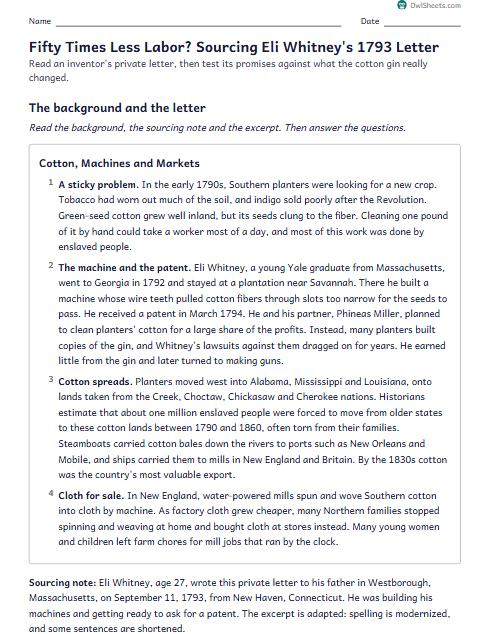
Fifty Times Less Labor? Sourcing Eli Whitney's 1793 Letter
Read an inventor's private letter, then test its promises against what the cotton gin really changed.
The background and the letter
Read the background, the sourcing note and the excerpt. Then answer the questions.
Cotton, Machines and Markets
1A sticky problem. In the early 1790s, Southern planters were looking for a new crop. Tobacco had worn out much of the soil, and indigo sold poorly after the Revolution. Green-seed cotton grew well inland, but its seeds clung to the fiber. Cleaning one pound of it by hand could take a worker most of a day, and most of this work was done by enslaved people.
2The machine and the patent. Eli Whitney, a young Yale graduate from Massachusetts, went to Georgia in 1792 and stayed at a plantation near Savannah. There he built a machine whose wire teeth pulled cotton fibers through slots too narrow for the seeds to pass. He received a patent in March 1794. He and his partner, Phineas Miller, planned to clean planters' cotton for a large share of the profits. Instead, many planters built copies of the gin, and Whitney's lawsuits against them dragged on for years. He earned little from the gin and later turned to making guns.
3Cotton spreads. Planters moved west into Alabama, Mississippi and Louisiana, onto lands taken from the Creek, Choctaw, Chickasaw and Cherokee nations. Historians estimate that about one million enslaved people were forced to move from older states to these cotton lands between 1790 and 1860, often torn from their families. Steamboats carried cotton bales down the rivers to ports such as New Orleans and Mobile, and ships carried them to mills in New England and Britain. By the 1830s cotton was the country's most valuable export.
4Cloth for sale. In New England, water-powered mills spun and wove Southern cotton into cloth by machine. As factory cloth grew cheaper, many Northern families stopped spinning and weaving at home and bought cloth at stores instead. Many young women and children left farm chores for mill jobs that ran by the clock.
Excerpt: “Soon after I arrived in Georgia, I heard many gentlemen say that if a machine could be invented to clean cotton quickly, it would be a great thing both to the country and to the inventor. I thought about the matter and worked out a plan for a machine. In about ten days I made a little model. This machine may be turned by water or by a horse with the greatest ease, and one man and a horse will do more than fifty men with the old machines. It makes the labor fifty times less, without throwing any class of people out of business. I am going to Philadelphia soon to get a patent. It is generally said by those who know anything about it that I shall make a fortune by it. I ask you not to show this letter to anyone except my brothers and sister, and to have them keep the whole a profound secret.”
- A. Its fiber was too short to be spun into thread or cloth.
- B. Pulling out its sticky seeds by hand took far too long.
- C. It grew only along the coast, where land was already taken.
- D. British mills had stopped buying cotton after the Revolution.
The preview shows the first questions. Unlock the worksheet to see all of it.
Related worksheets
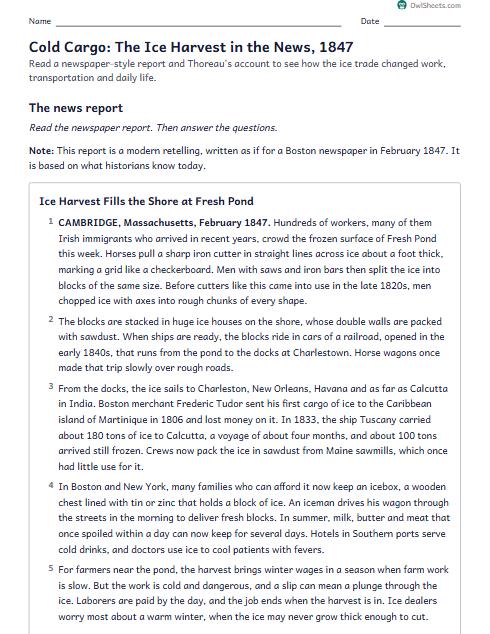
Cold Cargo: The Ice Harvest in the News, 1847
Grade 8 · ECO.8.1
14 questionsPremium
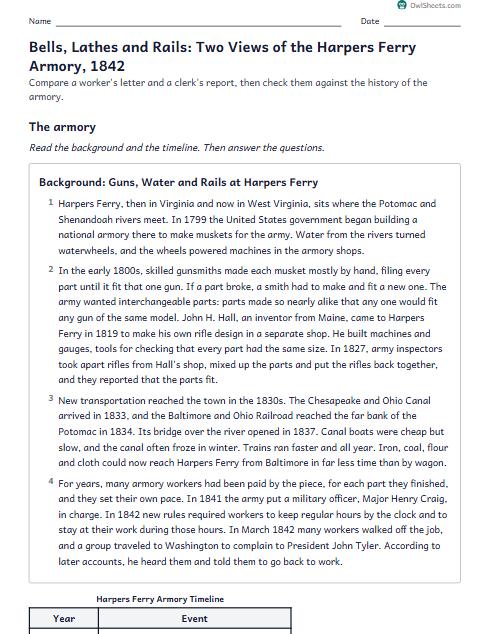
Bells, Lathes and Rails: Two Views of the Harpers Ferry Armory, 1842
Grade 8 · ECO.8.1
14 questionsPremium
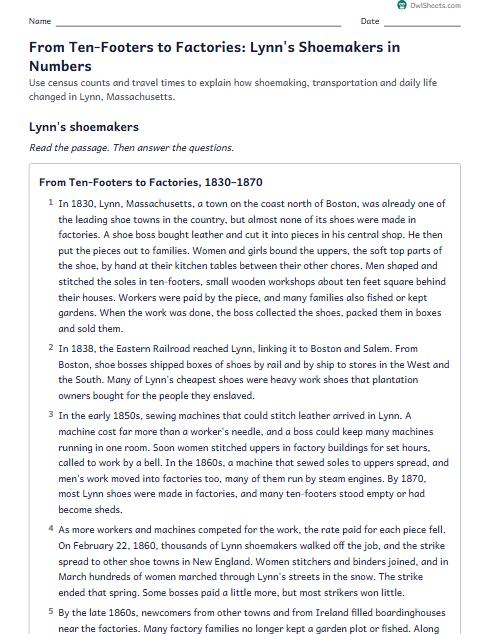
From Ten-Footers to Factories: Lynn's Shoemakers in Numbers
Grade 8 · ECO.8.1
13 questionsPremium
Collars, Horseshoes and Steamboats: Field Notes from Troy, New York
Grade 8 · ECO.8.1
13 questionsPremium
Hogs by Rail: A Farm Family Goes to Porkopolis, 1854
Grade 8 · ECO.8.1
11 questionsPremium
From Cradle to Reaper: A Prairie Farm Exhibit
Grade 8 · ECO.8.1
11 questionsPremium