Grade 8 · Social StudiesECO.8.1Premium
Collars, Horseshoes and Steamboats: Field Notes from Troy, New York
Grade 8 economics: a historian's field notes from Troy, New York, on steamboats, a horseshoe machine and collar laundries show the market revolution at work.
Preview
OwlSheets.com
Collars, Horseshoes and Steamboats: Field Notes from Troy, New York
Follow a historian through Troy to see how industry and new transportation changed work and daily life.
The field notes
Dr. Teodora Vance, a historian, spent a week in Troy, New York, studying how the city changed from about 1800 to 1870. Read her notes. Then answer the questions.
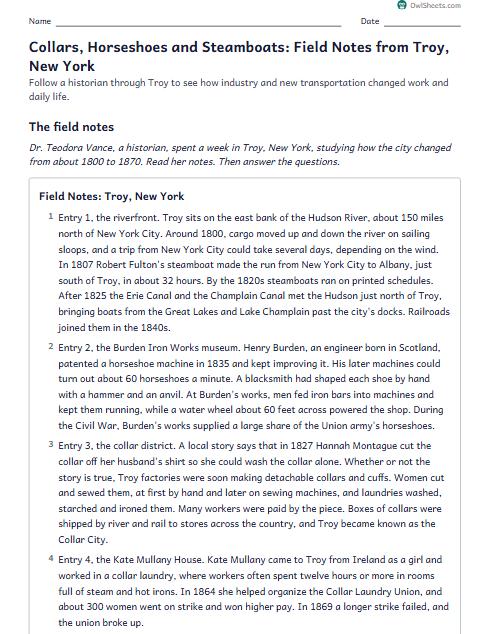
Field Notes: Troy, New York
1Entry 1, the riverfront. Troy sits on the east bank of the Hudson River, about 150 miles north of New York City. Around 1800, cargo moved up and down the river on sailing sloops, and a trip from New York City could take several days, depending on the wind. In 1807 Robert Fulton's steamboat made the run from New York City to Albany, just south of Troy, in about 32 hours. By the 1820s steamboats ran on printed schedules. After 1825 the Erie Canal and the Champlain Canal met the Hudson just north of Troy, bringing boats from the Great Lakes and Lake Champlain past the city's docks. Railroads joined them in the 1840s.
2Entry 2, the Burden Iron Works museum. Henry Burden, an engineer born in Scotland, patented a horseshoe machine in 1835 and kept improving it. His later machines could turn out about 60 horseshoes a minute. A blacksmith had shaped each shoe by hand with a hammer and an anvil. At Burden's works, men fed iron bars into machines and kept them running, while a water wheel about 60 feet across powered the shop. During the Civil War, Burden's works supplied a large share of the Union army's horseshoes.
3Entry 3, the collar district. A local story says that in 1827 Hannah Montague cut the collar off her husband's shirt so she could wash the collar alone. Whether or not the story is true, Troy factories were soon making detachable collars and cuffs. Women cut and sewed them, at first by hand and later on sewing machines, and laundries washed, starched and ironed them. Many workers were paid by the piece. Boxes of collars were shipped by river and rail to stores across the country, and Troy became known as the Collar City.
4Entry 4, the Kate Mullany House. Kate Mullany came to Troy from Ireland as a girl and worked in a collar laundry, where workers often spent twelve hours or more in rooms full of steam and hot irons. In 1864 she helped organize the Collar Laundry Union, and about 300 women went on strike and won higher pay. In 1869 a longer strike failed, and the union broke up.
5Entry 5, the city history museum. One case holds a shelf clock made in a Connecticut factory, a box of ready-made collars and a railroad timetable from the 1850s. A label notes that by then many Troy families earned cash wages and bought such goods at stores. I saw these objects in the museum today.
- A. He could expect shipments on a schedule instead of waiting on the wind.
- B. He would have to sail his own sloop to New York City for each order.
- C. He would pay more, since steamboats took longer than sloops to arrive.
- D. He could stop using the Hudson River and send goods by canal instead.
At about 60 horseshoes a minute, one of Burden's later machines could make about horseshoes in one hour.
The preview shows the first questions. Unlock the worksheet to see all of it.
Related worksheets
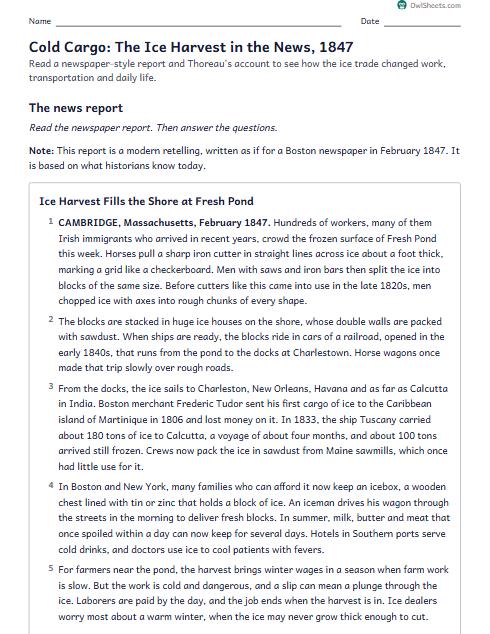
Cold Cargo: The Ice Harvest in the News, 1847
Grade 8 · ECO.8.1
14 questionsPremium
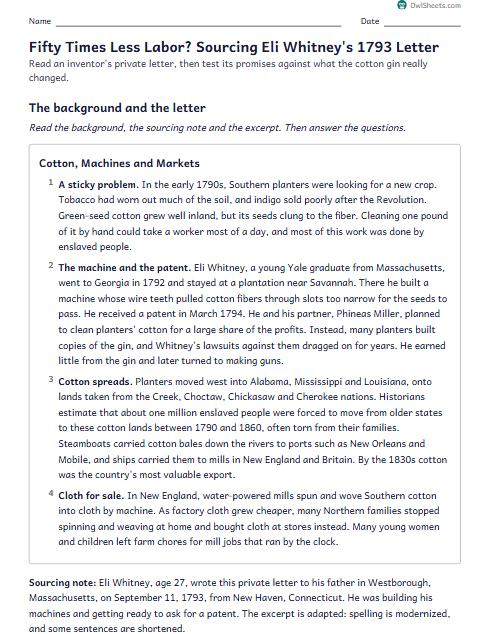
Fifty Times Less Labor? Sourcing Eli Whitney's 1793 Letter
Grade 8 · ECO.8.1
14 questionsPremium
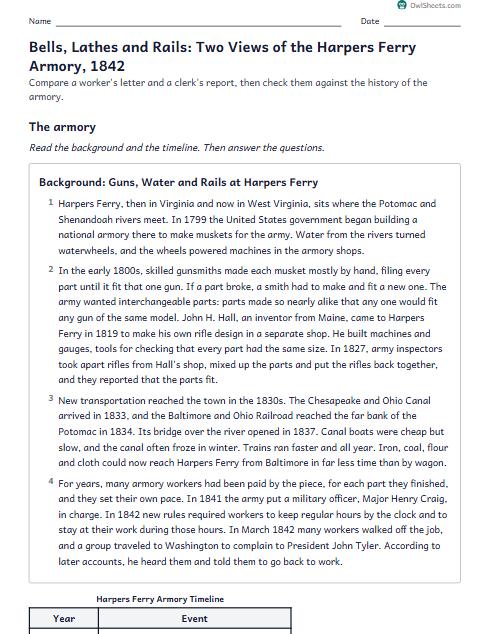
Bells, Lathes and Rails: Two Views of the Harpers Ferry Armory, 1842
Grade 8 · ECO.8.1
14 questionsPremium
From Ten-Footers to Factories: Lynn's Shoemakers in Numbers
Grade 8 · ECO.8.1
13 questionsPremium
Hogs by Rail: A Farm Family Goes to Porkopolis, 1854
Grade 8 · ECO.8.1
11 questionsPremium
From Cradle to Reaper: A Prairie Farm Exhibit
Grade 8 · ECO.8.1
11 questionsPremium