Grade 8 · Social StudiesECO.8.1Premium
Bells, Lathes and Rails: Two Views of the Harpers Ferry Armory, 1842
Grade 8 economics: compare two 1842 accounts of the Harpers Ferry armory to see how machines, clock rules and railroads changed work and daily life.
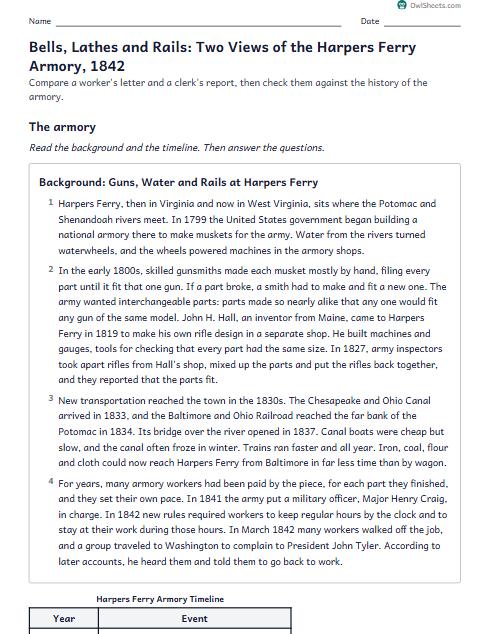
Preview
OwlSheets.com
Bells, Lathes and Rails: Two Views of the Harpers Ferry Armory, 1842
Compare a worker's letter and a clerk's report, then check them against the history of the armory.
The armory
Read the background and the timeline. Then answer the questions.
Background: Guns, Water and Rails at Harpers Ferry
1Harpers Ferry, then in Virginia and now in West Virginia, sits where the Potomac and Shenandoah rivers meet. In 1799 the United States government began building a national armory there to make muskets for the army. Water from the rivers turned waterwheels, and the wheels powered machines in the armory shops.
2In the early 1800s, skilled gunsmiths made each musket mostly by hand, filing every part until it fit that one gun. If a part broke, a smith had to make and fit a new one. The army wanted interchangeable parts: parts made so nearly alike that any one would fit any gun of the same model. John H. Hall, an inventor from Maine, came to Harpers Ferry in 1819 to make his own rifle design in a separate shop. He built machines and gauges, tools for checking that every part had the same size. In 1827, army inspectors took apart rifles from Hall's shop, mixed up the parts and put the rifles back together, and they reported that the parts fit.
3New transportation reached the town in the 1830s. The Chesapeake and Ohio Canal arrived in 1833, and the Baltimore and Ohio Railroad reached the far bank of the Potomac in 1834. Its bridge over the river opened in 1837. Canal boats were cheap but slow, and the canal often froze in winter. Trains ran faster and all year. Iron, coal, flour and cloth could now reach Harpers Ferry from Baltimore in far less time than by wagon.
4For years, many armory workers had been paid by the piece, for each part they finished, and they set their own pace. In 1841 the army put a military officer, Major Henry Craig, in charge. In 1842 new rules required workers to keep regular hours by the clock and to stay at their work during those hours. In March 1842 many workers walked off the job, and a group traveled to Washington to complain to President John Tyler. According to later accounts, he heard them and told them to go back to work.
| Year | Event |
|---|---|
| 1799 | Building of the national armory begins |
| 1819 | John Hall opens his rifle shop |
| 1827 | Inspectors test Hall's rifle parts |
| 1833 | C&O Canal reaches Harpers Ferry |
| 1834 | B&O Railroad reaches the Potomac |
| 1837 | Railroad bridge over the Potomac opens |
| 1841 | Major Henry Craig takes charge |
| March 1842 | Workers walk off over the clock rules |
- A. A spare part could replace it without a gunsmith refitting it.
- B. A smith would need to file a new part to fit that one rifle.
- C. He would have to send the whole rifle back to Hall's shop in Maine.
- D. He could no longer use the rifle once any part of it broke.
The preview shows the first questions. Unlock the worksheet to see all of it.
Related worksheets
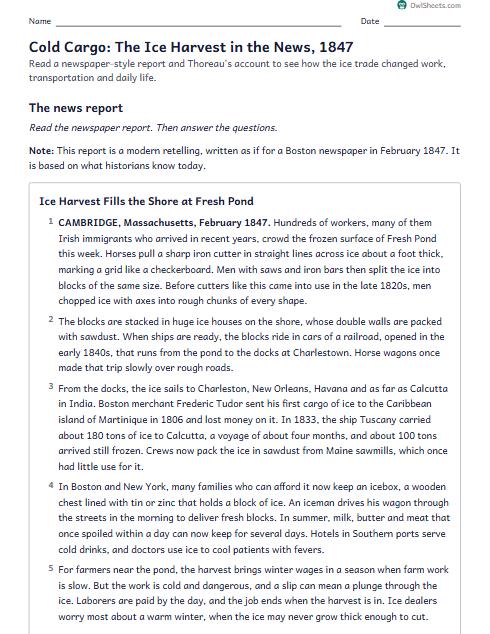
Cold Cargo: The Ice Harvest in the News, 1847
Grade 8 · ECO.8.1
14 questionsPremium
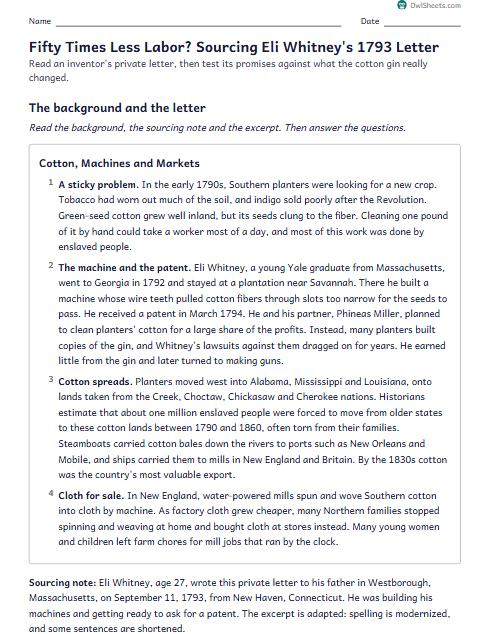
Fifty Times Less Labor? Sourcing Eli Whitney's 1793 Letter
Grade 8 · ECO.8.1
14 questionsPremium
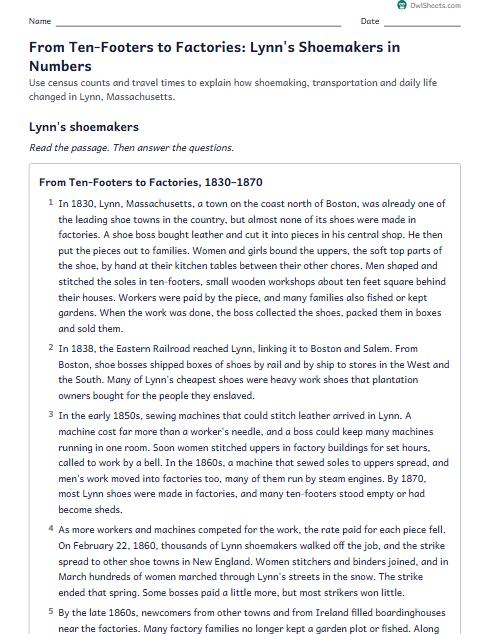
From Ten-Footers to Factories: Lynn's Shoemakers in Numbers
Grade 8 · ECO.8.1
13 questionsPremium
Collars, Horseshoes and Steamboats: Field Notes from Troy, New York
Grade 8 · ECO.8.1
13 questionsPremium
Hogs by Rail: A Farm Family Goes to Porkopolis, 1854
Grade 8 · ECO.8.1
11 questionsPremium
From Cradle to Reaper: A Prairie Farm Exhibit
Grade 8 · ECO.8.1
11 questionsPremium