Grade 8 · Social StudiesECO.8.1Premium
Cold Cargo: The Ice Harvest in the News, 1847
Grade 8 economics: a modern news retelling of the 1847 Fresh Pond ice harvest and an adapted Thoreau excerpt show how the market revolution changed life.
Preview
OwlSheets.com
Cold Cargo: The Ice Harvest in the News, 1847
Read a newspaper-style report and Thoreau's account to see how the ice trade changed work, transportation and daily life.
The news report
Read the newspaper report. Then answer the questions.
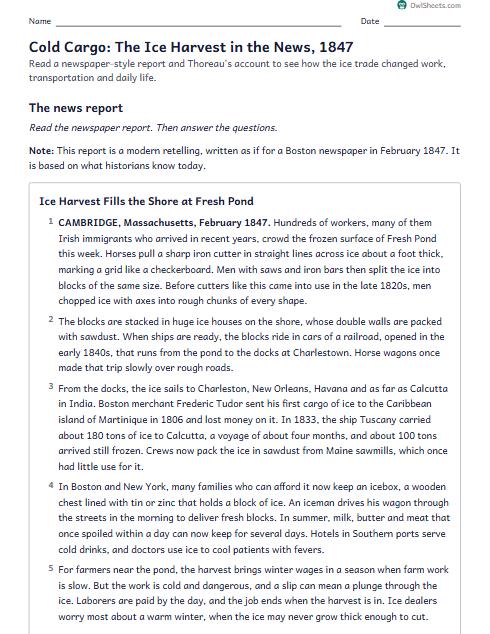
Ice Harvest Fills the Shore at Fresh Pond
1CAMBRIDGE, Massachusetts, February 1847. Hundreds of workers, many of them Irish immigrants who arrived in recent years, crowd the frozen surface of Fresh Pond this week. Horses pull a sharp iron cutter in straight lines across ice about a foot thick, marking a grid like a checkerboard. Men with saws and iron bars then split the ice into blocks of the same size. Before cutters like this came into use in the late 1820s, men chopped ice with axes into rough chunks of every shape.
2The blocks are stacked in huge ice houses on the shore, whose double walls are packed with sawdust. When ships are ready, the blocks ride in cars of a railroad, opened in the early 1840s, that runs from the pond to the docks at Charlestown. Horse wagons once made that trip slowly over rough roads.
3From the docks, the ice sails to Charleston, New Orleans, Havana and as far as Calcutta in India. Boston merchant Frederic Tudor sent his first cargo of ice to the Caribbean island of Martinique in 1806 and lost money on it. In 1833, the ship Tuscany carried about 180 tons of ice to Calcutta, a voyage of about four months, and about 100 tons arrived still frozen. Crews now pack the ice in sawdust from Maine sawmills, which once had little use for it.
4In Boston and New York, many families who can afford it now keep an icebox, a wooden chest lined with tin or zinc that holds a block of ice. An iceman drives his wagon through the streets in the morning to deliver fresh blocks. In summer, milk, butter and meat that once spoiled within a day can now keep for several days. Hotels in Southern ports serve cold drinks, and doctors use ice to cool patients with fevers.
5For farmers near the pond, the harvest brings winter wages in a season when farm work is slow. But the work is cold and dangerous, and a slip can mean a plunge through the ice. Laborers are paid by the day, and the job ends when the harvest is in. Ice dealers worry most about a warm winter, when the ice may never grow thick enough to cut.
- A. Workers could harvest ice in summer as well as in the coldest winter months.
- B. Workers chopped the ice with axes into blocks that were easier to carry.
- C. Workers no longer needed saws, since the horses split each block.
- D. Workers could cut blocks of one size quickly instead of chopping rough chunks.
The preview shows the first questions. Unlock the worksheet to see all of it.
Related worksheets
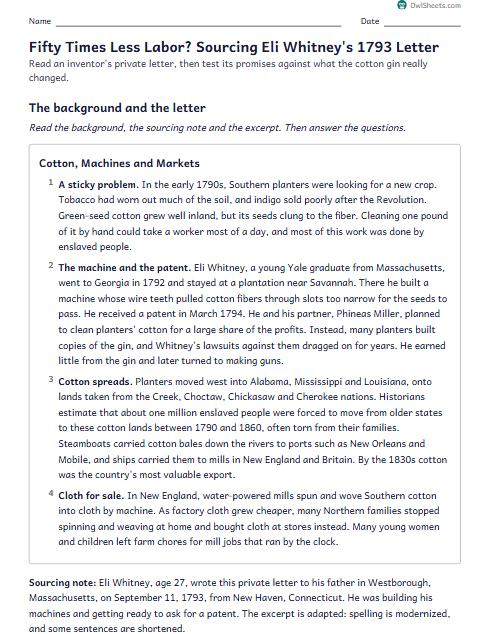
Fifty Times Less Labor? Sourcing Eli Whitney's 1793 Letter
Grade 8 · ECO.8.1
14 questionsPremium
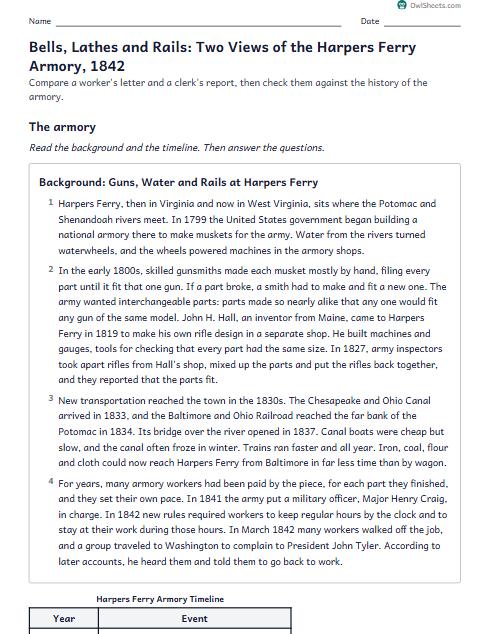
Bells, Lathes and Rails: Two Views of the Harpers Ferry Armory, 1842
Grade 8 · ECO.8.1
14 questionsPremium
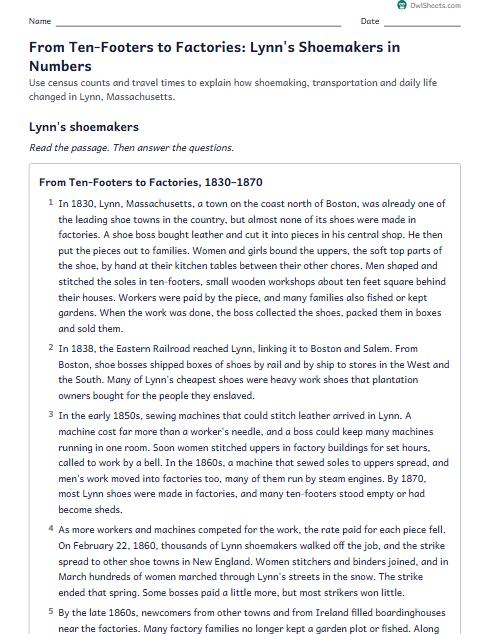
From Ten-Footers to Factories: Lynn's Shoemakers in Numbers
Grade 8 · ECO.8.1
13 questionsPremium
Collars, Horseshoes and Steamboats: Field Notes from Troy, New York
Grade 8 · ECO.8.1
13 questionsPremium
Hogs by Rail: A Farm Family Goes to Porkopolis, 1854
Grade 8 · ECO.8.1
11 questionsPremium
From Cradle to Reaper: A Prairie Farm Exhibit
Grade 8 · ECO.8.1
11 questionsPremium