Grade 8 · Social StudiesECO.8.1Premium
From Ten-Footers to Factories: Lynn's Shoemakers in Numbers
Grade 8 history: census and travel-time tables and a passage show how machines, railroads and markets changed shoemaking in Lynn, Massachusetts, 1830–1870.
Preview
OwlSheets.com
From Ten-Footers to Factories: Lynn's Shoemakers in Numbers
Use census counts and travel times to explain how shoemaking, transportation and daily life changed in Lynn, Massachusetts.
Lynn's shoemakers
Read the passage. Then answer the questions.
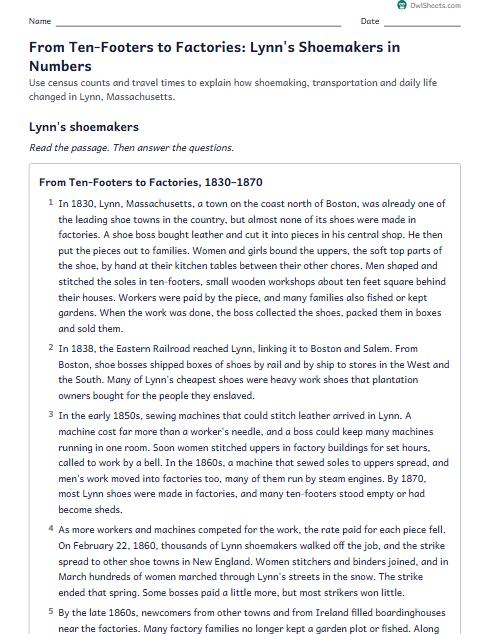
From Ten-Footers to Factories, 1830–1870
1In 1830, Lynn, Massachusetts, a town on the coast north of Boston, was already one of the leading shoe towns in the country, but almost none of its shoes were made in factories. A shoe boss bought leather and cut it into pieces in his central shop. He then put the pieces out to families. Women and girls bound the uppers, the soft top parts of the shoe, by hand at their kitchen tables between their other chores. Men shaped and stitched the soles in ten-footers, small wooden workshops about ten feet square behind their houses. Workers were paid by the piece, and many families also fished or kept gardens. When the work was done, the boss collected the shoes, packed them in boxes and sold them.
2In 1838, the Eastern Railroad reached Lynn, linking it to Boston and Salem. From Boston, shoe bosses shipped boxes of shoes by rail and by ship to stores in the West and the South. Many of Lynn's cheapest shoes were heavy work shoes that plantation owners bought for the people they enslaved.
3In the early 1850s, sewing machines that could stitch leather arrived in Lynn. A machine cost far more than a worker's needle, and a boss could keep many machines running in one room. Soon women stitched uppers in factory buildings for set hours, called to work by a bell. In the 1860s, a machine that sewed soles to uppers spread, and men's work moved into factories too, many of them run by steam engines. By 1870, most Lynn shoes were made in factories, and many ten-footers stood empty or had become sheds.
4As more workers and machines competed for the work, the rate paid for each piece fell. On February 22, 1860, thousands of Lynn shoemakers walked off the job, and the strike spread to other shoe towns in New England. Women stitchers and binders joined, and in March hundreds of women marched through Lynn's streets in the snow. The strike ended that spring. Some bosses paid a little more, but most strikers won little.
5By the late 1860s, newcomers from other towns and from Ireland filled boardinghouses near the factories. Many factory families no longer kept a garden plot or fished. Along Lynn's main streets, new stores sold flour, coal and ready-made clothing.
- A. Each family made whole shoes for itself and traded extras with neighbors.
- B. Workers ran machines in a factory and were paid for the hours they worked.
- C. Families bought their own leather and sold finished shoes in Boston.
- D. A boss cut the leather and paid families by the piece to work at home.
| The shoe boss | Men in ten-footers | Women and girls at home |
|---|---|---|
The preview shows the first questions. Unlock the worksheet to see all of it.
Related worksheets
Cold Cargo: The Ice Harvest in the News, 1847
Grade 8 · ECO.8.1
14 questionsPremium
Fifty Times Less Labor? Sourcing Eli Whitney's 1793 Letter
Grade 8 · ECO.8.1
14 questionsPremium
Bells, Lathes and Rails: Two Views of the Harpers Ferry Armory, 1842
Grade 8 · ECO.8.1
14 questionsPremium
Collars, Horseshoes and Steamboats: Field Notes from Troy, New York
Grade 8 · ECO.8.1
13 questionsPremium
Hogs by Rail: A Farm Family Goes to Porkopolis, 1854
Grade 8 · ECO.8.1
11 questionsPremium
From Cradle to Reaper: A Prairie Farm Exhibit
Grade 8 · ECO.8.1
11 questionsPremium