Grade 8 · Social StudiesHIS.8.2Premium
Six Objects, Six Tests: An Exhibit on the Early Republic, 1791–1814
Grade 8 early republic: six museum labels on the Whiskey Rebellion, neutrality, party newspapers, the 1796 vote, impressment and Horseshoe Bend.
Preview
OwlSheets.com
Six Objects, Six Tests: An Exhibit on the Early Republic, 1791–1814
Read six museum labels and judge the challenges the young nation faced.
Tests at home
Read the exhibit labels. Then answer the questions.
Exhibit Labels
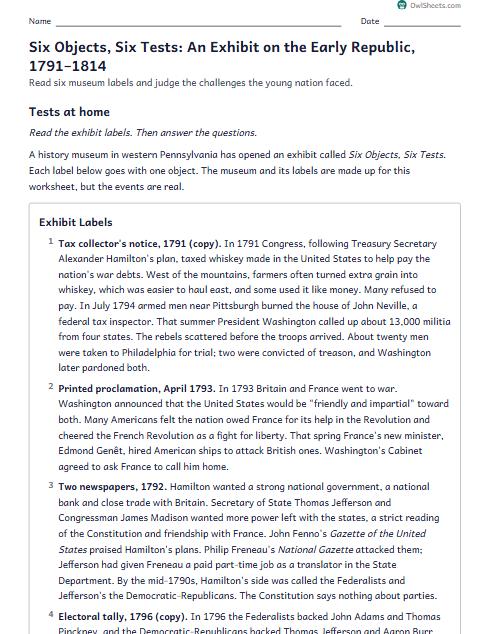
1Tax collector's notice, 1791 (copy). In 1791 Congress, following Treasury Secretary Alexander Hamilton's plan, taxed whiskey made in the United States to help pay the nation's war debts. West of the mountains, farmers often turned extra grain into whiskey, which was easier to haul east, and some used it like money. Many refused to pay. In July 1794 armed men near Pittsburgh burned the house of John Neville, a federal tax inspector. That summer President Washington called up about 13,000 militia from four states. The rebels scattered before the troops arrived. About twenty men were taken to Philadelphia for trial; two were convicted of treason, and Washington later pardoned both.
2Printed proclamation, April 1793. In 1793 Britain and France went to war. Washington announced that the United States would be "friendly and impartial" toward both. Many Americans felt the nation owed France for its help in the Revolution and cheered the French Revolution as a fight for liberty. That spring France's new minister, Edmond Genêt, hired American ships to attack British ones. Washington's Cabinet agreed to ask France to call him home.
3Two newspapers, 1792. Hamilton wanted a strong national government, a national bank and close trade with Britain. Secretary of State Thomas Jefferson and Congressman James Madison wanted more power left with the states, a strict reading of the Constitution and friendship with France. John Fenno's Gazette of the United States praised Hamilton's plans. Philip Freneau's National Gazette attacked them; Jefferson had given Freneau a paid part-time job as a translator in the State Department. By the mid-1790s, Hamilton's side was called the Federalists and Jefferson's the Democratic-Republicans. The Constitution says nothing about parties.
4Electoral tally, 1796 (copy). In 1796 the Federalists backed John Adams and Thomas Pinckney, and the Democratic-Republicans backed Thomas Jefferson and Aaron Burr. Under the rules then, each elector cast two votes for president. The person with the most votes became president, and the runner-up became vice president.
5Seaman's protection certificate, 1806. From 1796, customs officers could give an American sailor a paper saying he was a U.S. citizen. This one, for a sailor from Providence, Rhode Island, lists his height, his brown hair and a scar on his left hand. Britain's navy, short of men, stopped American ships and took sailors it claimed were British, often ignoring papers like this one. Historians estimate the British took several thousand men from American ships between 1803 and 1812. Britain also blocked American trade with France. In June 1812 Congress declared war. Every Federalist in Congress voted no. Many Federalist voters lived in New England port towns, where most ships traded with Britain.
6Treaty map, 1814 (copy). During the war, the Muscogee (Creek) people split. The Red Sticks fought to stop American settlers, while other Muscogee towns sided with the United States. In March 1814 Andrew Jackson's army, with Cherokee and Muscogee allies, defeated the Red Sticks at Horseshoe Bend in present-day Alabama. That August the Treaty of Fort Jackson took about 23 million acres of Muscogee land, much of it from towns that had fought beside Jackson. In December the Treaty of Ghent ended the war with Britain and left the border with British Canada where it had been. Today the Muscogee Nation has its government in Oklahoma, and the Poarch Band of Creek Indians lives in Alabama.
- A. The farm paid the tax to Pennsylvania instead of to Congress.
- B. The farm turned extra grain into whiskey to sell and to trade.
- C. The farm hauled its grain over the mountains instead of whiskey.
- D. The tax was charged only on whiskey made west of the mountains.
The preview shows the first questions. Unlock the worksheet to see all of it.
Related worksheets
Fired On off Cape Henry: A Norfolk Newspaper Reports, 1807–1815
Grade 8 · HIS.8.2
14 questionsPremium
Whose Land, Whose War? A Mock Council from Vincennes to Congress, 1810–1812
Grade 8 · HIS.8.2
15 questionsPremium
Up the Hudson to Plattsburgh: A Route Map of the Early Republic
Grade 8 · HIS.8.2
14 questionsPremium
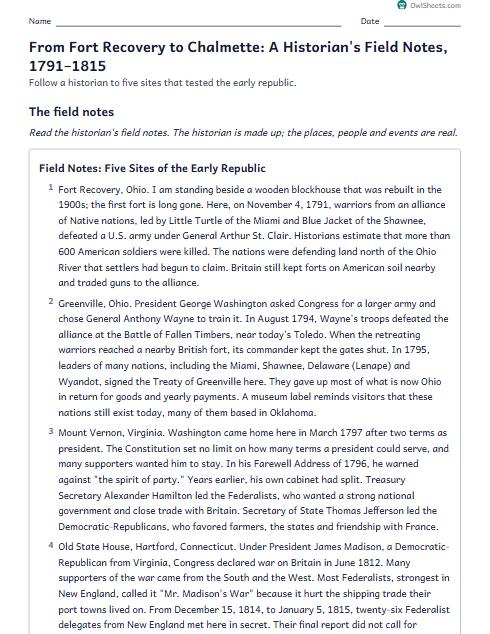
From Fort Recovery to Chalmette: A Historian's Field Notes, 1791–1815
Grade 8 · HIS.8.2
13 questionsPremium
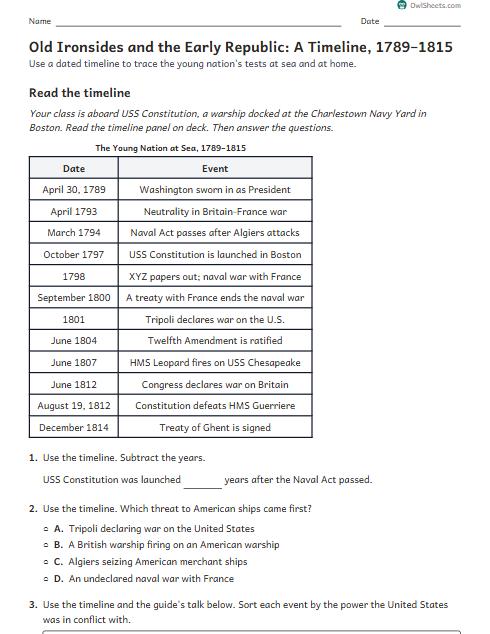
Old Ironsides and the Early Republic: A Timeline, 1789–1815
Grade 8 · HIS.8.2
11 questionsPremium
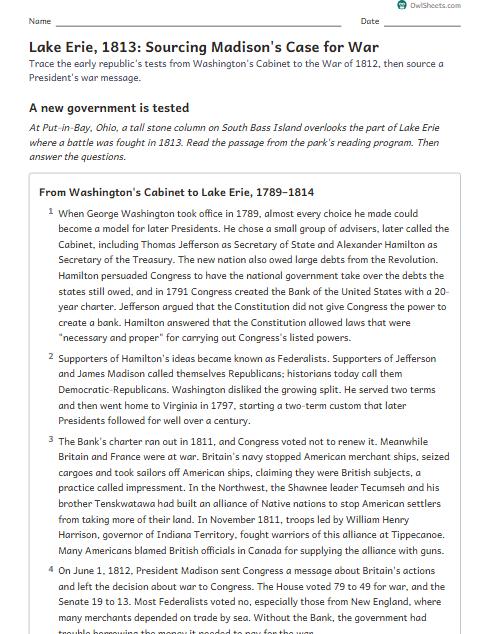
Lake Erie, 1813: Sourcing Madison's Case for War
Grade 8 · HIS.8.2
12 questionsPremium