Grade 8 · Social StudiesHIS.8.2Premium
Up the Hudson to Plattsburgh: A Route Map of the Early Republic
Grade 8 history: a described New York route map from Federal Hall to Plattsburgh traces Washington's presidency, the first parties and the War of 1812.
Preview
OwlSheets.com
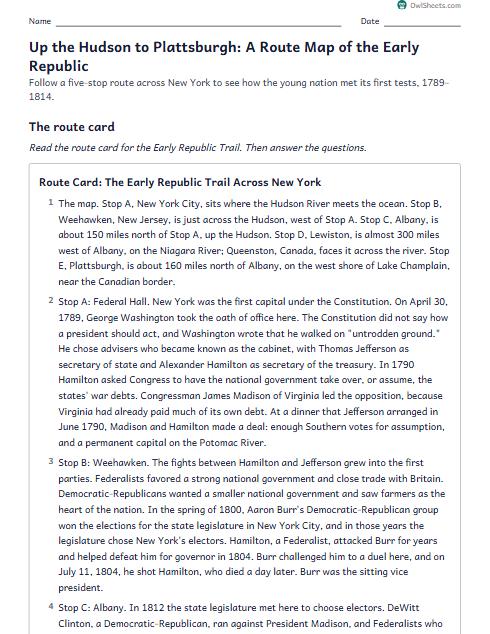
Up the Hudson to Plattsburgh: A Route Map of the Early Republic
Follow a five-stop route across New York to see how the young nation met its first tests, 1789–1814.
The route card
Read the route card for the Early Republic Trail. Then answer the questions.
Route Card: The Early Republic Trail Across New York
1The map. Stop A, New York City, sits where the Hudson River meets the ocean. Stop B, Weehawken, New Jersey, is just across the Hudson, west of Stop A. Stop C, Albany, is about 150 miles north of Stop A, up the Hudson. Stop D, Lewiston, is almost 300 miles west of Albany, on the Niagara River; Queenston, Canada, faces it across the river. Stop E, Plattsburgh, is about 160 miles north of Albany, on the west shore of Lake Champlain, near the Canadian border.
2Stop A: Federal Hall. New York was the first capital under the Constitution. On April 30, 1789, George Washington took the oath of office here. The Constitution did not say how a president should act, and Washington wrote that he walked on "untrodden ground." He chose advisers who became known as the cabinet, with Thomas Jefferson as secretary of state and Alexander Hamilton as secretary of the treasury. In 1790 Hamilton asked Congress to have the national government take over, or assume, the states' war debts. Congressman James Madison of Virginia led the opposition, because Virginia had already paid much of its own debt. At a dinner that Jefferson arranged in June 1790, Madison and Hamilton made a deal: enough Southern votes for assumption, and a permanent capital on the Potomac River.
3Stop B: Weehawken. The fights between Hamilton and Jefferson grew into the first parties. Federalists favored a strong national government and close trade with Britain. Democratic-Republicans wanted a smaller national government and saw farmers as the heart of the nation. In the spring of 1800, Aaron Burr's Democratic-Republican group won the elections for the state legislature in New York City, and in those years the legislature chose New York's electors. Hamilton, a Federalist, attacked Burr for years and helped defeat him for governor in 1804. Burr challenged him to a duel here, and on July 11, 1804, he shot Hamilton, who died a day later. Burr was the sitting vice president.
4Stop C: Albany. In 1812 the state legislature met here to choose electors. DeWitt Clinton, a Democratic-Republican, ran against President Madison, and Federalists who opposed the war with Britain backed Clinton. Madison won the national count, 128 to 89.
5Stop D: Lewiston. Congress declared war on Britain in June 1812, and many Americans expected to conquer Canada quickly. On October 13, American troops crossed the river and attacked Queenston Heights. Hundreds of New York militia stayed on the American bank, saying militia could not be ordered to fight outside the country. The troops across the river were defeated, and hundreds were captured.
6Stop E: Plattsburgh. In 1807, Jefferson's Embargo Act had stopped American ships from carrying goods to foreign ports. Many local farmers kept sending potash and lumber across Lake Champlain to Canada. In 1808 Jefferson declared the area in insurrection and sent soldiers to stop the trade. In September 1814, a British army of about 10,000 marched south toward Plattsburgh. On September 11, Thomas Macdonough's small fleet defeated the British ships in the bay, and the army returned to Canada. When the news reached the peace talks in Ghent, British negotiators soon dropped their demand to keep land their armies held. The treaty, signed December 24, 1814, restored the old borders and said nothing about the seizing of sailors.
| Election | Votes went to | Party | NY electoral votes |
|---|---|---|---|
| 1796 | John Adams | Federalist | 12 |
| 1800 | Thomas Jefferson | Democratic-Republican | 12 |
| 1804 | Thomas Jefferson | Democratic-Republican | 19 |
| 1812 | DeWitt Clinton | Dem.-Rep., Federalist support | 29 |
- A. Southeast
- B. Southwest
- C. Northwest
- D. Northeast
The preview shows the first questions. Unlock the worksheet to see all of it.
Related worksheets
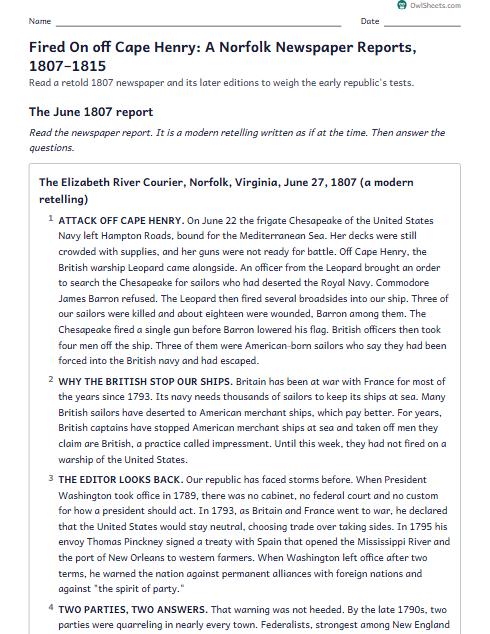
Fired On off Cape Henry: A Norfolk Newspaper Reports, 1807–1815
Grade 8 · HIS.8.2
14 questionsPremium
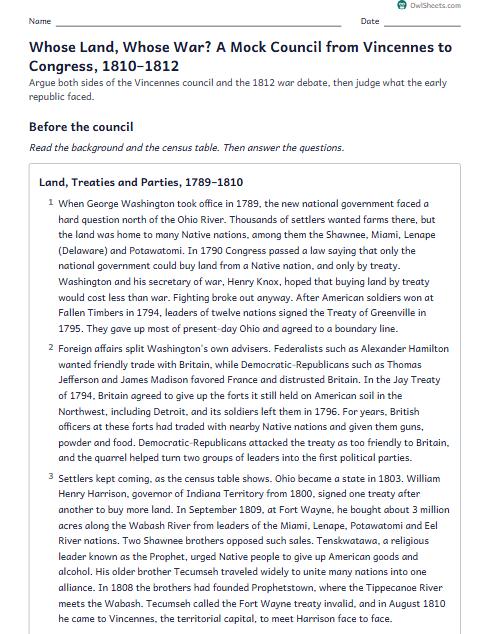
Whose Land, Whose War? A Mock Council from Vincennes to Congress, 1810–1812
Grade 8 · HIS.8.2
15 questionsPremium
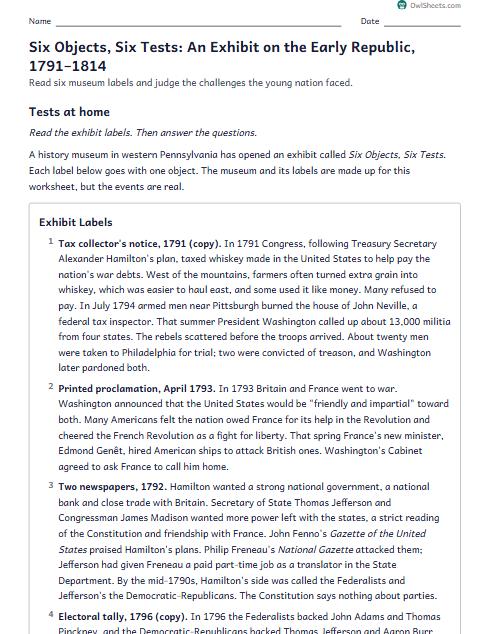
Six Objects, Six Tests: An Exhibit on the Early Republic, 1791–1814
Grade 8 · HIS.8.2
14 questionsPremium
From Fort Recovery to Chalmette: A Historian's Field Notes, 1791–1815
Grade 8 · HIS.8.2
13 questionsPremium
Old Ironsides and the Early Republic: A Timeline, 1789–1815
Grade 8 · HIS.8.2
11 questionsPremium
Lake Erie, 1813: Sourcing Madison's Case for War
Grade 8 · HIS.8.2
12 questionsPremium