Grade 8 · Social StudiesHIS.8.2Premium
From Fort Recovery to Chalmette: A Historian's Field Notes, 1791–1815
Grade 8 early republic: field notes on the Northwest war, Washington's two terms, the first parties, the Hartford Convention and the Battle of New Orleans.
Preview
OwlSheets.com
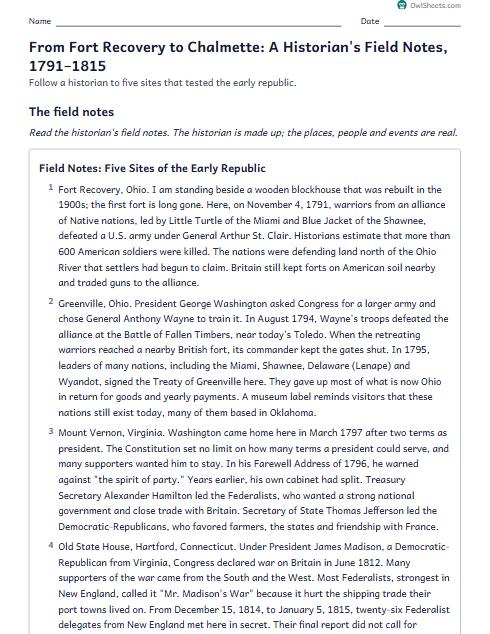
From Fort Recovery to Chalmette: A Historian's Field Notes, 1791–1815
Follow a historian to five sites that tested the early republic.
The field notes
Read the historian's field notes. The historian is made up; the places, people and events are real.
Field Notes: Five Sites of the Early Republic
1Fort Recovery, Ohio. I am standing beside a wooden blockhouse that was rebuilt in the 1900s; the first fort is long gone. Here, on November 4, 1791, warriors from an alliance of Native nations, led by Little Turtle of the Miami and Blue Jacket of the Shawnee, defeated a U.S. army under General Arthur St. Clair. Historians estimate that more than 600 American soldiers were killed. The nations were defending land north of the Ohio River that settlers had begun to claim. Britain still kept forts on American soil nearby and traded guns to the alliance.
2Greenville, Ohio. President George Washington asked Congress for a larger army and chose General Anthony Wayne to train it. In August 1794, Wayne's troops defeated the alliance at the Battle of Fallen Timbers, near today's Toledo. When the retreating warriors reached a nearby British fort, its commander kept the gates shut. In 1795, leaders of many nations, including the Miami, Shawnee, Delaware (Lenape) and Wyandot, signed the Treaty of Greenville here. They gave up most of what is now Ohio in return for goods and yearly payments. A museum label reminds visitors that these nations still exist today, many of them based in Oklahoma.
3Mount Vernon, Virginia. Washington came home here in March 1797 after two terms as president. The Constitution set no limit on how many terms a president could serve, and many supporters wanted him to stay. In his Farewell Address of 1796, he warned against "the spirit of party." Years earlier, his own cabinet had split. Treasury Secretary Alexander Hamilton led the Federalists, who wanted a strong national government and close trade with Britain. Secretary of State Thomas Jefferson led the Democratic-Republicans, who favored farmers, the states and friendship with France.
4Old State House, Hartford, Connecticut. Under President James Madison, a Democratic-Republican from Virginia, Congress declared war on Britain in June 1812. Many supporters of the war came from the South and the West. Most Federalists, strongest in New England, called it "Mr. Madison's War" because it hurt the shipping trade their port towns lived on. From December 15, 1814, to January 5, 1815, twenty-six Federalist delegates from New England met here in secret. Their final report did not call for leaving the Union. It proposed amendments: a two-thirds vote of Congress to declare war or to limit trade with other nations, an end to counting three-fifths of enslaved people when dividing seats in the House, and no two presidents in a row from the same state. Virginians had held the presidency for all but four years since 1789.
5Chalmette Battlefield, Louisiana. On December 24, 1814, American and British diplomats in Europe signed the Treaty of Ghent, which ended the war and changed no borders. News crossed the ocean by ship and took weeks. On January 8, 1815, British troops attacked General Andrew Jackson's lines here, just below New Orleans. Jackson's army of regular soldiers, frontier militia, free Black soldiers from New Orleans, Choctaw warriors and local sailors drove them back. Historians estimate the British lost about 2,000 men killed, wounded or captured, and the Americans fewer than 100. When the Hartford delegates reached Washington, D.C., in February, the city was celebrating news of both New Orleans and the peace treaty.
- A. Native nations, armed with British guns, resisted U.S. claims to their land.
- B. The states refused to let Congress raise a larger army for the frontier.
- C. France sent an army to take back land it had lost in an earlier war.
- D. Settlers refused to move west until Congress sold them land more cheaply.
- A. Wayne's army had already captured the British fort and closed it to them.
- B. Britain and the United States had become allies against the Native nations.
- C. It could not count on Britain to fight beside it against the United States.
- D. Britain had already handed its Northwest forts over to the United States.
The preview shows the first questions. Unlock the worksheet to see all of it.
Related worksheets
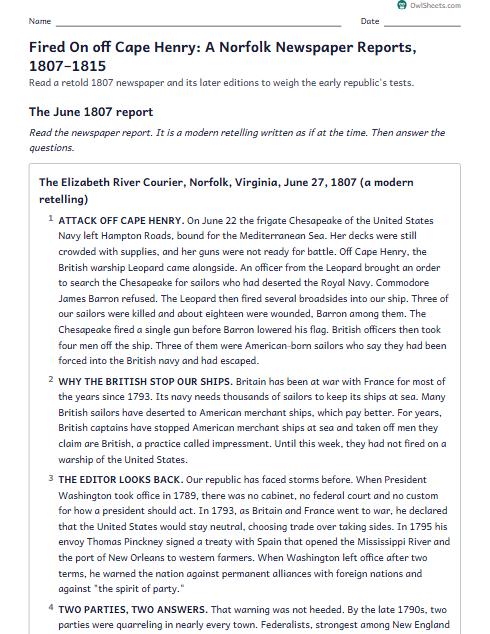
Fired On off Cape Henry: A Norfolk Newspaper Reports, 1807–1815
Grade 8 · HIS.8.2
14 questionsPremium
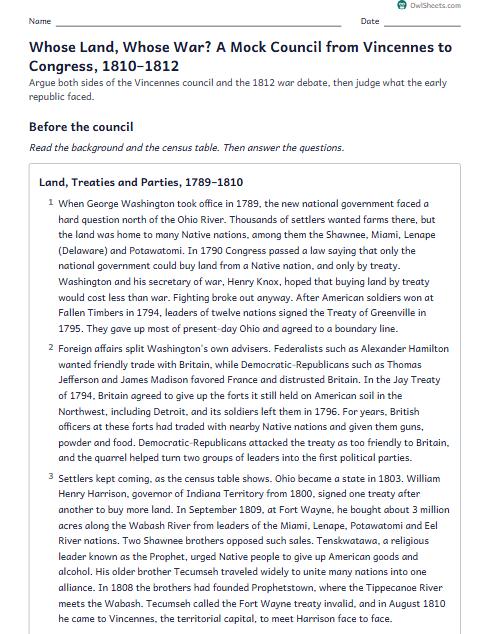
Whose Land, Whose War? A Mock Council from Vincennes to Congress, 1810–1812
Grade 8 · HIS.8.2
15 questionsPremium
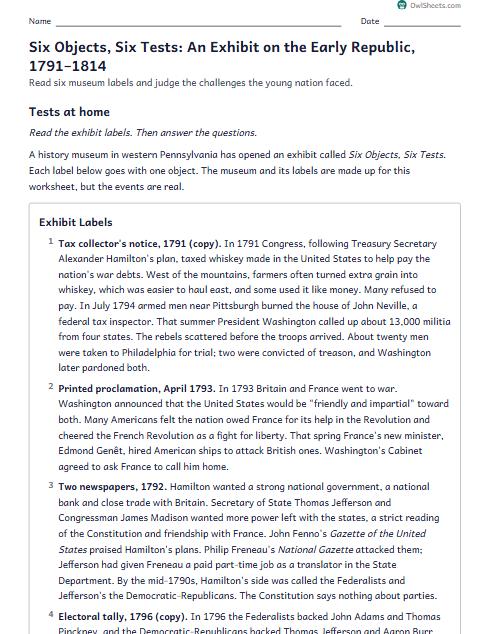
Six Objects, Six Tests: An Exhibit on the Early Republic, 1791–1814
Grade 8 · HIS.8.2
14 questionsPremium
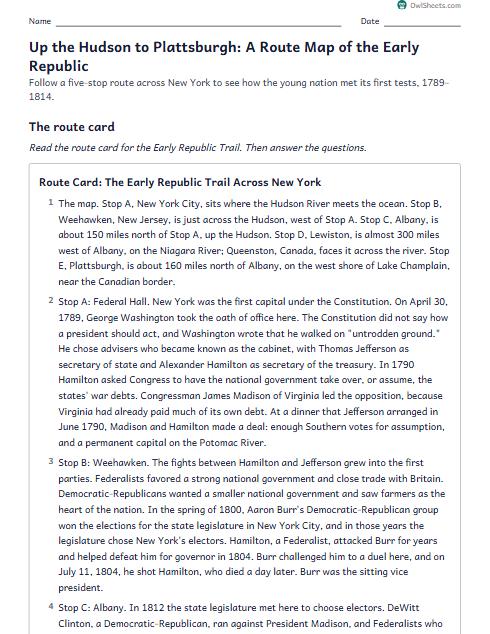
Up the Hudson to Plattsburgh: A Route Map of the Early Republic
Grade 8 · HIS.8.2
14 questionsPremium
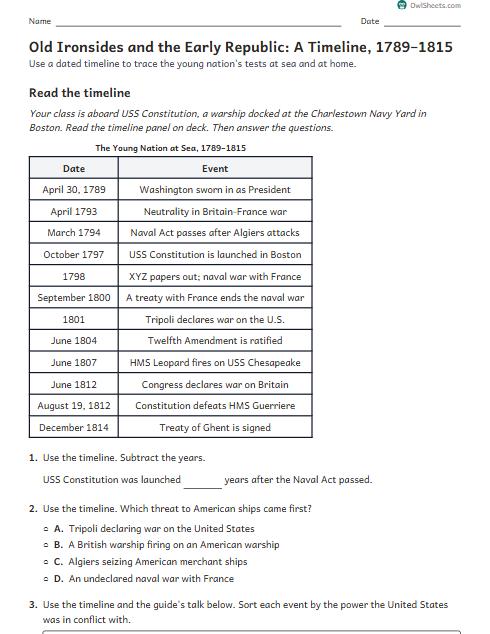
Old Ironsides and the Early Republic: A Timeline, 1789–1815
Grade 8 · HIS.8.2
11 questionsPremium
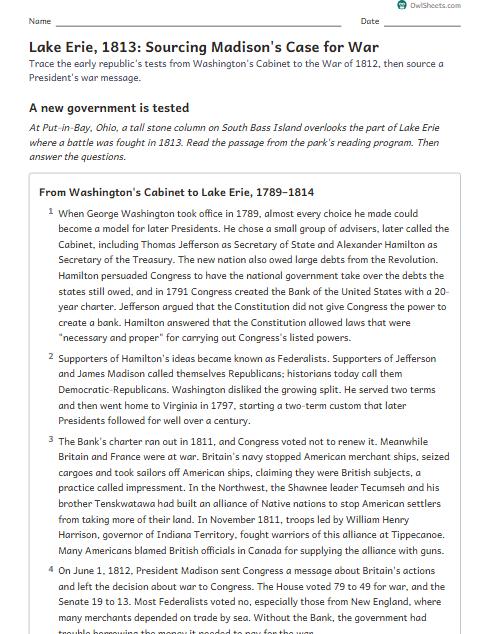
Lake Erie, 1813: Sourcing Madison's Case for War
Grade 8 · HIS.8.2
12 questionsPremium