Grade 8 · Social StudiesHIS.8.2Premium
Fired On off Cape Henry: A Norfolk Newspaper Reports, 1807–1815
Grade 8 early republic: a retold Norfolk newspaper on the 1807 Chesapeake attack links Washington's choices, the first parties and the War of 1812.
Preview
OwlSheets.com
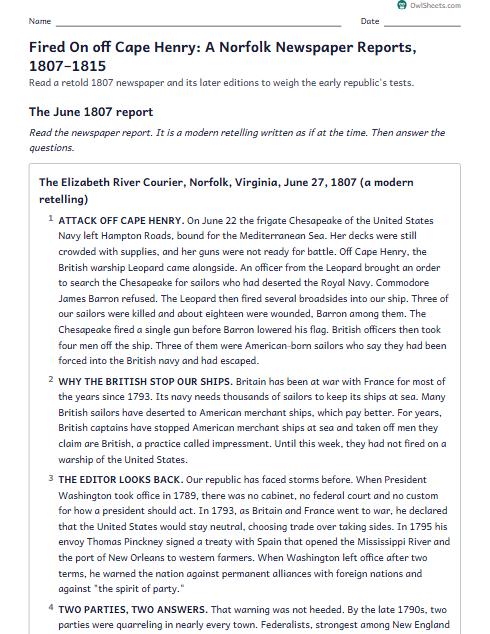
Fired On off Cape Henry: A Norfolk Newspaper Reports, 1807–1815
Read a retold 1807 newspaper and its later editions to weigh the early republic's tests.
The June 1807 report
Read the newspaper report. It is a modern retelling written as if at the time. Then answer the questions.
The Elizabeth River Courier, Norfolk, Virginia, June 27, 1807 (a modern retelling)
1ATTACK OFF CAPE HENRY. On June 22 the frigate Chesapeake of the United States Navy left Hampton Roads, bound for the Mediterranean Sea. Her decks were still crowded with supplies, and her guns were not ready for battle. Off Cape Henry, the British warship Leopard came alongside. An officer from the Leopard brought an order to search the Chesapeake for sailors who had deserted the Royal Navy. Commodore James Barron refused. The Leopard then fired several broadsides into our ship. Three of our sailors were killed and about eighteen were wounded, Barron among them. The Chesapeake fired a single gun before Barron lowered his flag. British officers then took four men off the ship. Three of them were American-born sailors who say they had been forced into the British navy and had escaped.
2WHY THE BRITISH STOP OUR SHIPS. Britain has been at war with France for most of the years since 1793. Its navy needs thousands of sailors to keep its ships at sea. Many British sailors have deserted to American merchant ships, which pay better. For years, British captains have stopped American merchant ships at sea and taken off men they claim are British, a practice called impressment. Until this week, they had not fired on a warship of the United States.
3THE EDITOR LOOKS BACK. Our republic has faced storms before. When President Washington took office in 1789, there was no cabinet, no federal court and no custom for how a president should act. In 1793, as Britain and France went to war, he declared that the United States would stay neutral, choosing trade over taking sides. In 1795 his envoy Thomas Pinckney signed a treaty with Spain that opened the Mississippi River and the port of New Orleans to western farmers. When Washington left office after two terms, he warned the nation against permanent alliances with foreign nations and against "the spirit of party."
4TWO PARTIES, TWO ANSWERS. That warning was not heeded. By the late 1790s, two parties were quarreling in nearly every town. Federalists, strongest among New England merchants and shipowners, wanted friendly trade with Britain and a strong national government. Democratic-Republicans, the party of President Jefferson, were strongest among Southern and Western farmers. They distrusted Britain and had long favored France. This week both parties are angry, but they do not agree on what to do.
5THIS WEEK IN NORFOLK. Town meetings here and in Hampton have voted to stop selling food and water to the British warships anchored off our coast. Many people in the streets demand war. Others ask whether a nation with so few warships can afford one. The choice now rests with President Jefferson and Congress.
- A. It treated a ship of the national government as if Britain could search it at will.
- B. It was the first time a British captain had taken a sailor off an American ship.
- C. It took place inside a harbor that Washington had closed to British warships in 1793.
- D. It showed that Britain had joined France in a war against the United States.
Britain has been at war with France for most of the years since 1793.Its navy needs thousands of sailors to keep its ships at sea.Many British sailors have deserted to American merchant ships, which pay better.For years, British captains have stopped American merchant ships at sea and taken off men they claim are British, a practice called impressment.Until this week, they had not fired on a warship of the United States.
The preview shows the first questions. Unlock the worksheet to see all of it.
Related worksheets
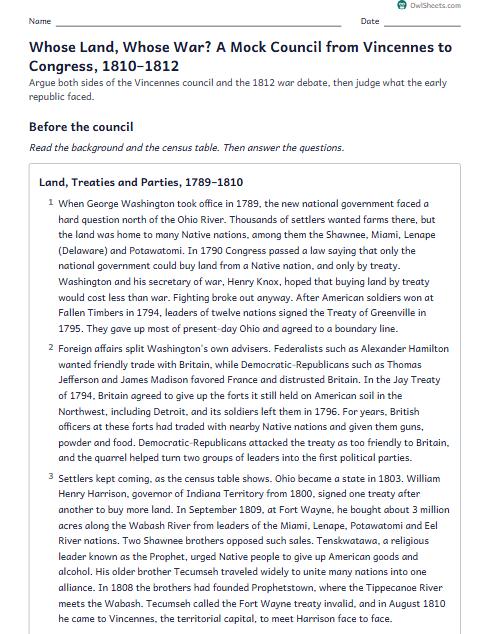
Whose Land, Whose War? A Mock Council from Vincennes to Congress, 1810–1812
Grade 8 · HIS.8.2
15 questionsPremium
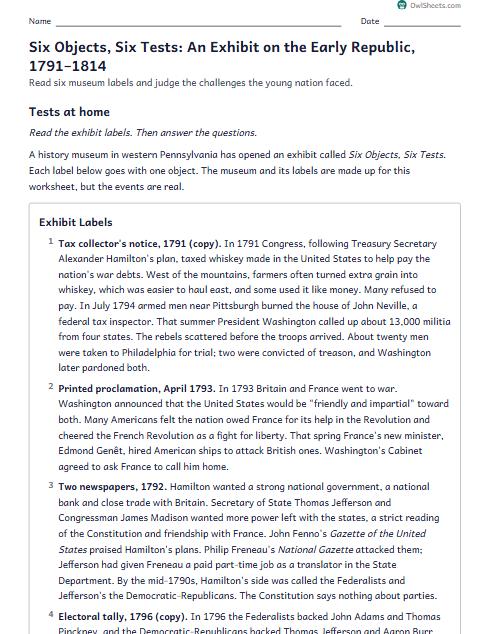
Six Objects, Six Tests: An Exhibit on the Early Republic, 1791–1814
Grade 8 · HIS.8.2
14 questionsPremium
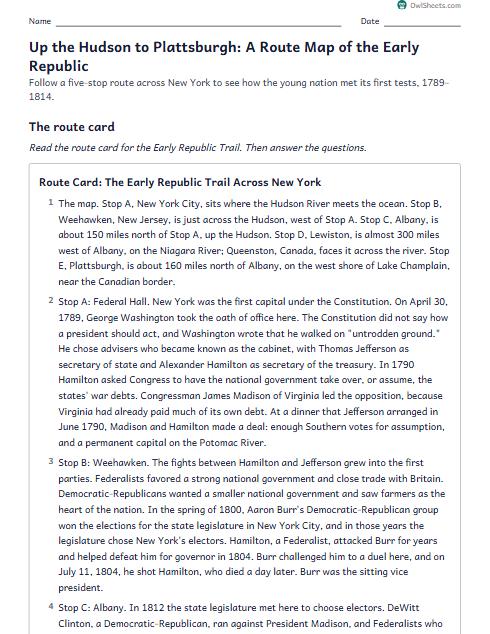
Up the Hudson to Plattsburgh: A Route Map of the Early Republic
Grade 8 · HIS.8.2
14 questionsPremium
From Fort Recovery to Chalmette: A Historian's Field Notes, 1791–1815
Grade 8 · HIS.8.2
13 questionsPremium
Old Ironsides and the Early Republic: A Timeline, 1789–1815
Grade 8 · HIS.8.2
11 questionsPremium
Lake Erie, 1813: Sourcing Madison's Case for War
Grade 8 · HIS.8.2
12 questionsPremium