Grade 8 · Social StudiesHIS.8.2Premium
Whose Land, Whose War? A Mock Council from Vincennes to Congress, 1810–1812
Grade 8 early republic: a mock debate pits Tecumseh against Harrison in 1810 and War Hawks against Federalists in 1812, with census data.
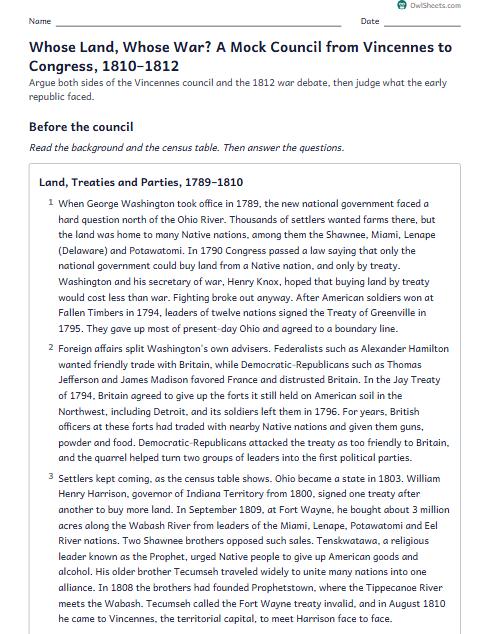
Preview
OwlSheets.com
Whose Land, Whose War? A Mock Council from Vincennes to Congress, 1810–1812
Argue both sides of the Vincennes council and the 1812 war debate, then judge what the early republic faced.
Before the council
Read the background and the census table. Then answer the questions.
Land, Treaties and Parties, 1789–1810
1When George Washington took office in 1789, the new national government faced a hard question north of the Ohio River. Thousands of settlers wanted farms there, but the land was home to many Native nations, among them the Shawnee, Miami, Lenape (Delaware) and Potawatomi. In 1790 Congress passed a law saying that only the national government could buy land from a Native nation, and only by treaty. Washington and his secretary of war, Henry Knox, hoped that buying land by treaty would cost less than war. Fighting broke out anyway. After American soldiers won at Fallen Timbers in 1794, leaders of twelve nations signed the Treaty of Greenville in 1795. They gave up most of present-day Ohio and agreed to a boundary line.
2Foreign affairs split Washington's own advisers. Federalists such as Alexander Hamilton wanted friendly trade with Britain, while Democratic-Republicans such as Thomas Jefferson and James Madison favored France and distrusted Britain. In the Jay Treaty of 1794, Britain agreed to give up the forts it still held on American soil in the Northwest, including Detroit, and its soldiers left them in 1796. For years, British officers at these forts had traded with nearby Native nations and given them guns, powder and food. Democratic-Republicans attacked the treaty as too friendly to Britain, and the quarrel helped turn two groups of leaders into the first political parties.
3Settlers kept coming, as the census table shows. Ohio became a state in 1803. William Henry Harrison, governor of Indiana Territory from 1800, signed one treaty after another to buy more land. In September 1809, at Fort Wayne, he bought about 3 million acres along the Wabash River from leaders of the Miami, Lenape, Potawatomi and Eel River nations. Two Shawnee brothers opposed such sales. Tenskwatawa, a religious leader known as the Prophet, urged Native people to give up American goods and alcohol. His older brother Tecumseh traveled widely to unite many nations into one alliance. In 1808 the brothers had founded Prophetstown, where the Tippecanoe River meets the Wabash. Tecumseh called the Fort Wayne treaty invalid, and in August 1810 he came to Vincennes, the territorial capital, to meet Harrison face to face.
| Year | Ohio | Indiana |
|---|---|---|
| 1800 | 45,365 | 2,632 |
| 1810 | 230,760 | 24,520 |
| 1820 | 581,434 | 147,178 |
- A. As not valid, because it was not a national treaty
- B. As valid, because the Shawnee town had agreed to the price
- C. As not valid, because Native nations could not own land
- D. As valid, once Kentucky's own lawmakers had approved it
The preview shows the first questions. Unlock the worksheet to see all of it.
Related worksheets
Fired On off Cape Henry: A Norfolk Newspaper Reports, 1807–1815
Grade 8 · HIS.8.2
14 questionsPremium
Six Objects, Six Tests: An Exhibit on the Early Republic, 1791–1814
Grade 8 · HIS.8.2
14 questionsPremium
Up the Hudson to Plattsburgh: A Route Map of the Early Republic
Grade 8 · HIS.8.2
14 questionsPremium
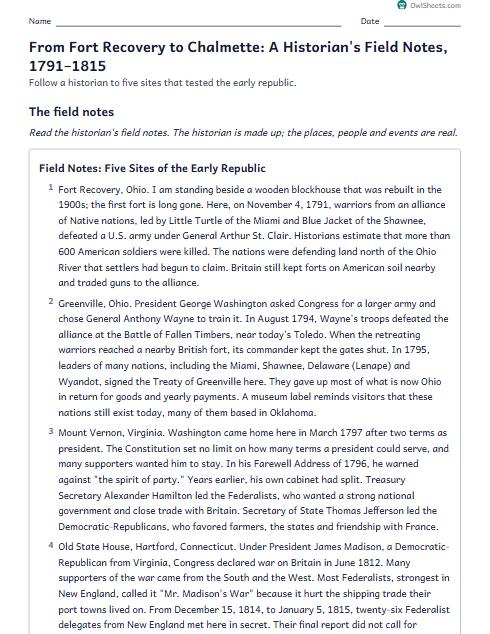
From Fort Recovery to Chalmette: A Historian's Field Notes, 1791–1815
Grade 8 · HIS.8.2
13 questionsPremium
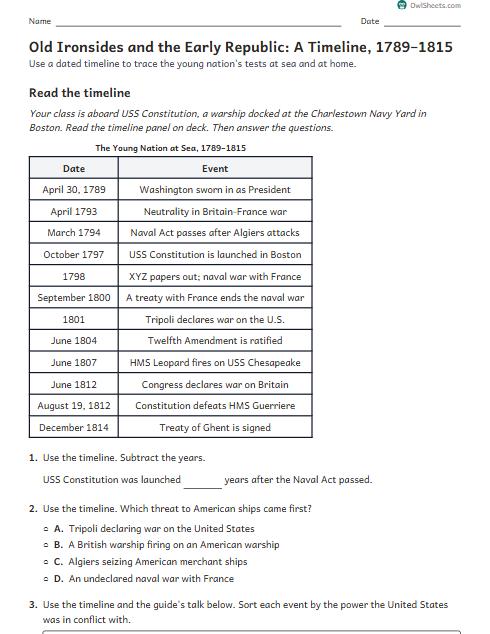
Old Ironsides and the Early Republic: A Timeline, 1789–1815
Grade 8 · HIS.8.2
11 questionsPremium
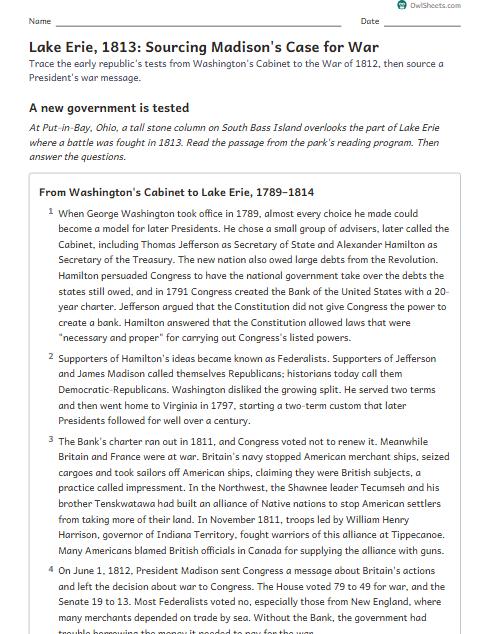
Lake Erie, 1813: Sourcing Madison's Case for War
Grade 8 · HIS.8.2
12 questionsPremium