Grade 8 · Social StudiesCIV.8.1Premium
Vetoes, Overrides and Rulings: Checks by the Numbers, 1789–1877
Grade 8 civics: real veto and override counts from Washington to Grant and four landmark rulings show federalism, separation of powers and checks and balances.
Preview
OwlSheets.com
Vetoes, Overrides and Rulings: Checks by the Numbers, 1789–1877
Use real veto counts and landmark rulings to see how the branches and the states limit one another.
How the checks work
Read the passage. Then answer the questions.
Counting the Checks
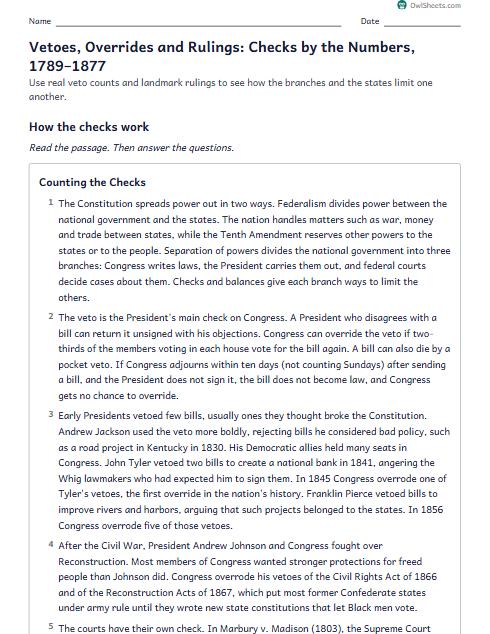
1The Constitution spreads power out in two ways. Federalism divides power between the national government and the states. The nation handles matters such as war, money and trade between states, while the Tenth Amendment reserves other powers to the states or to the people. Separation of powers divides the national government into three branches: Congress writes laws, the President carries them out, and federal courts decide cases about them. Checks and balances give each branch ways to limit the others.
2The veto is the President's main check on Congress. A President who disagrees with a bill can return it unsigned with his objections. Congress can override the veto if two-thirds of the members voting in each house vote for the bill again. A bill can also die by a pocket veto. If Congress adjourns within ten days (not counting Sundays) after sending a bill, and the President does not sign it, the bill does not become law, and Congress gets no chance to override.
3Early Presidents vetoed few bills, usually ones they thought broke the Constitution. Andrew Jackson used the veto more boldly, rejecting bills he considered bad policy, such as a road project in Kentucky in 1830. His Democratic allies held many seats in Congress. John Tyler vetoed two bills to create a national bank in 1841, angering the Whig lawmakers who had expected him to sign them. In 1845 Congress overrode one of Tyler's vetoes, the first override in the nation's history. Franklin Pierce vetoed bills to improve rivers and harbors, arguing that such projects belonged to the states. In 1856 Congress overrode five of those vetoes.
4After the Civil War, President Andrew Johnson and Congress fought over Reconstruction. Most members of Congress wanted stronger protections for freed people than Johnson did. Congress overrode his vetoes of the Civil Rights Act of 1866 and of the Reconstruction Acts of 1867, which put most former Confederate states under army rule until they wrote new state constitutions that let Black men vote.
5The courts have their own check. In Marbury v. Madison (1803), the Supreme Court struck down part of a law passed by Congress because it broke the Constitution, a power called judicial review. The Court has also settled conflicts between the nation and the states. But the other branches limit the courts, too. The President nominates federal judges, and the Senate can reject them, as it rejected John Rutledge for Chief Justice in 1795. When Congress and the states disagree with a ruling, they can amend the Constitution. The Fourteenth Amendment (1868) overturned the part of the Dred Scott ruling that said Black Americans could not be citizens.
- A. The bill becomes law, because the House reached two-thirds.
- B. The bill becomes law, because a majority of each house voted yes.
- C. The veto goes to the Supreme Court, because the houses disagreed.
- D. The veto stands, because the Senate fell short of two-thirds.
Andrew Jackson used the veto more boldly, rejecting bills he considered bad policy, such as a road project in Kentucky in 1830.John Tyler vetoed two bills to create a national bank in 1841, angering the Whig lawmakers who had expected him to sign them.Franklin Pierce vetoed bills to improve rivers and harbors, arguing that such projects belonged to the states.In 1856 Congress overrode five of those vetoes.
The preview shows the first questions. Unlock the worksheet to see all of it.
Related worksheets
Seven, Ten, Nine: A Timeline of the Court's Size, 1863–1871
Grade 8 · CIV.8.1
14 questionsPremium
Who Commands the Militia? A Mock Hartford Convention
Grade 8 · CIV.8.1
14 questionsPremium
Who May Suspend the Writ? Taney, Lincoln and John Merryman, 1861
Grade 8 · CIV.8.1
14 questionsPremium
Who Judges the Law? Kentucky and Massachusetts on the Sedition Act
Grade 8 · CIV.8.1
15 questionsPremium
Tariffs, Treaties and a Bank: A Historian's Notes on 1832–1834
Grade 8 · CIV.8.1
11 questionsPremium
One Block, Three Branches: A Walk Through the 1790s Capital
Grade 8 · CIV.8.1
11 questionsPremium