Grade 8 · Social StudiesCIV.8.1Premium
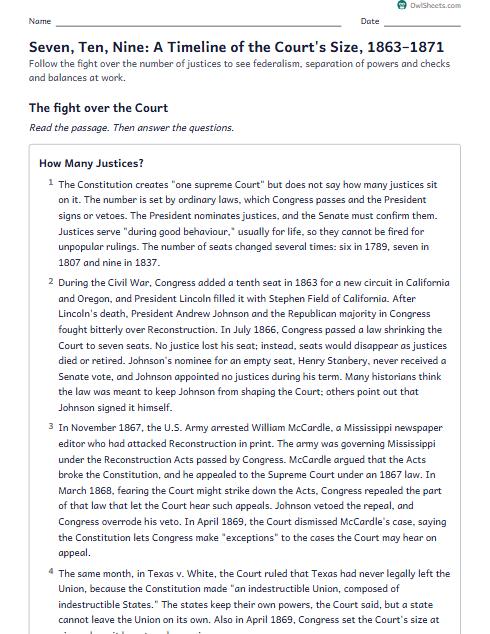
Seven, Ten, Nine: A Timeline of the Court's Size, 1863–1871
Grade 8 civics: a timeline of Court seats, Ex parte McCardle, Texas v. White and the legal tender cases shows how branches and states limit each other.
Preview
OwlSheets.com
Seven, Ten, Nine: A Timeline of the Court's Size, 1863–1871
Follow the fight over the number of justices to see federalism, separation of powers and checks and balances at work.
The fight over the Court
Read the passage. Then answer the questions.
How Many Justices?
1The Constitution creates "one supreme Court" but does not say how many justices sit on it. The number is set by ordinary laws, which Congress passes and the President signs or vetoes. The President nominates justices, and the Senate must confirm them. Justices serve "during good behaviour," usually for life, so they cannot be fired for unpopular rulings. The number of seats changed several times: six in 1789, seven in 1807 and nine in 1837.
2During the Civil War, Congress added a tenth seat in 1863 for a new circuit in California and Oregon, and President Lincoln filled it with Stephen Field of California. After Lincoln's death, President Andrew Johnson and the Republican majority in Congress fought bitterly over Reconstruction. In July 1866, Congress passed a law shrinking the Court to seven seats. No justice lost his seat; instead, seats would disappear as justices died or retired. Johnson's nominee for an empty seat, Henry Stanbery, never received a Senate vote, and Johnson appointed no justices during his term. Many historians think the law was meant to keep Johnson from shaping the Court; others point out that Johnson signed it himself.
3In November 1867, the U.S. Army arrested William McCardle, a Mississippi newspaper editor who had attacked Reconstruction in print. The army was governing Mississippi under the Reconstruction Acts passed by Congress. McCardle argued that the Acts broke the Constitution, and he appealed to the Supreme Court under an 1867 law. In March 1868, fearing the Court might strike down the Acts, Congress repealed the part of that law that let the Court hear such appeals. Johnson vetoed the repeal, and Congress overrode his veto. In April 1869, the Court dismissed McCardle's case, saying the Constitution lets Congress make "exceptions" to the cases the Court may hear on appeal.
4The same month, in Texas v. White, the Court ruled that Texas had never legally left the Union, because the Constitution made "an indestructible Union, composed of indestructible States." The states keep their own powers, the Court said, but a state cannot leave the Union on its own. Also in April 1869, Congress set the Court's size at nine, where it has stayed ever since.
5With seats to fill, President Ulysses S. Grant nominated his attorney general, Ebenezer Hoar, but the Senate rejected him in February 1870, 24 votes to 33. Historians say some senators were angry that Hoar had opposed their choices for federal judges. On February 7, 1870, the Court ruled 4 to 3 in Hepburn v. Griswold that the Legal Tender Act of 1862, which made paper "greenbacks" lawful money for paying debts, could not be applied to debts made before the Act. That same day, Grant nominated William Strong and Joseph Bradley, and the Senate confirmed both. In May 1871, in Knox v. Lee, the Court voted 5 to 4 to uphold the Act, overruling Hepburn. Both new justices voted with the majority.
- A. The Constitution creates the Court but leaves its size to ordinary laws.
- B. The Constitution lets the President change the Court's size by order.
- C. The Constitution sets nine seats but lets Congress add more in wartime.
- D. The Constitution lets the Court decide its own size at each new term.
- A. The President's, since he would have fewer seats on the Court to fill
- B. The justices', since the law removed several of them from the bench
- C. The Senate's, since it could no longer vote on any court nominee
- D. The states', since they could no longer send judges to the Court
The preview shows the first questions. Unlock the worksheet to see all of it.
Related worksheets
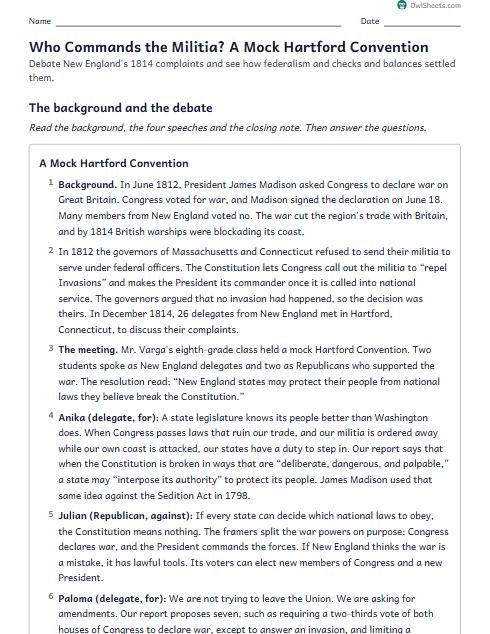
Who Commands the Militia? A Mock Hartford Convention
Grade 8 · CIV.8.1
14 questionsPremium
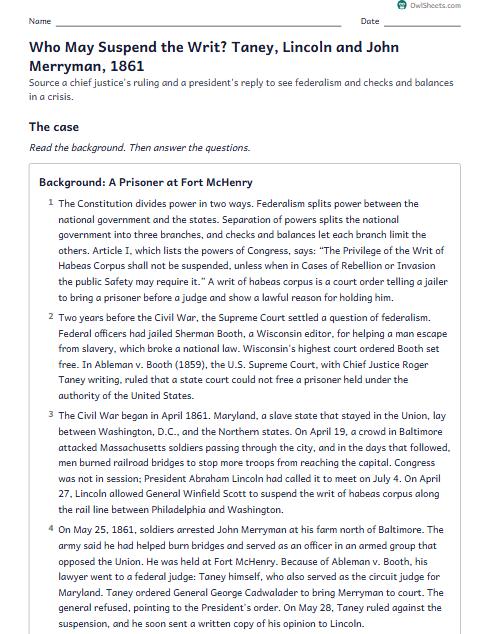
Who May Suspend the Writ? Taney, Lincoln and John Merryman, 1861
Grade 8 · CIV.8.1
14 questionsPremium
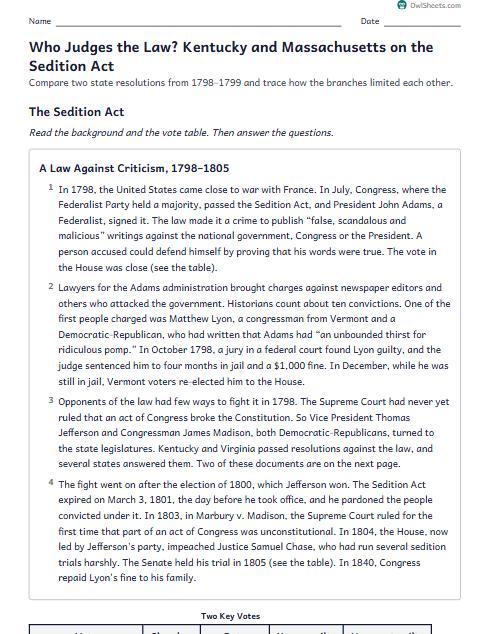
Who Judges the Law? Kentucky and Massachusetts on the Sedition Act
Grade 8 · CIV.8.1
15 questionsPremium
Vetoes, Overrides and Rulings: Checks by the Numbers, 1789–1877
Grade 8 · CIV.8.1
13 questionsPremium
Tariffs, Treaties and a Bank: A Historian's Notes on 1832–1834
Grade 8 · CIV.8.1
11 questionsPremium
One Block, Three Branches: A Walk Through the 1790s Capital
Grade 8 · CIV.8.1
11 questionsPremium