Grade 8 · Social StudiesCIV.8.1Premium
Who May Suspend the Writ? Taney, Lincoln and John Merryman, 1861
Grade 8 civics: source adapted excerpts from Taney's Merryman ruling and Lincoln's 1861 message to see federalism and checks and balances in a crisis.
Preview
OwlSheets.com
Who May Suspend the Writ? Taney, Lincoln and John Merryman, 1861
Source a chief justice's ruling and a president's reply to see federalism and checks and balances in a crisis.
The case
Read the background. Then answer the questions.
Background: A Prisoner at Fort McHenry
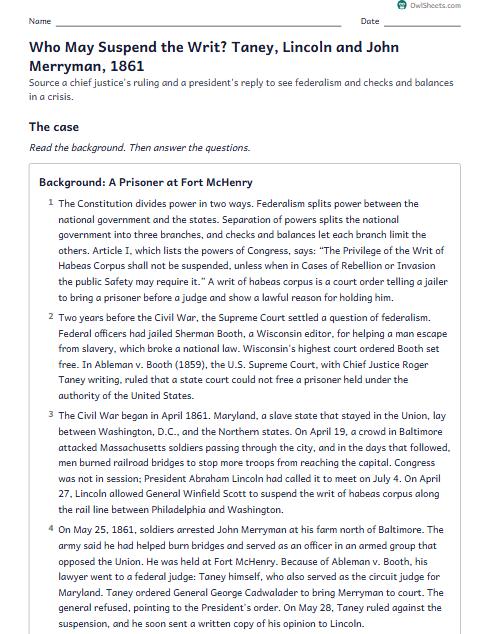
1The Constitution divides power in two ways. Federalism splits power between the national government and the states. Separation of powers splits the national government into three branches, and checks and balances let each branch limit the others. Article I, which lists the powers of Congress, says: “The Privilege of the Writ of Habeas Corpus shall not be suspended, unless when in Cases of Rebellion or Invasion the public Safety may require it.” A writ of habeas corpus is a court order telling a jailer to bring a prisoner before a judge and show a lawful reason for holding him.
2Two years before the Civil War, the Supreme Court settled a question of federalism. Federal officers had jailed Sherman Booth, a Wisconsin editor, for helping a man escape from slavery, which broke a national law. Wisconsin's highest court ordered Booth set free. In Ableman v. Booth (1859), the U.S. Supreme Court, with Chief Justice Roger Taney writing, ruled that a state court could not free a prisoner held under the authority of the United States.
3The Civil War began in April 1861. Maryland, a slave state that stayed in the Union, lay between Washington, D.C., and the Northern states. On April 19, a crowd in Baltimore attacked Massachusetts soldiers passing through the city, and in the days that followed, men burned railroad bridges to stop more troops from reaching the capital. Congress was not in session; President Abraham Lincoln had called it to meet on July 4. On April 27, Lincoln allowed General Winfield Scott to suspend the writ of habeas corpus along the rail line between Philadelphia and Washington.
4On May 25, 1861, soldiers arrested John Merryman at his farm north of Baltimore. The army said he had helped burn bridges and served as an officer in an armed group that opposed the Union. He was held at Fort McHenry. Because of Ableman v. Booth, his lawyer went to a federal judge: Taney himself, who also served as the circuit judge for Maryland. Taney ordered General George Cadwalader to bring Merryman to court. The general refused, pointing to the President's order. On May 28, Taney ruled against the suspension, and he soon sent a written copy of his opinion to Lincoln.
5Lincoln did not obey the ruling. In July 1861, Merryman was released from the fort and charged with treason in a federal court, but he never went on trial. On March 3, 1863, Congress passed a law allowing the President to suspend the writ while the rebellion lasted.
- A. Article I lists the powers of Congress, so the clause seems to point to it.
- B. Article I lists the courts' powers, so the clause seems to point to judges.
- C. Article I lists the states' powers, so the clause seems to point to governors.
- D. Article I lists the President's powers, so the clause seems to point to him.
- A. Maryland had left the Union, so its state courts had closed for the war.
- B. Taney was a Maryland state judge as well as the nation's Chief Justice.
- C. Congress had passed a law sending all wartime cases to Taney's court.
- D. A state court could not free a prisoner held by the national government.
The preview shows the first questions. Unlock the worksheet to see all of it.
Related worksheets
Seven, Ten, Nine: A Timeline of the Court's Size, 1863–1871
Grade 8 · CIV.8.1
14 questionsPremium
Who Commands the Militia? A Mock Hartford Convention
Grade 8 · CIV.8.1
14 questionsPremium
Who Judges the Law? Kentucky and Massachusetts on the Sedition Act
Grade 8 · CIV.8.1
15 questionsPremium
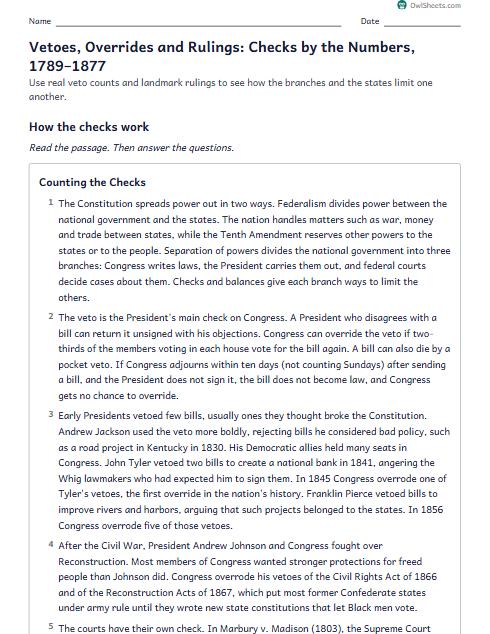
Vetoes, Overrides and Rulings: Checks by the Numbers, 1789–1877
Grade 8 · CIV.8.1
13 questionsPremium
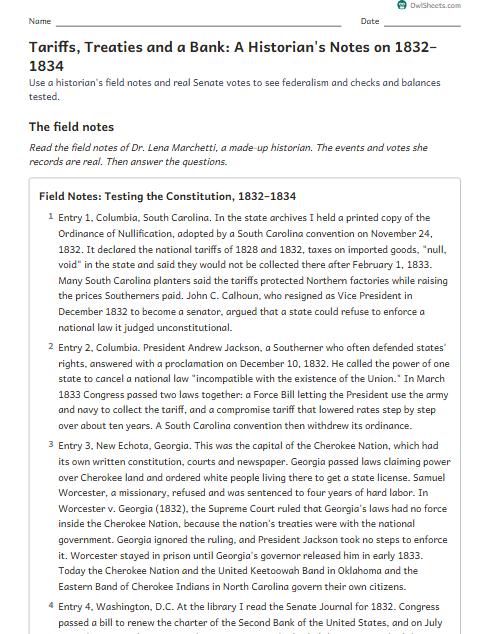
Tariffs, Treaties and a Bank: A Historian's Notes on 1832–1834
Grade 8 · CIV.8.1
11 questionsPremium
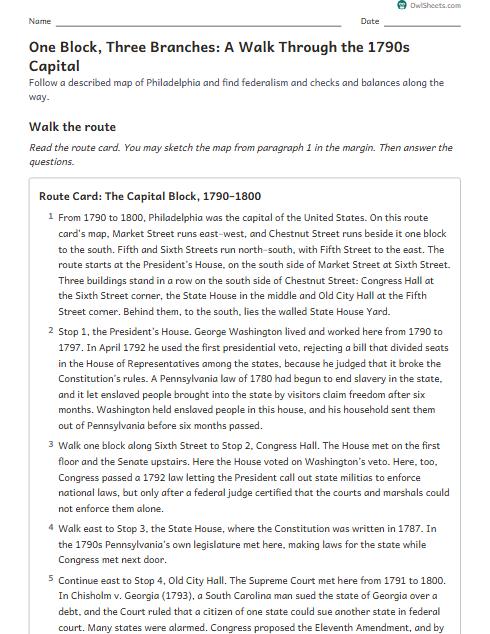
One Block, Three Branches: A Walk Through the 1790s Capital
Grade 8 · CIV.8.1
11 questionsPremium