Grade 8 · Social StudiesCIV.8.1Premium
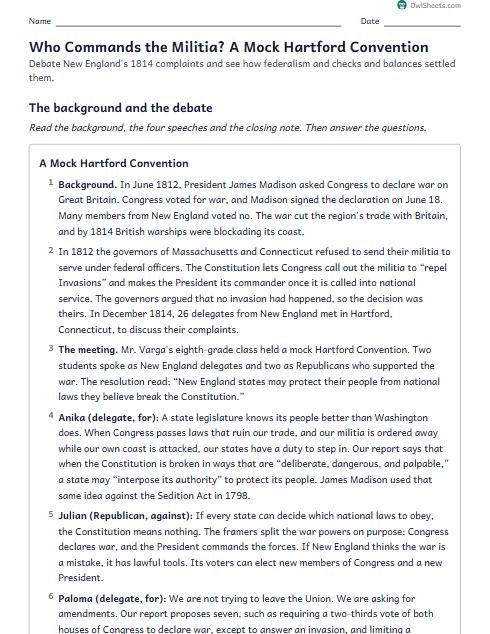
Who Commands the Militia? A Mock Hartford Convention
Grade 8 civics: a class re-creates the 1814 Hartford Convention to debate militia control, war powers and amendments, with real votes from 1812 to 1827.
Preview
OwlSheets.com
Who Commands the Militia? A Mock Hartford Convention
Debate New England's 1814 complaints and see how federalism and checks and balances settled them.
The background and the debate
Read the background, the four speeches and the closing note. Then answer the questions.
A Mock Hartford Convention
1Background. In June 1812, President James Madison asked Congress to declare war on Great Britain. Congress voted for war, and Madison signed the declaration on June 18. Many members from New England voted no. The war cut the region's trade with Britain, and by 1814 British warships were blockading its coast.
2In 1812 the governors of Massachusetts and Connecticut refused to send their militia to serve under federal officers. The Constitution lets Congress call out the militia to “repel Invasions” and makes the President its commander once it is called into national service. The governors argued that no invasion had happened, so the decision was theirs. In December 1814, 26 delegates from New England met in Hartford, Connecticut, to discuss their complaints.
3The meeting. Mr. Varga's eighth-grade class held a mock Hartford Convention. Two students spoke as New England delegates and two as Republicans who supported the war. The resolution read: “New England states may protect their people from national laws they believe break the Constitution.”
4Anika (delegate, for): A state legislature knows its people better than Washington does. When Congress passes laws that ruin our trade, and our militia is ordered away while our own coast is attacked, our states have a duty to step in. Our report says that when the Constitution is broken in ways that are “deliberate, dangerous, and palpable,” a state may “interpose its authority” to protect its people. James Madison used that same idea against the Sedition Act in 1798.
5Julian (Republican, against): If every state can decide which national laws to obey, the Constitution means nothing. The framers split the war powers on purpose: Congress declares war, and the President commands the forces. If New England thinks the war is a mistake, it has lawful tools. Its voters can elect new members of Congress and a new President.
6Paloma (delegate, for): We are not trying to leave the Union. We are asking for amendments. Our report proposes seven, such as requiring a two-thirds vote of both houses of Congress to declare war, except to answer an invasion, and limiting a President to one term. That is exactly the method Article V provides.
7Rafael (Republican, against): Amendments are lawful, but count the votes. An amendment needs two-thirds of both houses of Congress and then three-fourths of the states, and delegates came here from only five of the eighteen states. Meanwhile, other limits are already at work. Any peace treaty the President's diplomats sign must win the votes of two-thirds of the Senate. And the courts, not governors, should settle who commands the militia.
8Closing note. The Treaty of Ghent, ending the war, was signed in Europe on December 24, 1814, before the convention finished, but the news took weeks to cross the ocean. Massachusetts sent commissioners to carry the proposals to Washington. They arrived in February 1815, just as news of the treaty and of the American victory at New Orleans reached the capital. The proposals went nowhere in Congress. In 1827, in Martin v. Mott, the Supreme Court ruled that the President decides whether an emergency calls for the militia.
| Date | Body | Question | Result |
|---|---|---|---|
| June 1812 | House | Declare war on Britain | Yes 79, No 49 |
| June 1812 | Senate | Declare war on Britain | Yes 19, No 13 |
| Feb. 1815 | Senate | Approve Treaty of Ghent | Yes 35, No 0 |
| 1827 | Supreme Court | Martin v. Mott | Unanimous for the President |
- A. Madison asked for war, but only a vote of Congress could declare it.
- B. The Supreme Court approved the war before Madison could sign it.
- C. Madison declared the war, and Congress could only give him advice.
- D. The House declared the war, and the Senate chose who led the army.
The preview shows the first questions. Unlock the worksheet to see all of it.
Related worksheets
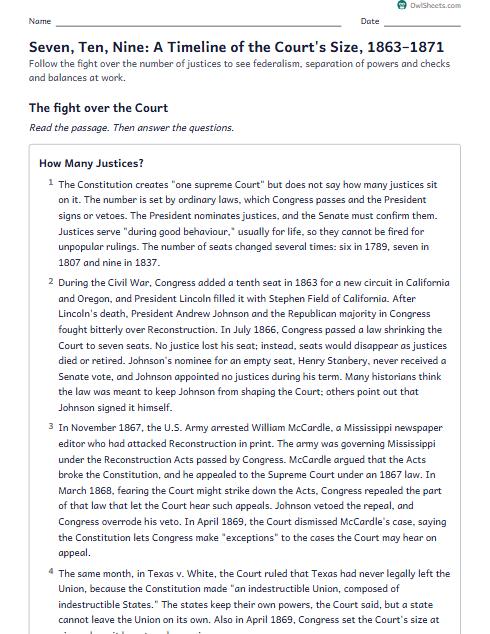
Seven, Ten, Nine: A Timeline of the Court's Size, 1863–1871
Grade 8 · CIV.8.1
14 questionsPremium
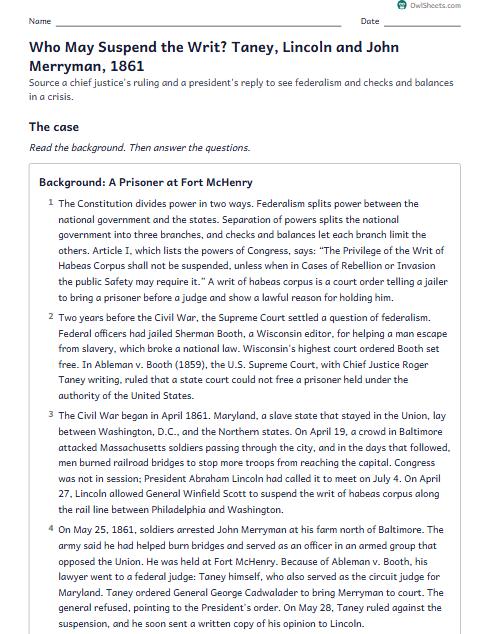
Who May Suspend the Writ? Taney, Lincoln and John Merryman, 1861
Grade 8 · CIV.8.1
14 questionsPremium
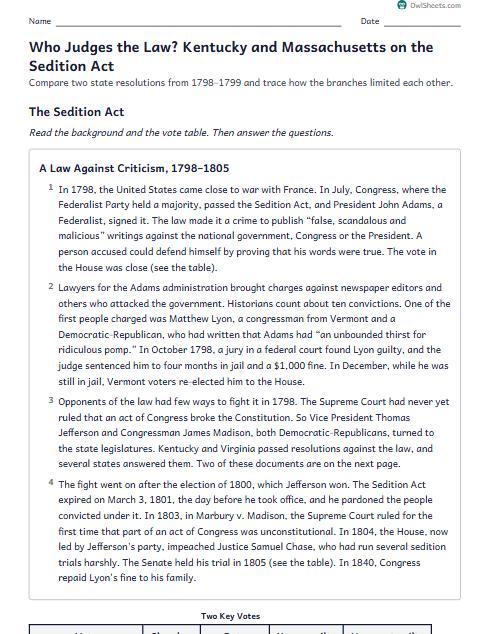
Who Judges the Law? Kentucky and Massachusetts on the Sedition Act
Grade 8 · CIV.8.1
15 questionsPremium
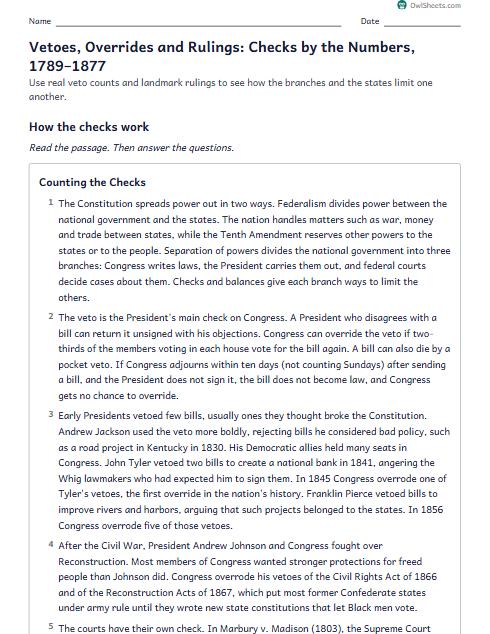
Vetoes, Overrides and Rulings: Checks by the Numbers, 1789–1877
Grade 8 · CIV.8.1
13 questionsPremium
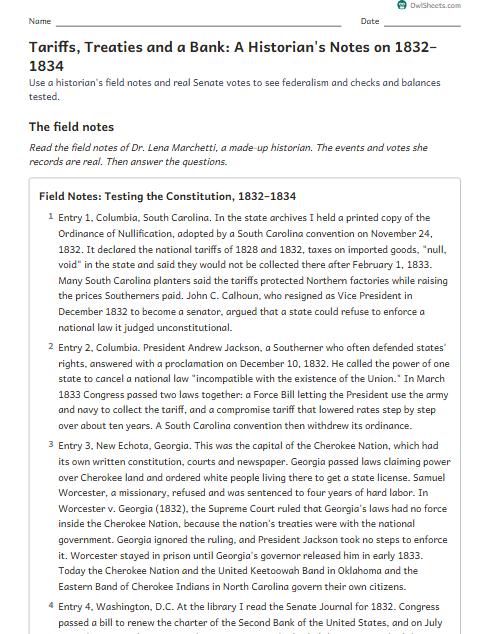
Tariffs, Treaties and a Bank: A Historian's Notes on 1832–1834
Grade 8 · CIV.8.1
11 questionsPremium
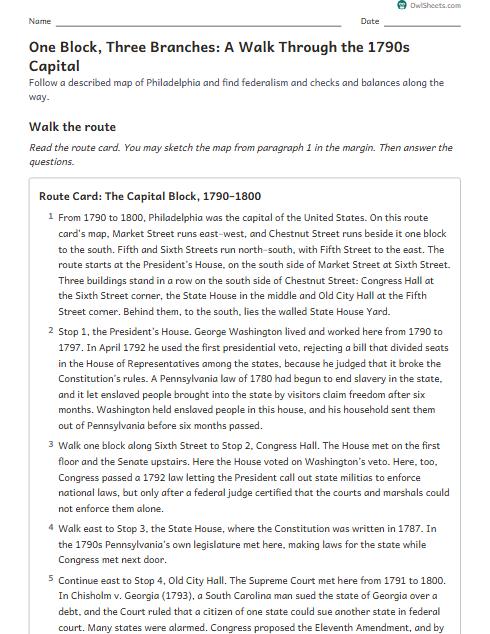
One Block, Three Branches: A Walk Through the 1790s Capital
Grade 8 · CIV.8.1
11 questionsPremium