Grade 8 · Social StudiesCIV.8.1Premium
Who Judges the Law? Kentucky and Massachusetts on the Sedition Act
Grade 8 civics: the Kentucky Resolutions and a Massachusetts reply disagree over the Sedition Act, with Lyon's trial, pardons and Justice Chase's impeachment.
Preview
OwlSheets.com
Who Judges the Law? Kentucky and Massachusetts on the Sedition Act
Compare two state resolutions from 1798–1799 and trace how the branches limited each other.
The Sedition Act
Read the background and the vote table. Then answer the questions.
A Law Against Criticism, 1798–1805
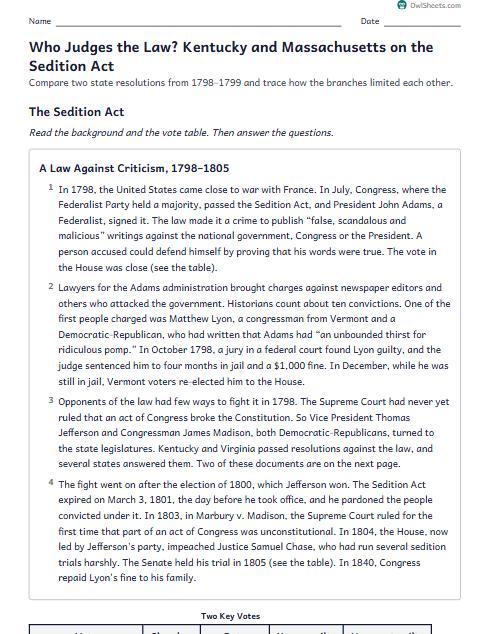
1In 1798, the United States came close to war with France. In July, Congress, where the Federalist Party held a majority, passed the Sedition Act, and President John Adams, a Federalist, signed it. The law made it a crime to publish “false, scandalous and malicious” writings against the national government, Congress or the President. A person accused could defend himself by proving that his words were true. The vote in the House was close (see the table).
2Lawyers for the Adams administration brought charges against newspaper editors and others who attacked the government. Historians count about ten convictions. One of the first people charged was Matthew Lyon, a congressman from Vermont and a Democratic-Republican, who had written that Adams had “an unbounded thirst for ridiculous pomp.” In October 1798, a jury in a federal court found Lyon guilty, and the judge sentenced him to four months in jail and a $1,000 fine. In December, while he was still in jail, Vermont voters re-elected him to the House.
3Opponents of the law had few ways to fight it in 1798. The Supreme Court had never yet ruled that an act of Congress broke the Constitution. So Vice President Thomas Jefferson and Congressman James Madison, both Democratic-Republicans, turned to the state legislatures. Kentucky and Virginia passed resolutions against the law, and several states answered them. Two of these documents are on the next page.
4The fight went on after the election of 1800, which Jefferson won. The Sedition Act expired on March 3, 1801, the day before he took office, and he pardoned the people convicted under it. In 1803, in Marbury v. Madison, the Supreme Court ruled for the first time that part of an act of Congress was unconstitutional. In 1804, the House, now led by Jefferson's party, impeached Justice Samuel Chase, who had run several sedition trials harshly. The Senate held his trial in 1805 (see the table). In 1840, Congress repaid Lyon's fine to his family.
| Vote | Chamber | Date | Yes or guilty | No or not guilty |
|---|---|---|---|---|
| Pass the Sedition bill | House | July 1798 | 44 | 41 |
| Remove Justice Chase | Senate | March 1805 | 19 | 15 |
- A. The President wrote the law; Congress charged Lyon; a court tried him.
- B. Congress wrote the law; a court charged Lyon; the President's officials tried him.
- C. Congress wrote the law; the President's lawyers charged Lyon; a court tried him.
- D. A court wrote the law; the President's lawyers charged Lyon; Congress tried him.
The preview shows the first questions. Unlock the worksheet to see all of it.
Related worksheets
Seven, Ten, Nine: A Timeline of the Court's Size, 1863–1871
Grade 8 · CIV.8.1
14 questionsPremium
Who Commands the Militia? A Mock Hartford Convention
Grade 8 · CIV.8.1
14 questionsPremium
Who May Suspend the Writ? Taney, Lincoln and John Merryman, 1861
Grade 8 · CIV.8.1
14 questionsPremium
Vetoes, Overrides and Rulings: Checks by the Numbers, 1789–1877
Grade 8 · CIV.8.1
13 questionsPremium
Tariffs, Treaties and a Bank: A Historian's Notes on 1832–1834
Grade 8 · CIV.8.1
11 questionsPremium
One Block, Three Branches: A Walk Through the 1790s Capital
Grade 8 · CIV.8.1
11 questionsPremium