Grade 8 · Social StudiesHIS.8.6Premium
From Port Royal to Appomattox: A Sea Islands Timeline, 1861–1865
Grade 8 Civil War: a Sea Islands timeline links Robert Smalls, the Combahee raid and Camp Saxton to Gettysburg, emancipation and Appomattox.
Preview
OwlSheets.com
From Port Royal to Appomattox: A Sea Islands Timeline, 1861–1865
Follow the Civil War's turning points from the coast of South Carolina, where freedom came early.
The timeline
Read the timeline and the notes. Then answer the questions.
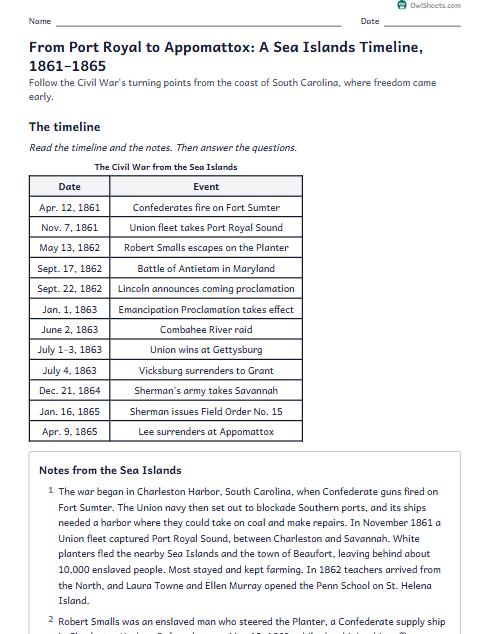
| Date | Event |
|---|---|
| Apr. 12, 1861 | Confederates fire on Fort Sumter |
| Nov. 7, 1861 | Union fleet takes Port Royal Sound |
| May 13, 1862 | Robert Smalls escapes on the Planter |
| Sept. 17, 1862 | Battle of Antietam in Maryland |
| Sept. 22, 1862 | Lincoln announces coming proclamation |
| Jan. 1, 1863 | Emancipation Proclamation takes effect |
| June 2, 1863 | Combahee River raid |
| July 1–3, 1863 | Union wins at Gettysburg |
| July 4, 1863 | Vicksburg surrenders to Grant |
| Dec. 21, 1864 | Sherman's army takes Savannah |
| Jan. 16, 1865 | Sherman issues Field Order No. 15 |
| Apr. 9, 1865 | Lee surrenders at Appomattox |
Notes from the Sea Islands
1The war began in Charleston Harbor, South Carolina, when Confederate guns fired on Fort Sumter. The Union navy then set out to blockade Southern ports, and its ships needed a harbor where they could take on coal and make repairs. In November 1861 a Union fleet captured Port Royal Sound, between Charleston and Savannah. White planters fled the nearby Sea Islands and the town of Beaufort, leaving behind about 10,000 enslaved people. Most stayed and kept farming. In 1862 teachers arrived from the North, and Laura Towne and Ellen Murray opened the Penn School on St. Helena Island.
2Robert Smalls was an enslaved man who steered the Planter, a Confederate supply ship in Charleston Harbor. Before dawn on May 13, 1862, while the ship's white officers were ashore, Smalls and the enslaved crew took the Planter, picked up their families at another wharf and steamed past the Confederate forts. As they neared the Union ships, they raised a white bedsheet. Smalls also brought what he knew about the harbor's defenses. That summer he went to Washington, and many historians say his visit helped persuade the War Department to let Union officers on the Sea Islands enlist Black soldiers.
3On January 1, 1863, thousands of freedpeople gathered at Camp Saxton, near Beaufort, with the 1st South Carolina Volunteers, a Union regiment of men who had been enslaved. They heard the Emancipation Proclamation read aloud. It declared free the enslaved people in all areas still in rebellion, which included all of South Carolina, and it opened the army and navy to Black men.
4Harriet Tubman, who had escaped slavery in Maryland, worked as a scout for the Union army in South Carolina. On June 2, 1863, she guided Union gunboats carrying Black soldiers up the Combahee River. The soldiers burned rice mills and plantation buildings, and about 750 enslaved people ran to the boats and sailed away to freedom. Many of the men soon joined the Union army. A month later, the Union won at Gettysburg, after which Lee never again invaded the North, and Vicksburg's surrender gave the Union control of the Mississippi River.
5In December 1864 General William T. Sherman's army reached the coast at Savannah, followed by thousands of freed families. In January 1865 his Field Order No. 15 set aside the coast and islands from Charleston south into Florida for freed families, with up to 40 acres each. Union troops, including Black regiments, entered Charleston in February. Lee surrendered at Appomattox on April 9. On April 14, four years after the war began, the U.S. flag that had flown over Fort Sumter in 1861 was raised there again, and Smalls brought the Planter, crowded with freedpeople, to watch. That night President Lincoln was shot. Later in 1865, President Andrew Johnson ordered most of the coastal land returned to its former owners.
Lincoln announced the coming proclamation about months before it took effect. The flag went back up over Fort Sumter days after Lee surrendered.
The preview shows the first questions. Unlock the worksheet to see all of it.
Related worksheets
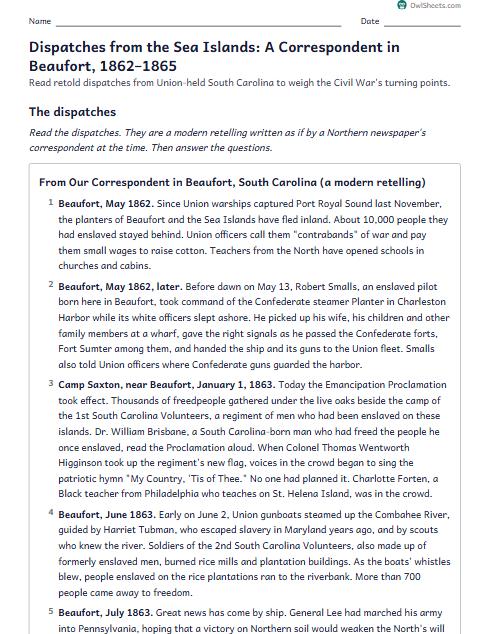
Dispatches from the Sea Islands: A Correspondent in Beaufort, 1862–1865
Grade 8 · HIS.8.6
14 questionsPremium
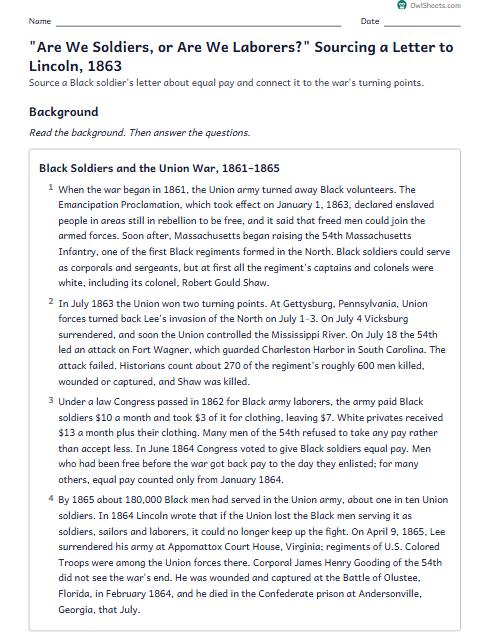
"Are We Soldiers, or Are We Laborers?" Sourcing a Letter to Lincoln, 1863
Grade 8 · HIS.8.6
14 questionsPremium
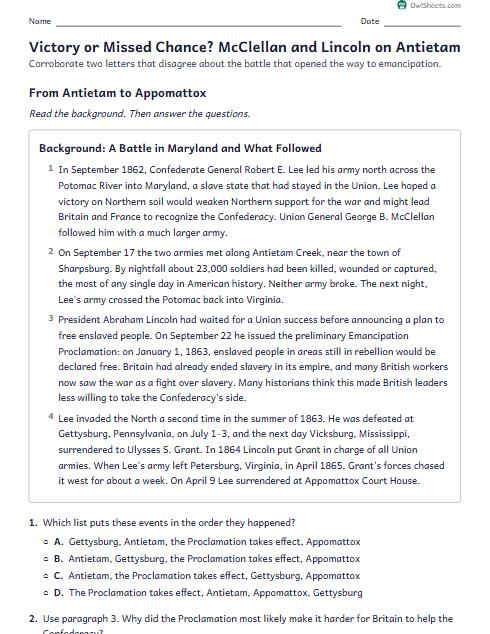
Victory or Missed Chance? McClellan and Lincoln on Antietam
Grade 8 · HIS.8.6
13 questionsPremium
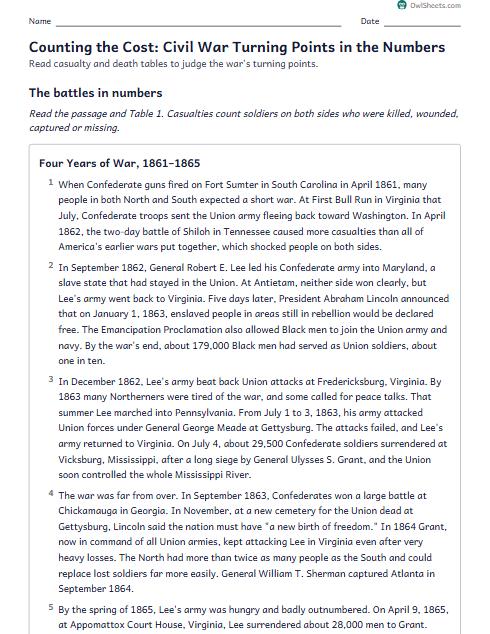
Counting the Cost: Civil War Turning Points in the Numbers
Grade 8 · HIS.8.6
13 questionsPremium
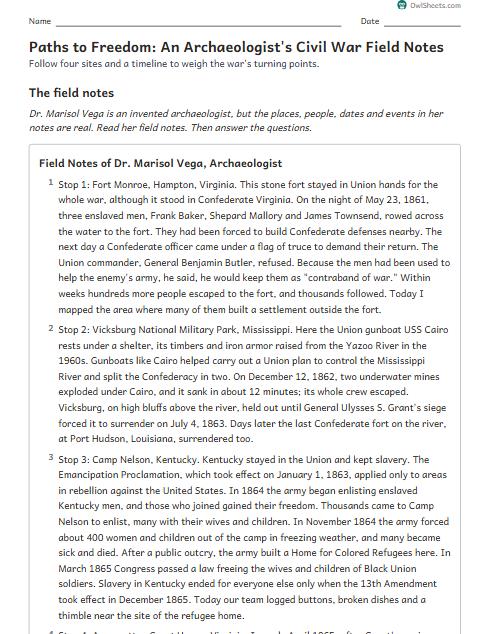
Paths to Freedom: An Archaeologist's Civil War Field Notes
Grade 8 · HIS.8.6
11 questionsPremium
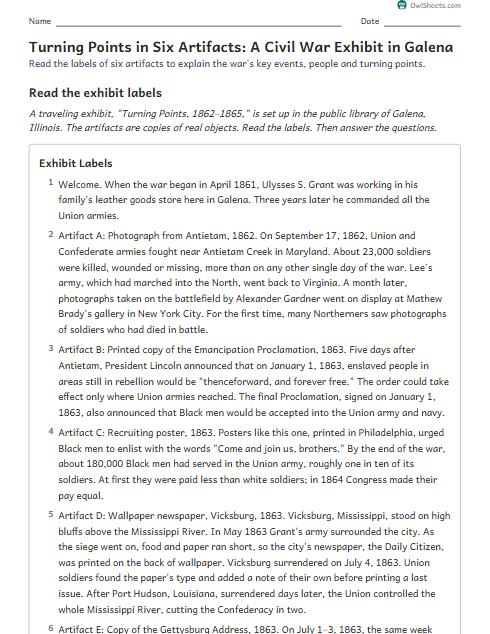
Turning Points in Six Artifacts: A Civil War Exhibit in Galena
Grade 8 · HIS.8.6
11 questionsFree