Grade 8 · Social StudiesHIS.8.6Premium
Victory or Missed Chance? McClellan and Lincoln on Antietam
Grade 8 history: compare letters by McClellan and Lincoln on Antietam, check them against data, and link the battle to emancipation and Appomattox.
Preview
OwlSheets.com
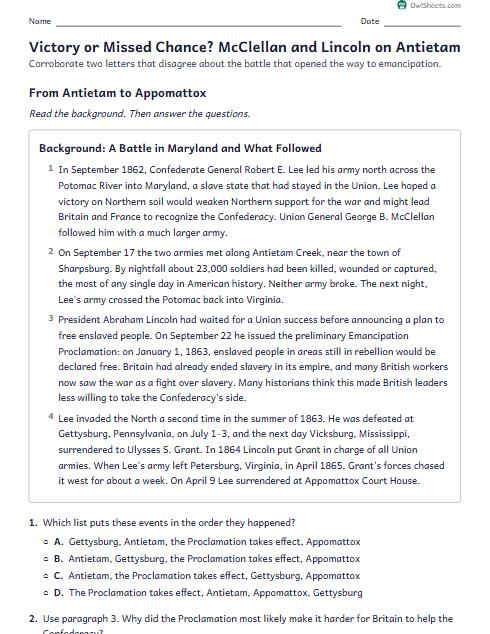
Victory or Missed Chance? McClellan and Lincoln on Antietam
Corroborate two letters that disagree about the battle that opened the way to emancipation.
From Antietam to Appomattox
Read the background. Then answer the questions.
Background: A Battle in Maryland and What Followed
1In September 1862, Confederate General Robert E. Lee led his army north across the Potomac River into Maryland, a slave state that had stayed in the Union. Lee hoped a victory on Northern soil would weaken Northern support for the war and might lead Britain and France to recognize the Confederacy. Union General George B. McClellan followed him with a much larger army.
2On September 17 the two armies met along Antietam Creek, near the town of Sharpsburg. By nightfall about 23,000 soldiers had been killed, wounded or captured, the most of any single day in American history. Neither army broke. The next night, Lee's army crossed the Potomac back into Virginia.
3President Abraham Lincoln had waited for a Union success before announcing a plan to free enslaved people. On September 22 he issued the preliminary Emancipation Proclamation: on January 1, 1863, enslaved people in areas still in rebellion would be declared free. Britain had already ended slavery in its empire, and many British workers now saw the war as a fight over slavery. Many historians think this made British leaders less willing to take the Confederacy's side.
4Lee invaded the North a second time in the summer of 1863. He was defeated at Gettysburg, Pennsylvania, on July 1–3, and the next day Vicksburg, Mississippi, surrendered to Ulysses S. Grant. In 1864 Lincoln put Grant in charge of all Union armies. When Lee's army left Petersburg, Virginia, in April 1865, Grant's forces chased it west for about a week. On April 9 Lee surrendered at Appomattox Court House.
- A. Gettysburg, Antietam, the Proclamation takes effect, Appomattox
- B. Antietam, Gettysburg, the Proclamation takes effect, Appomattox
- C. Antietam, the Proclamation takes effect, Gettysburg, Appomattox
- D. The Proclamation takes effect, Antietam, Appomattox, Gettysburg
- A. It made the war a fight over slavery, which Britain had already ended.
- B. It freed enslaved people in Britain's colonies along with the South.
- C. It ordered British ships to stay out of all Southern ports that year.
- D. It promised Britain the cotton crop of every state still in rebellion.
The preview shows the first questions. Unlock the worksheet to see all of it.
Related worksheets
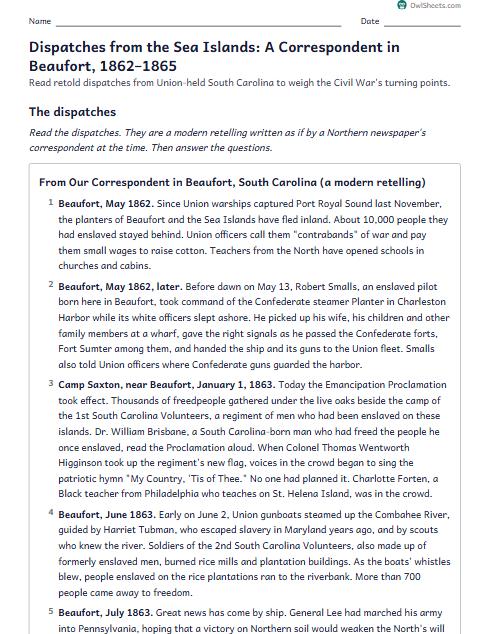
Dispatches from the Sea Islands: A Correspondent in Beaufort, 1862–1865
Grade 8 · HIS.8.6
14 questionsPremium
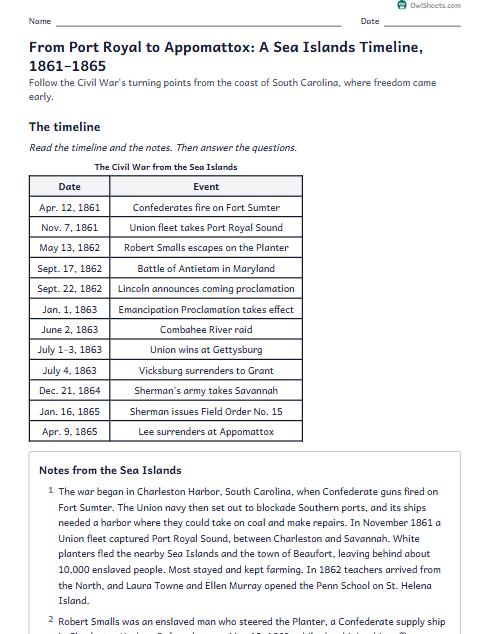
From Port Royal to Appomattox: A Sea Islands Timeline, 1861–1865
Grade 8 · HIS.8.6
14 questionsPremium
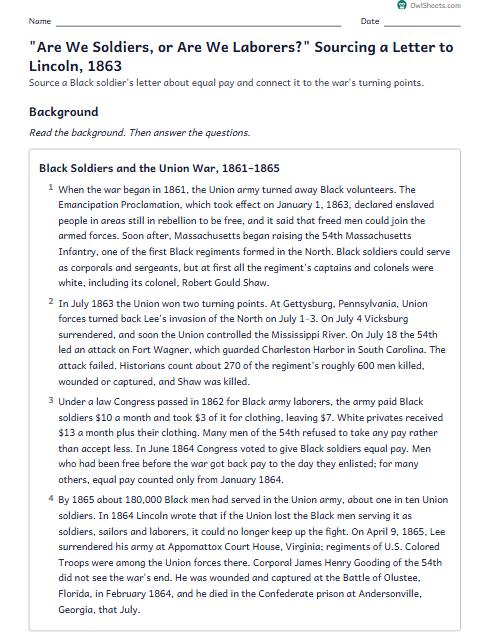
"Are We Soldiers, or Are We Laborers?" Sourcing a Letter to Lincoln, 1863
Grade 8 · HIS.8.6
14 questionsPremium
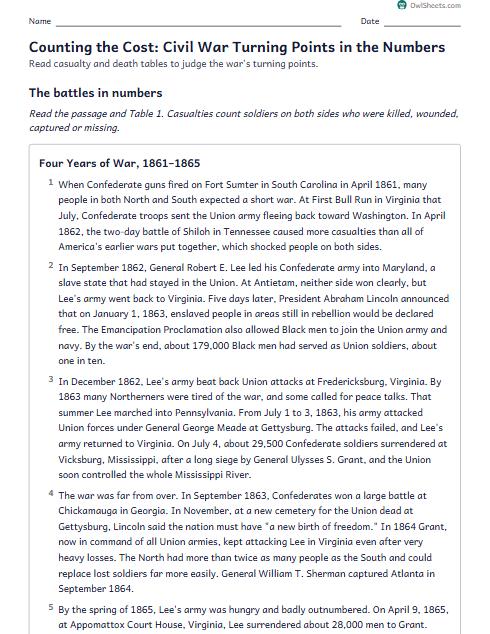
Counting the Cost: Civil War Turning Points in the Numbers
Grade 8 · HIS.8.6
13 questionsPremium
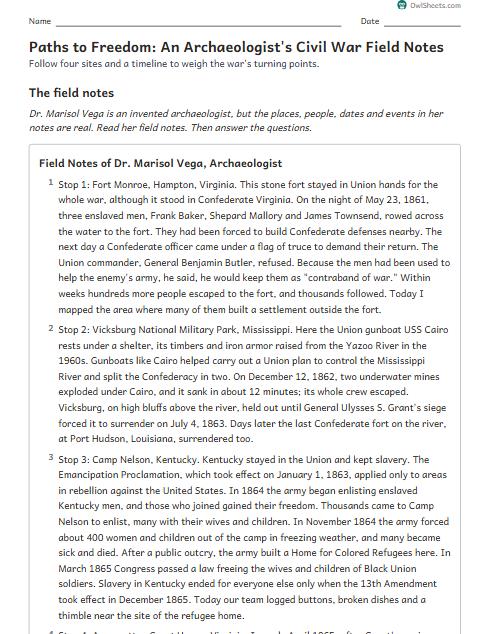
Paths to Freedom: An Archaeologist's Civil War Field Notes
Grade 8 · HIS.8.6
11 questionsPremium
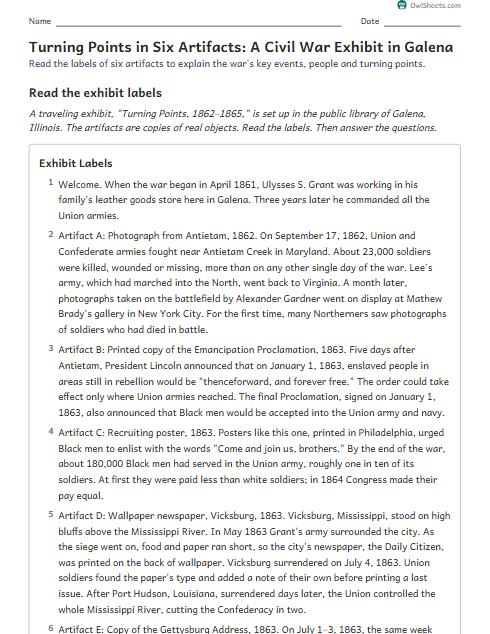
Turning Points in Six Artifacts: A Civil War Exhibit in Galena
Grade 8 · HIS.8.6
11 questionsFree