Grade 8 · Social StudiesHIS.8.6Premium
"Are We Soldiers, or Are We Laborers?" Sourcing a Letter to Lincoln, 1863
Grade 8 Civil War: source Corporal James Henry Gooding's 1863 letter to Lincoln on equal pay, with the Emancipation Proclamation, Gettysburg and Appomattox.
Preview
OwlSheets.com
"Are We Soldiers, or Are We Laborers?" Sourcing a Letter to Lincoln, 1863
Source a Black soldier's letter about equal pay and connect it to the war's turning points.
Background
Read the background. Then answer the questions.
Black Soldiers and the Union War, 1861–1865
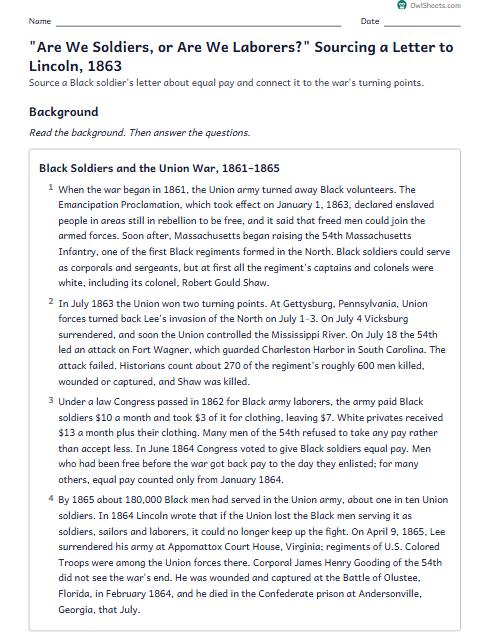
1When the war began in 1861, the Union army turned away Black volunteers. The Emancipation Proclamation, which took effect on January 1, 1863, declared enslaved people in areas still in rebellion to be free, and it said that freed men could join the armed forces. Soon after, Massachusetts began raising the 54th Massachusetts Infantry, one of the first Black regiments formed in the North. Black soldiers could serve as corporals and sergeants, but at first all the regiment's captains and colonels were white, including its colonel, Robert Gould Shaw.
2In July 1863 the Union won two turning points. At Gettysburg, Pennsylvania, Union forces turned back Lee's invasion of the North on July 1–3. On July 4 Vicksburg surrendered, and soon the Union controlled the Mississippi River. On July 18 the 54th led an attack on Fort Wagner, which guarded Charleston Harbor in South Carolina. The attack failed. Historians count about 270 of the regiment's roughly 600 men killed, wounded or captured, and Shaw was killed.
3Under a law Congress passed in 1862 for Black army laborers, the army paid Black soldiers $10 a month and took $3 of it for clothing, leaving $7. White privates received $13 a month plus their clothing. Many men of the 54th refused to take any pay rather than accept less. In June 1864 Congress voted to give Black soldiers equal pay. Men who had been free before the war got back pay to the day they enlisted; for many others, equal pay counted only from January 1864.
4By 1865 about 180,000 Black men had served in the Union army, about one in ten Union soldiers. In 1864 Lincoln wrote that if the Union lost the Black men serving it as soldiers, sailors and laborers, it could no longer keep up the fight. On April 9, 1865, Lee surrendered his army at Appomattox Court House, Virginia; regiments of U.S. Colored Troops were among the Union forces there. Corporal James Henry Gooding of the 54th did not see the war's end. He was wounded and captured at the Battle of Olustee, Florida, in February 1864, and he died in the Confederate prison at Andersonville, Georgia, that July.
- A. The Proclamation let freed men join, and his state was raising a Black regiment.
- B. The army had lost so many men at Gettysburg that it now took Black volunteers.
- C. Congress had ordered the army to make Black volunteers into captains.
- D. The Proclamation had freed Black men in Massachusetts so they could enlist.
Each month, a Black private kept dollars less than a white private. Over 12 months, that came to dollars less.
The preview shows the first questions. Unlock the worksheet to see all of it.
Related worksheets
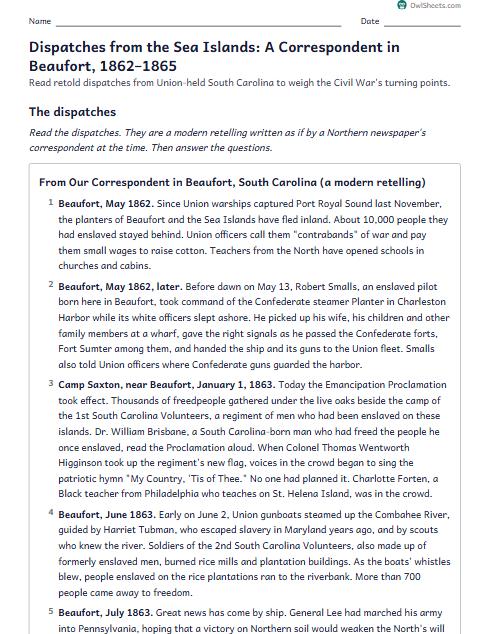
Dispatches from the Sea Islands: A Correspondent in Beaufort, 1862–1865
Grade 8 · HIS.8.6
14 questionsPremium
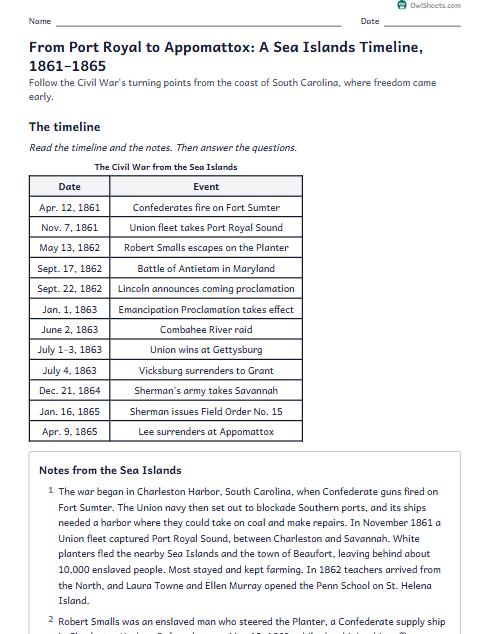
From Port Royal to Appomattox: A Sea Islands Timeline, 1861–1865
Grade 8 · HIS.8.6
14 questionsPremium
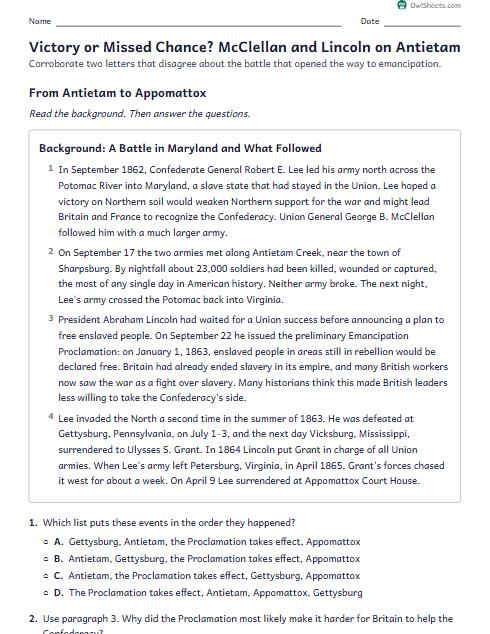
Victory or Missed Chance? McClellan and Lincoln on Antietam
Grade 8 · HIS.8.6
13 questionsPremium
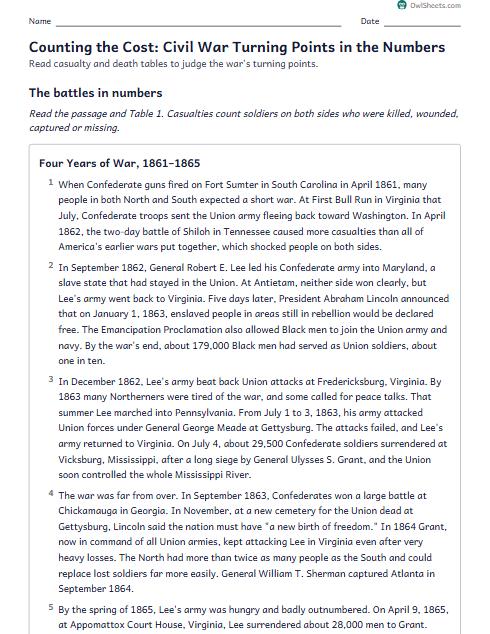
Counting the Cost: Civil War Turning Points in the Numbers
Grade 8 · HIS.8.6
13 questionsPremium
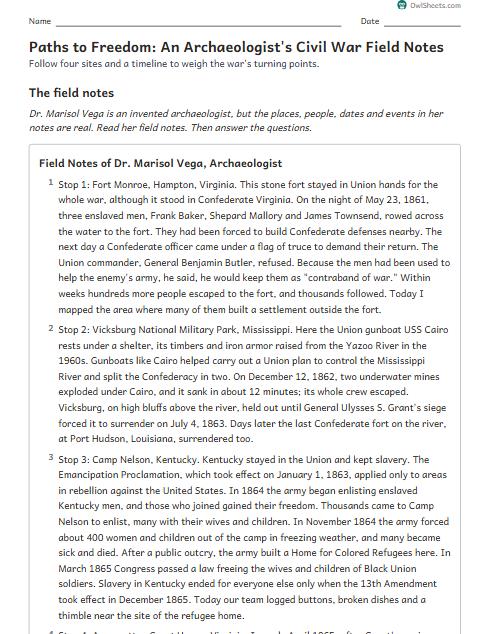
Paths to Freedom: An Archaeologist's Civil War Field Notes
Grade 8 · HIS.8.6
11 questionsPremium
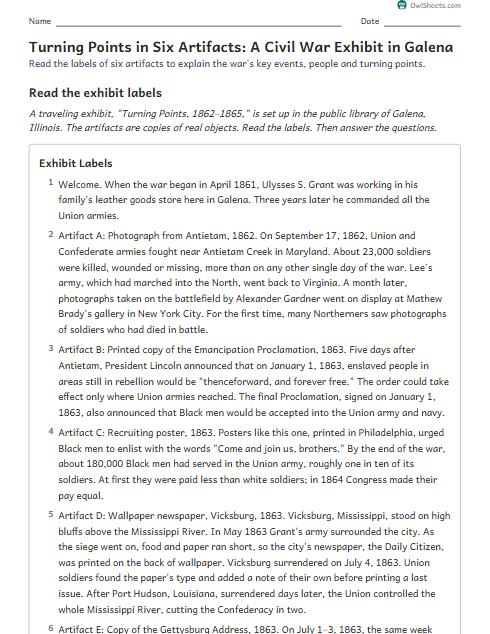
Turning Points in Six Artifacts: A Civil War Exhibit in Galena
Grade 8 · HIS.8.6
11 questionsFree