Grade 8 · Social StudiesHIS.8.6Premium
Dispatches from the Sea Islands: A Correspondent in Beaufort, 1862–1865
Grade 8 Civil War: retold dispatches from Beaufort, S.C., cover Robert Smalls, the Emancipation Proclamation, the Combahee raid, Gettysburg and Appomattox.
Preview
OwlSheets.com
Dispatches from the Sea Islands: A Correspondent in Beaufort, 1862–1865
Read retold dispatches from Union-held South Carolina to weigh the Civil War's turning points.
The dispatches
Read the dispatches. They are a modern retelling written as if by a Northern newspaper's correspondent at the time. Then answer the questions.
From Our Correspondent in Beaufort, South Carolina (a modern retelling)
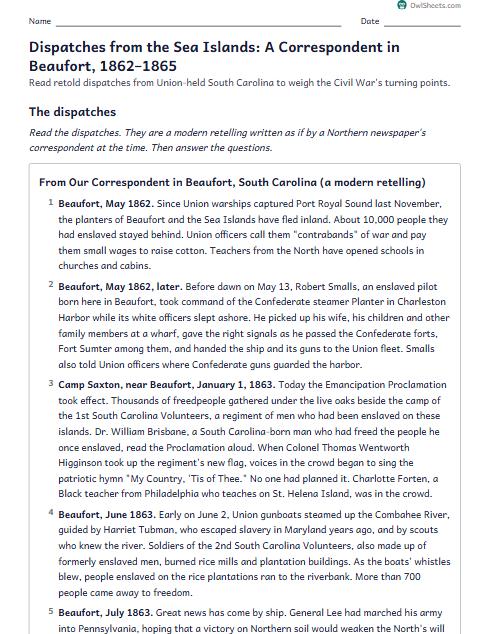
1Beaufort, May 1862. Since Union warships captured Port Royal Sound last November, the planters of Beaufort and the Sea Islands have fled inland. About 10,000 people they had enslaved stayed behind. Union officers call them "contrabands" of war and pay them small wages to raise cotton. Teachers from the North have opened schools in churches and cabins.
2Beaufort, May 1862, later. Before dawn on May 13, Robert Smalls, an enslaved pilot born here in Beaufort, took command of the Confederate steamer Planter in Charleston Harbor while its white officers slept ashore. He picked up his wife, his children and other family members at a wharf, gave the right signals as he passed the Confederate forts, Fort Sumter among them, and handed the ship and its guns to the Union fleet. Smalls also told Union officers where Confederate guns guarded the harbor.
3Camp Saxton, near Beaufort, January 1, 1863. Today the Emancipation Proclamation took effect. Thousands of freedpeople gathered under the live oaks beside the camp of the 1st South Carolina Volunteers, a regiment of men who had been enslaved on these islands. Dr. William Brisbane, a South Carolina-born man who had freed the people he once enslaved, read the Proclamation aloud. When Colonel Thomas Wentworth Higginson took up the regiment's new flag, voices in the crowd began to sing the patriotic hymn "My Country, 'Tis of Thee." No one had planned it. Charlotte Forten, a Black teacher from Philadelphia who teaches on St. Helena Island, was in the crowd.
4Beaufort, June 1863. Early on June 2, Union gunboats steamed up the Combahee River, guided by Harriet Tubman, who escaped slavery in Maryland years ago, and by scouts who knew the river. Soldiers of the 2nd South Carolina Volunteers, also made up of formerly enslaved men, burned rice mills and plantation buildings. As the boats' whistles blew, people enslaved on the rice plantations ran to the riverbank. More than 700 people came away to freedom.
5Beaufort, July 1863. Great news has come by ship. General Lee had marched his army into Pennsylvania, hoping that a victory on Northern soil would weaken the North's will to fight. At Gettysburg, on July 3, his final attack on the Union center at Cemetery Ridge failed, and Lee retreated to Virginia. On July 4, the Confederate army at Vicksburg surrendered to General Grant, and the Union soon held the whole Mississippi River.
6Charleston Harbor, April 14, 1865. Five days after General Lee surrendered his army to General Grant at Appomattox Court House, Virginia, the United States flag was raised again over Fort Sumter, where the war began four years ago. Among the ships in the harbor was the Planter, piloted by Robert Smalls and crowded with freedpeople who came to see the ceremony.
- A. Congress bought the islands from South Carolina and freed the people who lived there.
- B. They escaped from Charleston on the Planter and settled on the islands afterward.
- C. Union forces took the islands, and most enslaved people stayed when planters fled.
- D. Their enslavers freed them and moved north before the Union navy arrived.
- A. Robert Smalls bringing freedpeople to the flag ceremony at Fort Sumter
- B. Robert Smalls delivering the Planter and his knowledge of the harbor
- C. The raid up the Combahee River guided by Harriet Tubman
- D. The freedpeople singing together at the Camp Saxton ceremony
The preview shows the first questions. Unlock the worksheet to see all of it.
Related worksheets
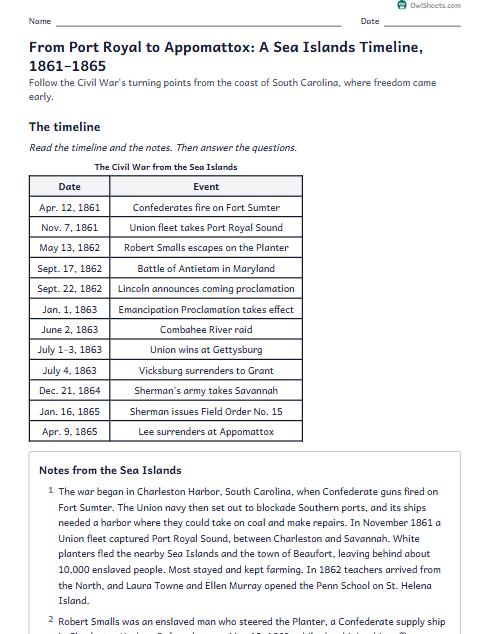
From Port Royal to Appomattox: A Sea Islands Timeline, 1861–1865
Grade 8 · HIS.8.6
14 questionsPremium
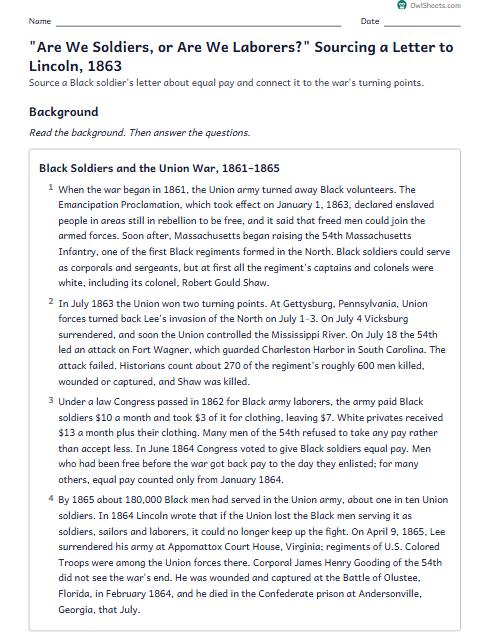
"Are We Soldiers, or Are We Laborers?" Sourcing a Letter to Lincoln, 1863
Grade 8 · HIS.8.6
14 questionsPremium
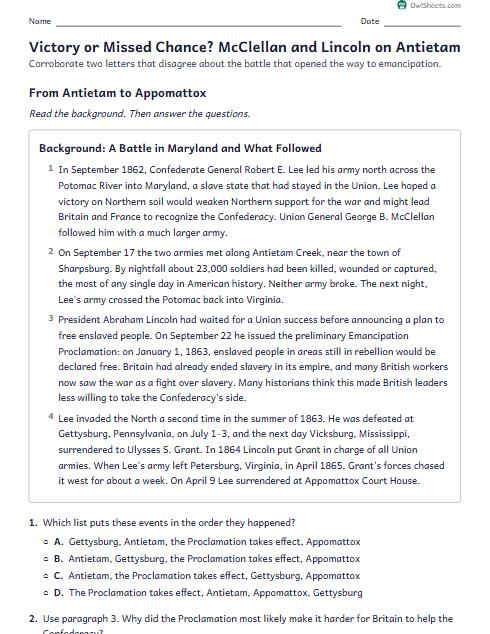
Victory or Missed Chance? McClellan and Lincoln on Antietam
Grade 8 · HIS.8.6
13 questionsPremium
Counting the Cost: Civil War Turning Points in the Numbers
Grade 8 · HIS.8.6
13 questionsPremium
Paths to Freedom: An Archaeologist's Civil War Field Notes
Grade 8 · HIS.8.6
11 questionsPremium
Turning Points in Six Artifacts: A Civil War Exhibit in Galena
Grade 8 · HIS.8.6
11 questionsFree