Grade 8 · Social StudiesCIV.8.2Premium
From Schenck to Brandenburg: Free Speech on Trial, 1917–1969
Grade 8 civics: a timeline from 1791 to 1969 traces how judicial review and cases from Schenck to Brandenburg shaped freedom of speech.
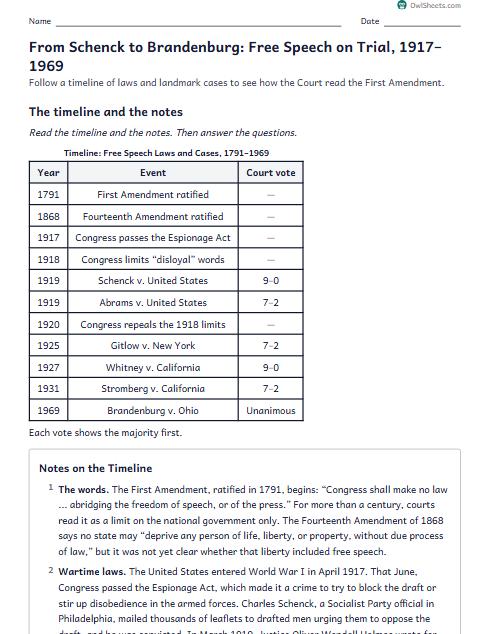
Preview
OwlSheets.com
From Schenck to Brandenburg: Free Speech on Trial, 1917–1969
Follow a timeline of laws and landmark cases to see how the Court read the First Amendment.
The timeline and the notes
Read the timeline and the notes. Then answer the questions.
| Year | Event | Court vote |
|---|---|---|
| 1791 | First Amendment ratified | — |
| 1868 | Fourteenth Amendment ratified | — |
| 1917 | Congress passes the Espionage Act | — |
| 1918 | Congress limits “disloyal” words | — |
| 1919 | Schenck v. United States | 9–0 |
| 1919 | Abrams v. United States | 7–2 |
| 1920 | Congress repeals the 1918 limits | — |
| 1925 | Gitlow v. New York | 7–2 |
| 1927 | Whitney v. California | 9–0 |
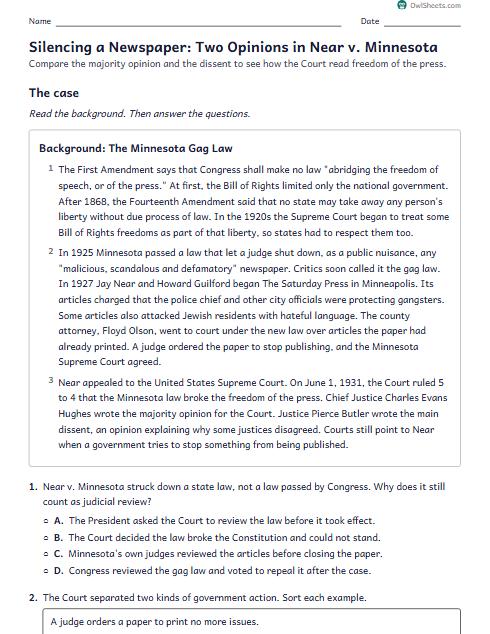
| 1931 | Stromberg v. California | 7–2 |
| 1969 | Brandenburg v. Ohio | Unanimous |
Notes on the Timeline
1The words. The First Amendment, ratified in 1791, begins: “Congress shall make no law ... abridging the freedom of speech, or of the press.” For more than a century, courts read it as a limit on the national government only. The Fourteenth Amendment of 1868 says no state may “deprive any person of life, liberty, or property, without due process of law,” but it was not yet clear whether that liberty included free speech.
2Wartime laws. The United States entered World War I in April 1917. That June, Congress passed the Espionage Act, which made it a crime to try to block the draft or stir up disobedience in the armed forces. Charles Schenck, a Socialist Party official in Philadelphia, mailed thousands of leaflets to drafted men urging them to oppose the draft, and he was convicted. In March 1919, Justice Oliver Wendell Holmes wrote for the Court that the question is whether words create “a clear and present danger” of harms Congress may prevent. Free speech, he added, would not protect “a man in falsely shouting fire in a theatre and causing a panic.”
3A change of mind. In November 1919, the Court upheld the convictions of Jacob Abrams and others, who had thrown leaflets from a New York building attacking the sending of U.S. troops to Russia. This time Holmes dissented, joined by Justice Louis Brandeis. He wrote that a few leaflets printed in secret by unknown people posed no immediate danger. He argued that the best test of truth is the power of an idea to win acceptance in “the competition of the market.” A dissent does not change the law, but later judges and lawyers read it.
4The states. In 1925, Benjamin Gitlow lost his appeal of a New York conviction for publishing a pamphlet that called for revolution. Yet the Court said, for the first time, that freedom of speech is among the liberties the Fourteenth Amendment protects from the states. In 1927 the Court upheld Anita Whitney's conviction under a California law against groups that called for violent change. Brandeis agreed with the result for legal reasons but wrote that when there is time to answer false ideas, “the remedy to be applied is more speech, not enforced silence.” In 1931, in Stromberg v. California, the Court for the first time struck down a state law for breaking freedom of speech.
5A new test. In 1964 Clarence Brandenburg, a Ku Klux Klan leader, invited a TV reporter to film a rally in rural Ohio, where he made racist and threatening speeches. He was convicted under a 1919 Ohio law against urging violence to bring about political change. In 1969 the Court reversed his conviction. It ruled that the government may punish speech urging force or lawbreaking only when the speech is aimed at causing lawless action right away and is likely to cause it. The Court overruled Whitney, and Ohio's law could no longer be used to punish speech like his.
The Court said the Fourteenth Amendment protects speech from the states years after that amendment was ratified.
The rule of Whitney v. California stood for years before the Court overruled it.
The preview shows the first questions. Unlock the worksheet to see all of it.
Related worksheets
Calls from a Glass Booth: The Katz Ruling in the News, 1967
Grade 8 · CIV.8.2
15 questionsPremium
Evidence at the Door: A Class Debate on Mapp v. Ohio
Grade 8 · CIV.8.2
14 questionsPremium
The Right to Remain Silent: Reading the Miranda Opinion
Grade 8 · CIV.8.2
14 questionsPremium
Silencing a Newspaper: Two Opinions in Near v. Minnesota
Grade 8 · CIV.8.2
13 questionsPremium
At the Schoolhouse Gate: Students' Rights and the Supreme Court
Grade 8 · CIV.8.2
11 questionsPremium
Eight to One, Then Six to Three: The Flag Salute Cases
Grade 8 · CIV.8.2
10 questionsPremium