Grade 8 · Social StudiesCIV.8.2Premium
Calls from a Glass Booth: The Katz Ruling in the News, 1967
Grade 8 civics: a modern news retelling of Katz v. United States (1967) and Olmstead (1928) shows how judicial review shapes the Fourth Amendment.
Preview
OwlSheets.com
Calls from a Glass Booth: The Katz Ruling in the News, 1967
Read a newspaper-style report on Katz v. United States to see how the Supreme Court reads the Fourth Amendment and the rest of the Bill of Rights.
The news report
Read the newspaper report and the sidebar. Then answer the questions.
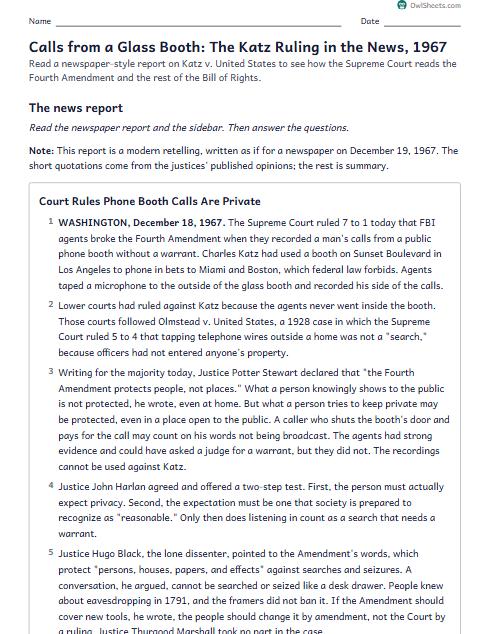
Court Rules Phone Booth Calls Are Private
1WASHINGTON, December 18, 1967. The Supreme Court ruled 7 to 1 today that FBI agents broke the Fourth Amendment when they recorded a man's calls from a public phone booth without a warrant. Charles Katz had used a booth on Sunset Boulevard in Los Angeles to phone in bets to Miami and Boston, which federal law forbids. Agents taped a microphone to the outside of the glass booth and recorded his side of the calls.
2Lower courts had ruled against Katz because the agents never went inside the booth. Those courts followed Olmstead v. United States, a 1928 case in which the Supreme Court ruled 5 to 4 that tapping telephone wires outside a home was not a "search," because officers had not entered anyone's property.
3Writing for the majority today, Justice Potter Stewart declared that "the Fourth Amendment protects people, not places." What a person knowingly shows to the public is not protected, he wrote, even at home. But what a person tries to keep private may be protected, even in a place open to the public. A caller who shuts the booth's door and pays for the call may count on his words not being broadcast. The agents had strong evidence and could have asked a judge for a warrant, but they did not. The recordings cannot be used against Katz.
4Justice John Harlan agreed and offered a two-step test. First, the person must actually expect privacy. Second, the expectation must be one that society is prepared to recognize as "reasonable." Only then does listening in count as a search that needs a warrant.
5Justice Hugo Black, the lone dissenter, pointed to the Amendment's words, which protect "persons, houses, papers, and effects" against searches and seizures. A conversation, he argued, cannot be searched or seized like a desk drawer. People knew about eavesdropping in 1791, and the framers did not ban it. If the Amendment should cover new tools, he wrote, the people should change it by amendment, not the Court by a ruling. Justice Thurgood Marshall took no part in the case.
Editor's note from today: In 1968, Congress passed a law setting rules for when officers may get a warrant to listen in on calls. Courts still use Harlan's test to decide what counts as a search.
The preview shows the first questions. Unlock the worksheet to see all of it.
Related worksheets
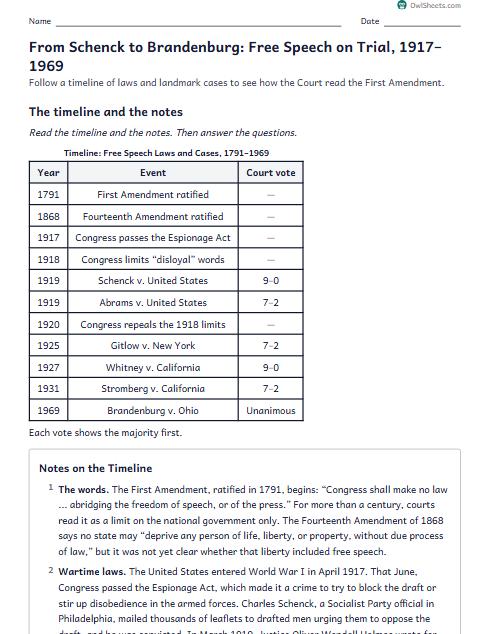
From Schenck to Brandenburg: Free Speech on Trial, 1917–1969
Grade 8 · CIV.8.2
14 questionsPremium
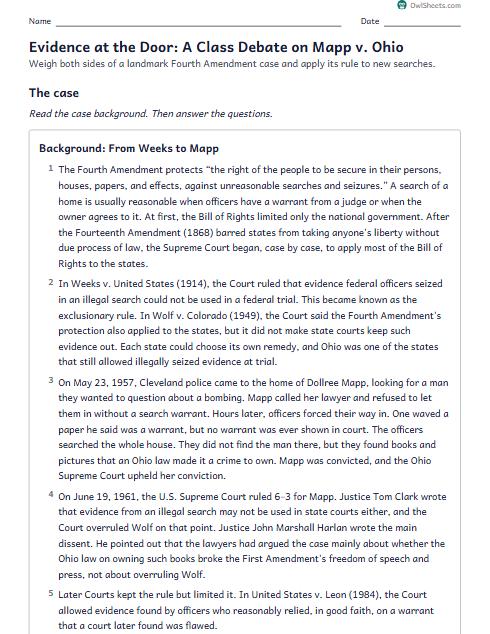
Evidence at the Door: A Class Debate on Mapp v. Ohio
Grade 8 · CIV.8.2
14 questionsPremium
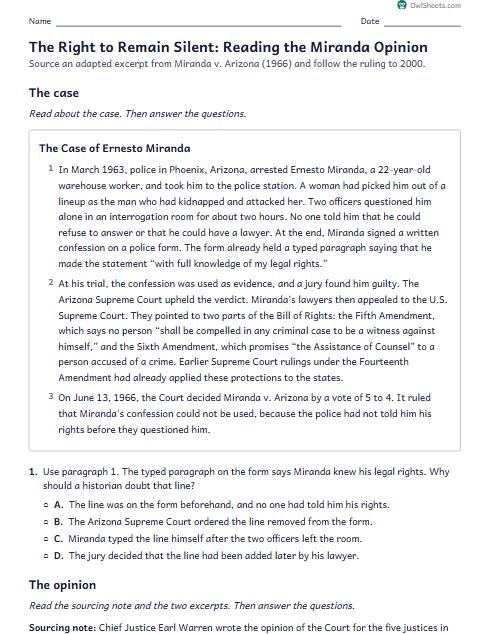
The Right to Remain Silent: Reading the Miranda Opinion
Grade 8 · CIV.8.2
14 questionsPremium
Silencing a Newspaper: Two Opinions in Near v. Minnesota
Grade 8 · CIV.8.2
13 questionsPremium
At the Schoolhouse Gate: Students' Rights and the Supreme Court
Grade 8 · CIV.8.2
11 questionsPremium
Eight to One, Then Six to Three: The Flag Salute Cases
Grade 8 · CIV.8.2
10 questionsPremium