Grade 8 · Social StudiesCIV.8.2Premium
Silencing a Newspaper: Two Opinions in Near v. Minnesota
Grade 8 civics: compare adapted majority and dissenting opinions in Near v. Minnesota (1931) to see how judicial review shaped freedom of the press.
Preview
OwlSheets.com
Silencing a Newspaper: Two Opinions in Near v. Minnesota
Compare the majority opinion and the dissent to see how the Court read freedom of the press.
The case
Read the background. Then answer the questions.
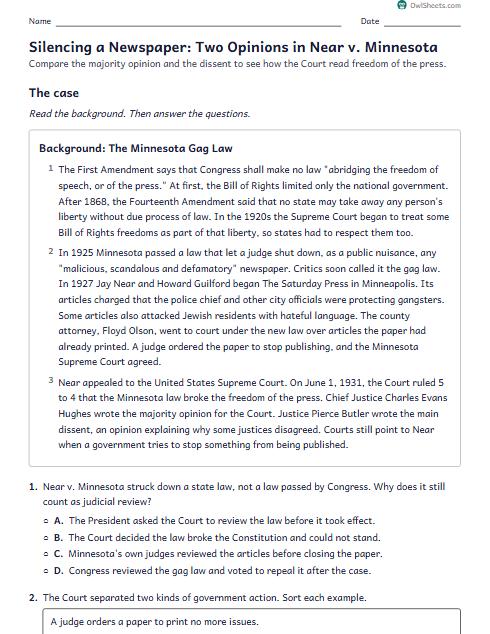
Background: The Minnesota Gag Law
1The First Amendment says that Congress shall make no law "abridging the freedom of speech, or of the press." At first, the Bill of Rights limited only the national government. After 1868, the Fourteenth Amendment said that no state may take away any person's liberty without due process of law. In the 1920s the Supreme Court began to treat some Bill of Rights freedoms as part of that liberty, so states had to respect them too.
2In 1925 Minnesota passed a law that let a judge shut down, as a public nuisance, any "malicious, scandalous and defamatory" newspaper. Critics soon called it the gag law. In 1927 Jay Near and Howard Guilford began The Saturday Press in Minneapolis. Its articles charged that the police chief and other city officials were protecting gangsters. Some articles also attacked Jewish residents with hateful language. The county attorney, Floyd Olson, went to court under the new law over articles the paper had already printed. A judge ordered the paper to stop publishing, and the Minnesota Supreme Court agreed.
3Near appealed to the United States Supreme Court. On June 1, 1931, the Court ruled 5 to 4 that the Minnesota law broke the freedom of the press. Chief Justice Charles Evans Hughes wrote the majority opinion for the Court. Justice Pierce Butler wrote the main dissent, an opinion explaining why some justices disagreed. Courts still point to Near when a government tries to stop something from being published.
- A. The President asked the Court to review the law before it took effect.
- B. The Court decided the law broke the Constitution and could not stand.
- C. Minnesota's own judges reviewed the articles before closing the paper.
- D. Congress reviewed the gag law and voted to repeal it after the case.
| Stops words before they are published | Punishes words after they are published |
|---|---|
The preview shows the first questions. Unlock the worksheet to see all of it.
Related worksheets
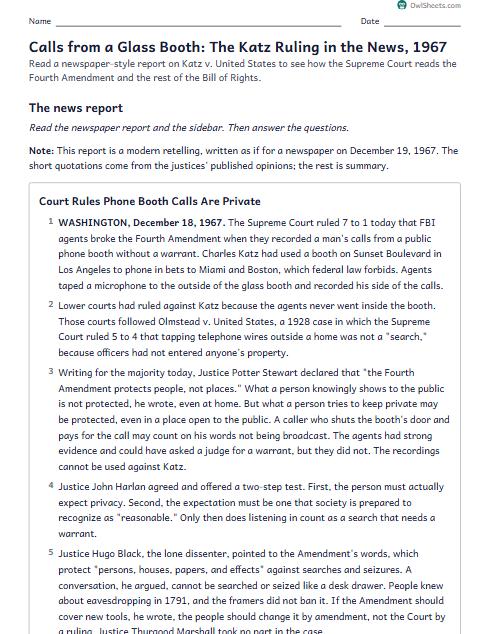
Calls from a Glass Booth: The Katz Ruling in the News, 1967
Grade 8 · CIV.8.2
15 questionsPremium
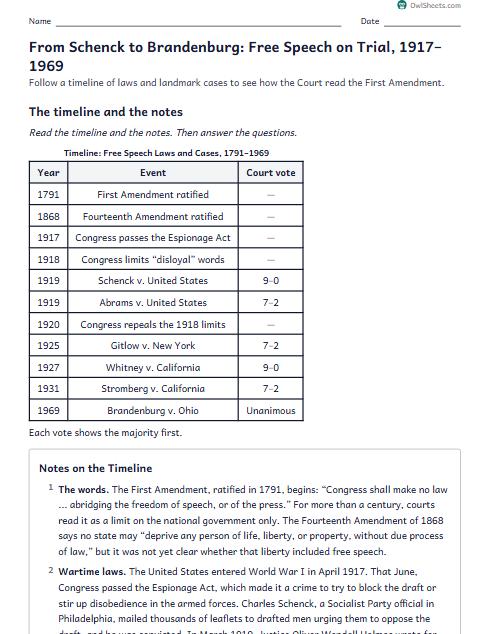
From Schenck to Brandenburg: Free Speech on Trial, 1917–1969
Grade 8 · CIV.8.2
14 questionsPremium
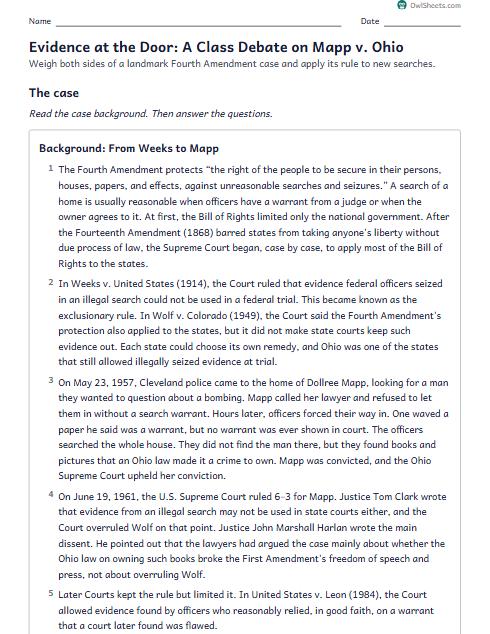
Evidence at the Door: A Class Debate on Mapp v. Ohio
Grade 8 · CIV.8.2
14 questionsPremium
The Right to Remain Silent: Reading the Miranda Opinion
Grade 8 · CIV.8.2
14 questionsPremium
At the Schoolhouse Gate: Students' Rights and the Supreme Court
Grade 8 · CIV.8.2
11 questionsPremium
Eight to One, Then Six to Three: The Flag Salute Cases
Grade 8 · CIV.8.2
10 questionsPremium