Grade 8 · Social StudiesCIV.8.2Premium
Evidence at the Door: A Class Debate on Mapp v. Ohio
Grade 8 civics: a class debate on Mapp v. Ohio (1961) shows how judicial review and landmark cases shaped the Fourth Amendment's limits on searches.
Preview
OwlSheets.com
Evidence at the Door: A Class Debate on Mapp v. Ohio
Weigh both sides of a landmark Fourth Amendment case and apply its rule to new searches.
The case
Read the case background. Then answer the questions.
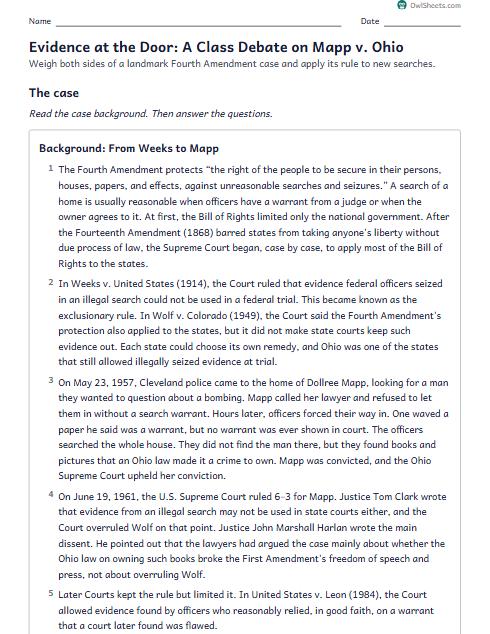
Background: From Weeks to Mapp
1The Fourth Amendment protects “the right of the people to be secure in their persons, houses, papers, and effects, against unreasonable searches and seizures.” A search of a home is usually reasonable when officers have a warrant from a judge or when the owner agrees to it. At first, the Bill of Rights limited only the national government. After the Fourteenth Amendment (1868) barred states from taking anyone's liberty without due process of law, the Supreme Court began, case by case, to apply most of the Bill of Rights to the states.
2In Weeks v. United States (1914), the Court ruled that evidence federal officers seized in an illegal search could not be used in a federal trial. This became known as the exclusionary rule. In Wolf v. Colorado (1949), the Court said the Fourth Amendment's protection also applied to the states, but it did not make state courts keep such evidence out. Each state could choose its own remedy, and Ohio was one of the states that still allowed illegally seized evidence at trial.
3On May 23, 1957, Cleveland police came to the home of Dollree Mapp, looking for a man they wanted to question about a bombing. Mapp called her lawyer and refused to let them in without a search warrant. Hours later, officers forced their way in. One waved a paper he said was a warrant, but no warrant was ever shown in court. The officers searched the whole house. They did not find the man there, but they found books and pictures that an Ohio law made it a crime to own. Mapp was convicted, and the Ohio Supreme Court upheld her conviction.
4On June 19, 1961, the U.S. Supreme Court ruled 6–3 for Mapp. Justice Tom Clark wrote that evidence from an illegal search may not be used in state courts either, and the Court overruled Wolf on that point. Justice John Marshall Harlan wrote the main dissent. He pointed out that the lawyers had argued the case mainly about whether the Ohio law on owning such books broke the First Amendment's freedom of speech and press, not about overruling Wolf.
5Later Courts kept the rule but limited it. In United States v. Leon (1984), the Court allowed evidence found by officers who reasonably relied, in good faith, on a warrant that a court later found was flawed.
- A. Only the agents' evidence, in a federal court
- B. Only the police evidence, in an Ohio state court
- C. Both, because Wolf let every court use such evidence
- D. Neither, because both searches broke the Fourth Amendment
First Amendment: freedom of speech and pressSecond Amendment: right to keep and bear armsFourth Amendment: no unreasonable searches and seizuresSixth Amendment: a speedy, public trial by juryEighth Amendment: no cruel and unusual punishments
The preview shows the first questions. Unlock the worksheet to see all of it.
Related worksheets
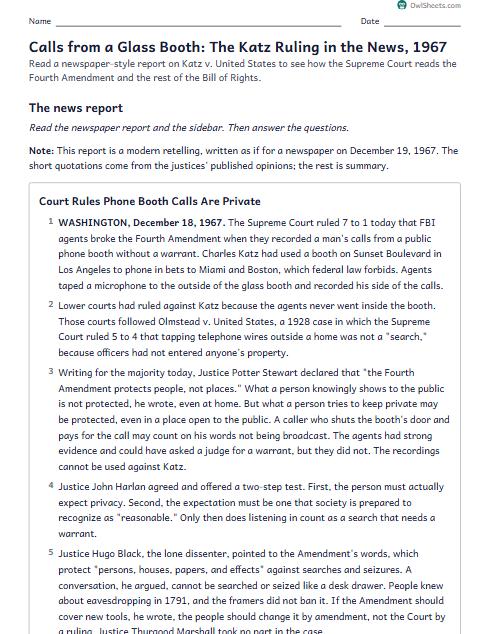
Calls from a Glass Booth: The Katz Ruling in the News, 1967
Grade 8 · CIV.8.2
15 questionsPremium
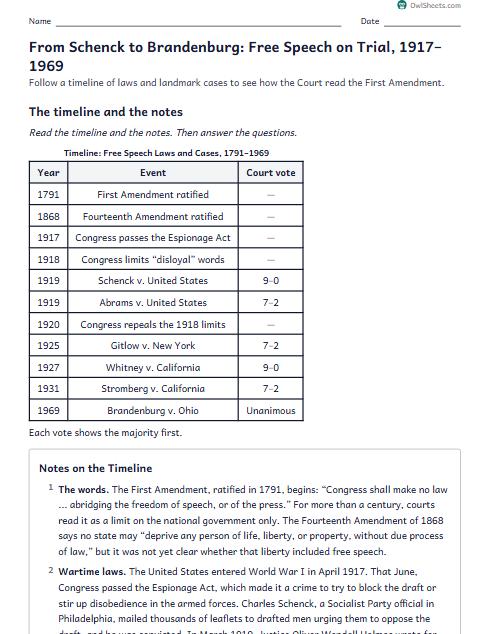
From Schenck to Brandenburg: Free Speech on Trial, 1917–1969
Grade 8 · CIV.8.2
14 questionsPremium
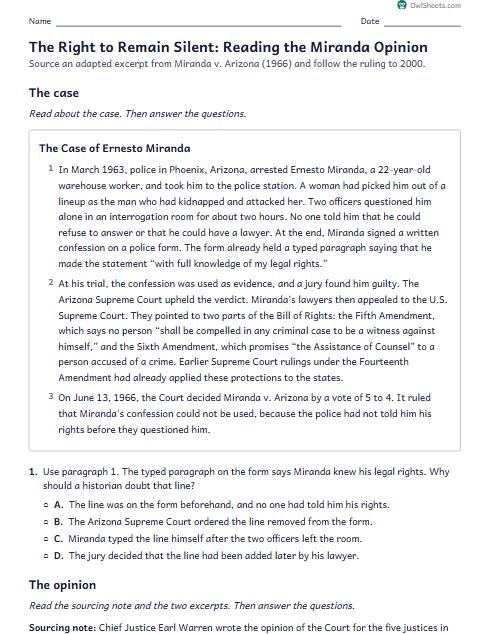
The Right to Remain Silent: Reading the Miranda Opinion
Grade 8 · CIV.8.2
14 questionsPremium
Silencing a Newspaper: Two Opinions in Near v. Minnesota
Grade 8 · CIV.8.2
13 questionsPremium
At the Schoolhouse Gate: Students' Rights and the Supreme Court
Grade 8 · CIV.8.2
11 questionsPremium
Eight to One, Then Six to Three: The Flag Salute Cases
Grade 8 · CIV.8.2
10 questionsPremium