Grade 8 · Social StudiesHIS.8.7Premium
Raleigh to Graham: A North Carolina Reconstruction Timeline, 1865–1877
Grade 8 Reconstruction: a North Carolina timeline from the Black Code to the 1868 constitution, Klan violence, Holden's removal and 1877.
Preview
OwlSheets.com
Raleigh to Graham: A North Carolina Reconstruction Timeline, 1865–1877
Trace the three amendments, a new state constitution and the violence that helped end Reconstruction in one state.
The timeline
Read the timeline and the notes. Then answer the questions.
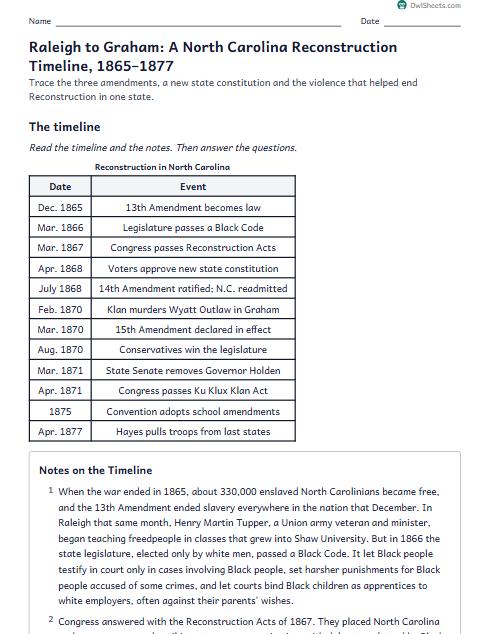
| Date | Event |
|---|---|
| Dec. 1865 | 13th Amendment becomes law |
| Mar. 1866 | Legislature passes a Black Code |
| Mar. 1867 | Congress passes Reconstruction Acts |
| Apr. 1868 | Voters approve new state constitution |
| July 1868 | 14th Amendment ratified; N.C. readmitted |
| Feb. 1870 | Klan murders Wyatt Outlaw in Graham |
| Mar. 1870 | 15th Amendment declared in effect |
| Aug. 1870 | Conservatives win the legislature |
| Mar. 1871 | State Senate removes Governor Holden |
| Apr. 1871 | Congress passes Ku Klux Klan Act |
| 1875 | Convention adopts school amendments |
| Apr. 1877 | Hayes pulls troops from last states |
Notes on the Timeline
1When the war ended in 1865, about 330,000 enslaved North Carolinians became free, and the 13th Amendment ended slavery everywhere in the nation that December. In Raleigh that same month, Henry Martin Tupper, a Union army veteran and minister, began teaching freedpeople in classes that grew into Shaw University. But in 1866 the state legislature, elected only by white men, passed a Black Code. It let Black people testify in court only in cases involving Black people, set harsher punishments for Black people accused of some crimes, and let courts bind Black children as apprentices to white employers, often against their parents' wishes.
2Congress answered with the Reconstruction Acts of 1867. They placed North Carolina under army command until it wrote a new constitution, with delegates elected by Black and white men, and ratified the 14th Amendment. Fifteen of the delegates who met in Raleigh in early 1868 were Black. The new constitution created free public schools for all children, ended property requirements for voting and holding office, and let voters elect their county officials. Voters approved it in April 1868, and William W. Holden, a Republican, became governor.
3Many white Conservatives fought the new government, and some joined the Ku Klux Klan, which used threats, beatings and murder. In February 1870 Klansmen hanged Wyatt Outlaw, a Black town commissioner, in Graham, in Alamance County. In May they killed State Senator John W. Stephens, a white Republican, in the Caswell County courthouse. Holden declared the two counties in a state of insurrection and sent a militia under Colonel George Kirk, which arrested about 100 suspects. Judges ordered the prisoners released, and no one was convicted of either murder at the time.
4In the August 1870 election, Conservatives, helped by many white voters' anger at the arrests and by Klan threats against Republican voters, won control of the legislature. The House impeached Holden, and in March 1871 the Senate removed him, the first U.S. governor ever removed this way. In April 1871 Congress passed the Ku Klux Klan Act, which let the President use federal courts and troops against groups that denied citizens their rights. Hundreds of Klansmen in the Carolinas were arrested, and Klan violence fell in many places.
5In 1874 voters in an eastern district with many Black voters elected John Adams Hyman, North Carolina's first Black member of Congress. But in 1875 a convention led by Conservatives wrote amendments to the state constitution, approved by voters in 1876, that required separate schools for Black and white children and gave the legislature power over county governments, which it soon used to take away voters' right to choose many county officials. Historians have found that schools for Black children usually received less money. In 1877 President Hayes pulled federal troops out of the last Southern states that still had them. The 14th and 15th Amendments stayed in the Constitution.
The 15th Amendment was ratified years after the 13th Amendment became law. North Carolina's promise of public schools for all children stood for years before a convention adopted amendments requiring separate schools.
The preview shows the first questions. Unlock the worksheet to see all of it.
Related worksheets
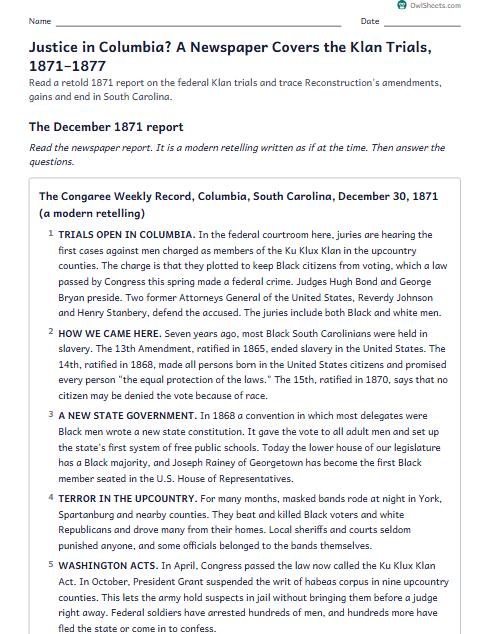
Justice in Columbia? A Newspaper Covers the Klan Trials, 1871–1877
Grade 8 · HIS.8.7
14 questionsPremium
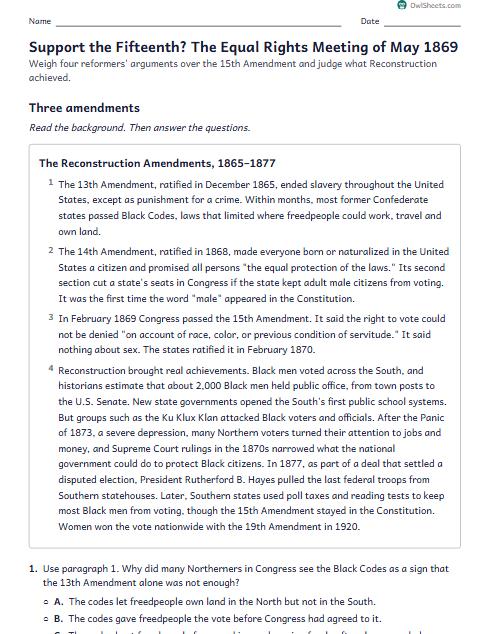
Support the Fifteenth? The Equal Rights Meeting of May 1869
Grade 8 · HIS.8.7
14 questionsPremium
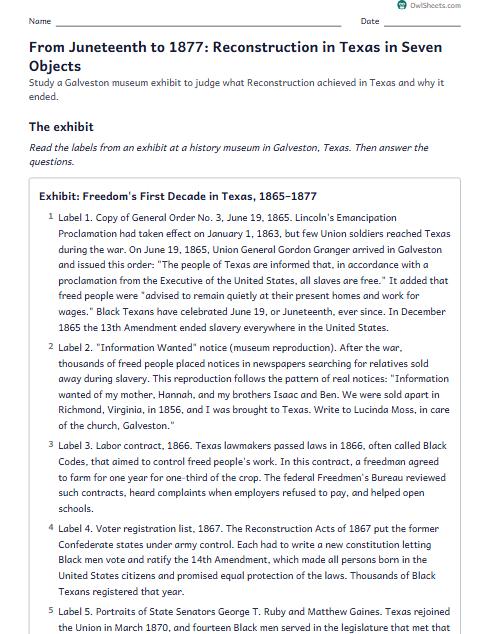
From Juneteenth to 1877: Reconstruction in Texas in Seven Objects
Grade 8 · HIS.8.7
13 questionsPremium
From the Capitol to the Crescent City: Mapping Reconstruction, 1865–1877
Grade 8 · HIS.8.7
13 questionsPremium
"We Simply Ask": Sourcing a Freedpeople's Address, 1865
Grade 8 · HIS.8.7
12 questionsPremium
One Senate Seat, Two Arguments: Hiram Revels and Reconstruction
Grade 8 · HIS.8.7
11 questionsFree