Grade 8 · Social StudiesHIS.8.7Premium
From the Capitol to the Crescent City: Mapping Reconstruction, 1865–1877
Grade 8 Reconstruction: a map journey through five cities traces the 13th, 14th and 15th Amendments, Reconstruction's gains and why it ended.
Preview
OwlSheets.com
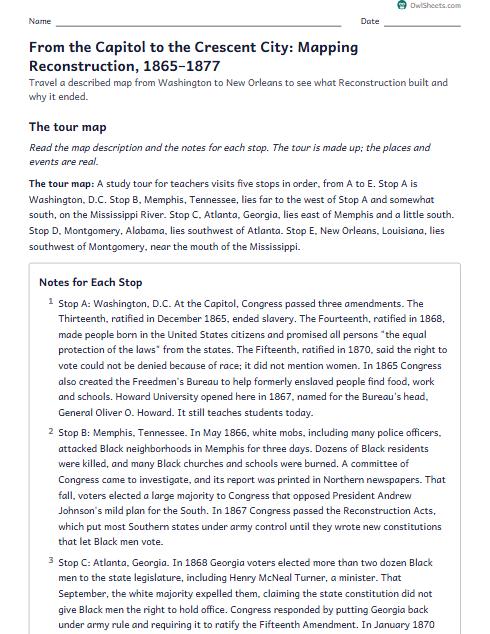
From the Capitol to the Crescent City: Mapping Reconstruction, 1865–1877
Travel a described map from Washington to New Orleans to see what Reconstruction built and why it ended.
The tour map
Read the map description and the notes for each stop. The tour is made up; the places and events are real.
Notes for Each Stop
1Stop A: Washington, D.C. At the Capitol, Congress passed three amendments. The Thirteenth, ratified in December 1865, ended slavery. The Fourteenth, ratified in 1868, made people born in the United States citizens and promised all persons "the equal protection of the laws" from the states. The Fifteenth, ratified in 1870, said the right to vote could not be denied because of race; it did not mention women. In 1865 Congress also created the Freedmen's Bureau to help formerly enslaved people find food, work and schools. Howard University opened here in 1867, named for the Bureau's head, General Oliver O. Howard. It still teaches students today.
2Stop B: Memphis, Tennessee. In May 1866, white mobs, including many police officers, attacked Black neighborhoods in Memphis for three days. Dozens of Black residents were killed, and many Black churches and schools were burned. A committee of Congress came to investigate, and its report was printed in Northern newspapers. That fall, voters elected a large majority to Congress that opposed President Andrew Johnson's mild plan for the South. In 1867 Congress passed the Reconstruction Acts, which put most Southern states under army control until they wrote new constitutions that let Black men vote.
3Stop C: Atlanta, Georgia. In 1868 Georgia voters elected more than two dozen Black men to the state legislature, including Henry McNeal Turner, a minister. That September, the white majority expelled them, claiming the state constitution did not give Black men the right to hold office. Congress responded by putting Georgia back under army rule and requiring it to ratify the Fifteenth Amendment. In January 1870 the expelled members took their seats again. Meanwhile, Atlanta University began training Black teachers.
4Stop D: Montgomery, Alabama. In 1861, delegates in Montgomery founded the Confederacy, and the city was its first capital. In 1868, Alabama's new constitution, written by a convention that included Black delegates, opened public schools to Black children, usually in separate schools. In 1870 Alabama voters sent Benjamin S. Turner of Selma, a man who had been enslaved, to the U.S. House of Representatives. In 1874, Democrats who opposed Reconstruction won control of the state, helped by threats and violence that kept many Black voters from the polls.
5Stop E: New Orleans, Louisiana. In December 1872, P. B. S. Pinchback became acting governor of Louisiana for about five weeks, the first Black governor of a U.S. state. Some New Orleans public schools taught Black and white children together until 1877. In the Slaughterhouse Cases (1873), which began here, the Supreme Court ruled that the Fourteenth Amendment protected only a short list of rights of national citizenship and left most rights to the states. In 1874, thousands of armed White League members fought the state's police in the streets. In United States v. Cruikshank (1876), the Court overturned the convictions of white men charged after a deadly 1873 attack at Colfax, Louisiana, ruling that the amendments limited what states did, not what private people did. In April 1877, after the disputed election of 1876, President Rutherford B. Hayes ordered federal troops back to their barracks, and Louisiana's Republican government fell.
- A. Southwest
- B. Northwest
- C. Northeast
- D. Southeast
The preview shows the first questions. Unlock the worksheet to see all of it.
Related worksheets
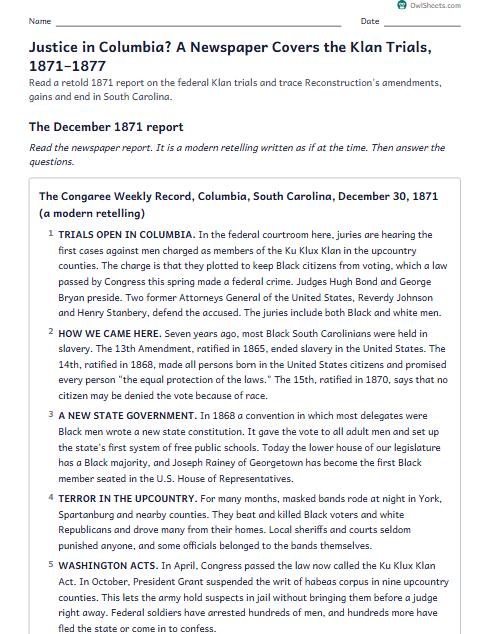
Justice in Columbia? A Newspaper Covers the Klan Trials, 1871–1877
Grade 8 · HIS.8.7
14 questionsPremium
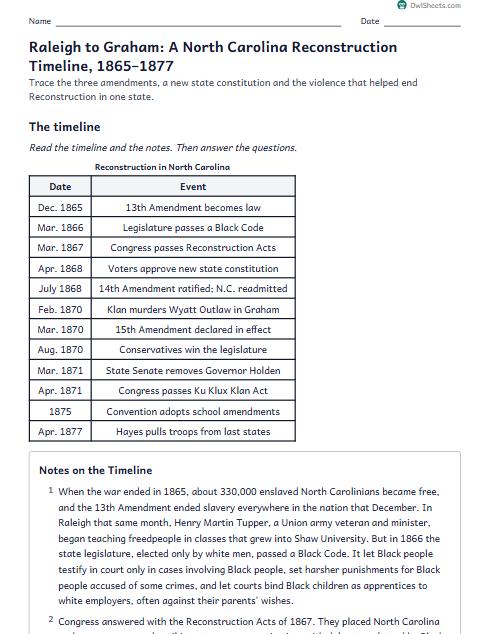
Raleigh to Graham: A North Carolina Reconstruction Timeline, 1865–1877
Grade 8 · HIS.8.7
14 questionsPremium
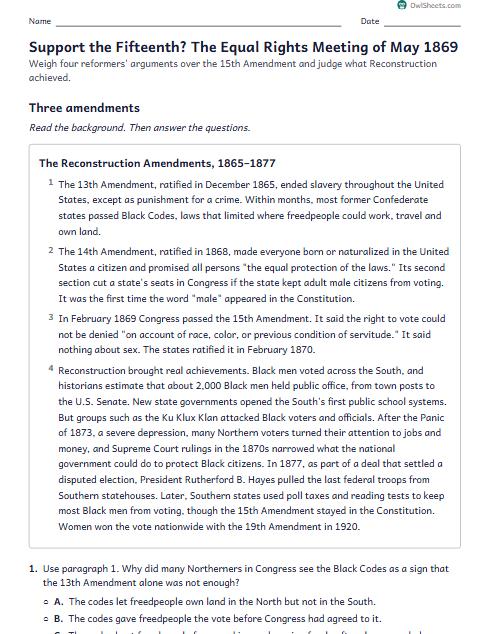
Support the Fifteenth? The Equal Rights Meeting of May 1869
Grade 8 · HIS.8.7
14 questionsPremium
From Juneteenth to 1877: Reconstruction in Texas in Seven Objects
Grade 8 · HIS.8.7
13 questionsPremium
"We Simply Ask": Sourcing a Freedpeople's Address, 1865
Grade 8 · HIS.8.7
12 questionsPremium
One Senate Seat, Two Arguments: Hiram Revels and Reconstruction
Grade 8 · HIS.8.7
11 questionsFree