Grade 8 · Social StudiesHIS.8.7Premium
Support the Fifteenth? The Equal Rights Meeting of May 1869
Grade 8 Reconstruction: the 13th, 14th and 15th Amendments, a May 1869 reform meeting split over the 15th, and why Reconstruction ended.
Preview
OwlSheets.com
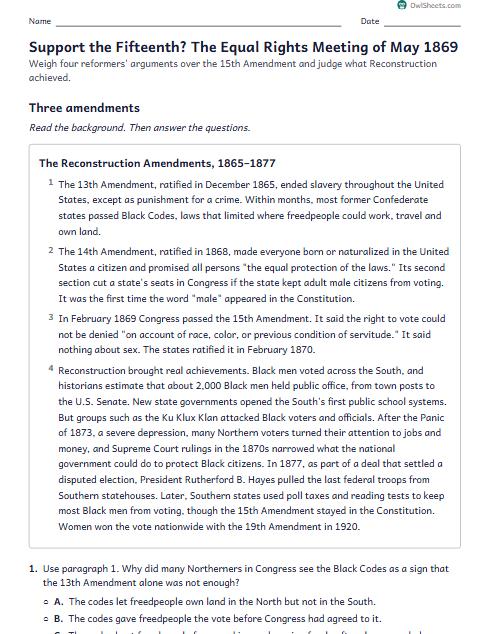
Support the Fifteenth? The Equal Rights Meeting of May 1869
Weigh four reformers' arguments over the 15th Amendment and judge what Reconstruction achieved.
Three amendments
Read the background. Then answer the questions.
The Reconstruction Amendments, 1865–1877
1The 13th Amendment, ratified in December 1865, ended slavery throughout the United States, except as punishment for a crime. Within months, most former Confederate states passed Black Codes, laws that limited where freedpeople could work, travel and own land.
2The 14th Amendment, ratified in 1868, made everyone born or naturalized in the United States a citizen and promised all persons "the equal protection of the laws." Its second section cut a state's seats in Congress if the state kept adult male citizens from voting. It was the first time the word "male" appeared in the Constitution.
3In February 1869 Congress passed the 15th Amendment. It said the right to vote could not be denied "on account of race, color, or previous condition of servitude." It said nothing about sex. The states ratified it in February 1870.
4Reconstruction brought real achievements. Black men voted across the South, and historians estimate that about 2,000 Black men held public office, from town posts to the U.S. Senate. New state governments opened the South's first public school systems. But groups such as the Ku Klux Klan attacked Black voters and officials. After the Panic of 1873, a severe depression, many Northern voters turned their attention to jobs and money, and Supreme Court rulings in the 1870s narrowed what the national government could do to protect Black citizens. In 1877, as part of a deal that settled a disputed election, President Rutherford B. Hayes pulled the last federal troops from Southern statehouses. Later, Southern states used poll taxes and reading tests to keep most Black men from voting, though the 15th Amendment stayed in the Constitution. Women won the vote nationwide with the 19th Amendment in 1920.
- A. The codes let freedpeople own land in the North but not in the South.
- B. The codes gave freedpeople the vote before Congress had agreed to it.
- C. The codes kept freedpeople from working and moving freely after slavery ended.
- D. The codes had been passed by Congress before the amendment was ratified.
- A. It banned women from holding public office in the states for ten years.
- B. It made men citizens but left women born in the country without citizenship.
- C. It wrote the word "male" into the Constitution, tying voting to men.
- D. It cut Congress seats for any state that let women vote in its elections.
The preview shows the first questions. Unlock the worksheet to see all of it.
Related worksheets
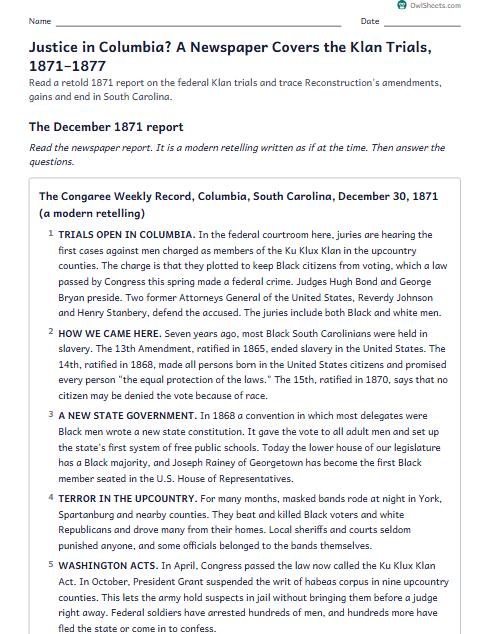
Justice in Columbia? A Newspaper Covers the Klan Trials, 1871–1877
Grade 8 · HIS.8.7
14 questionsPremium
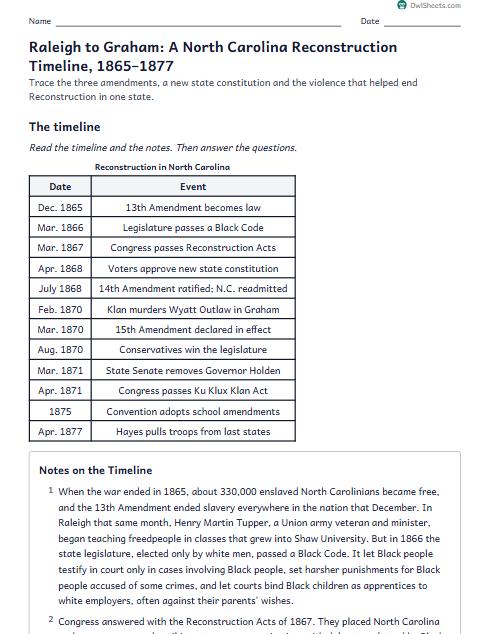
Raleigh to Graham: A North Carolina Reconstruction Timeline, 1865–1877
Grade 8 · HIS.8.7
14 questionsPremium
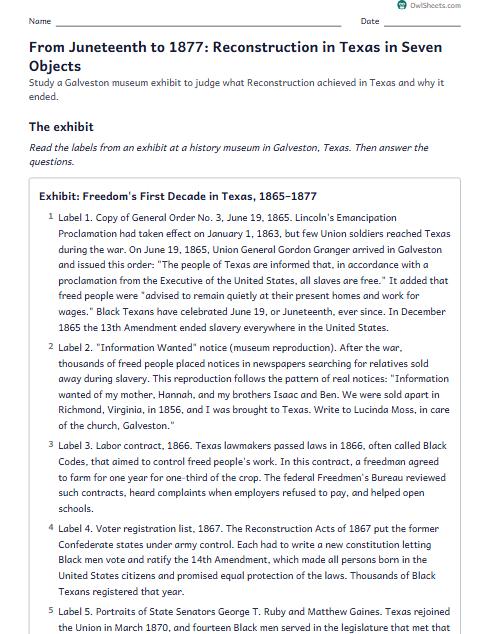
From Juneteenth to 1877: Reconstruction in Texas in Seven Objects
Grade 8 · HIS.8.7
13 questionsPremium
From the Capitol to the Crescent City: Mapping Reconstruction, 1865–1877
Grade 8 · HIS.8.7
13 questionsPremium
"We Simply Ask": Sourcing a Freedpeople's Address, 1865
Grade 8 · HIS.8.7
12 questionsPremium
One Senate Seat, Two Arguments: Hiram Revels and Reconstruction
Grade 8 · HIS.8.7
11 questionsFree