Grade 8 · Social StudiesHIS.8.7Premium
Justice in Columbia? A Newspaper Covers the Klan Trials, 1871–1877
Grade 8 Reconstruction: a retold 1871 report on South Carolina's federal Klan trials links the three amendments, Reconstruction's gains and its end.
Preview
OwlSheets.com
Justice in Columbia? A Newspaper Covers the Klan Trials, 1871–1877
Read a retold 1871 report on the federal Klan trials and trace Reconstruction's amendments, gains and end in South Carolina.
The December 1871 report
Read the newspaper report. It is a modern retelling written as if at the time. Then answer the questions.
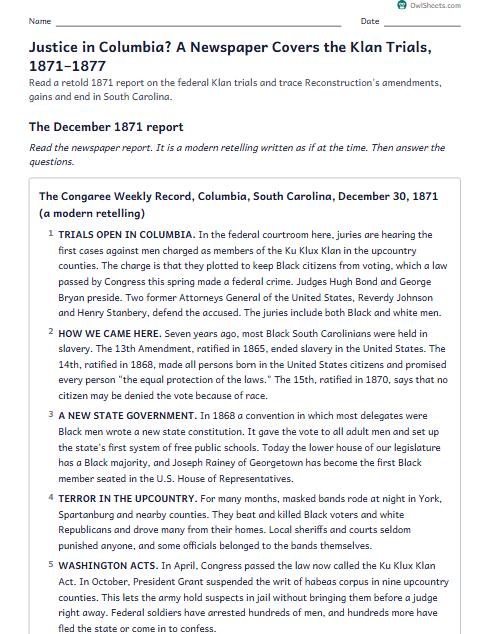
The Congaree Weekly Record, Columbia, South Carolina, December 30, 1871 (a modern retelling)
1TRIALS OPEN IN COLUMBIA. In the federal courtroom here, juries are hearing the first cases against men charged as members of the Ku Klux Klan in the upcountry counties. The charge is that they plotted to keep Black citizens from voting, which a law passed by Congress this spring made a federal crime. Judges Hugh Bond and George Bryan preside. Two former Attorneys General of the United States, Reverdy Johnson and Henry Stanbery, defend the accused. The juries include both Black and white men.
2HOW WE CAME HERE. Seven years ago, most Black South Carolinians were held in slavery. The 13th Amendment, ratified in 1865, ended slavery in the United States. The 14th, ratified in 1868, made all persons born in the United States citizens and promised every person "the equal protection of the laws." The 15th, ratified in 1870, says that no citizen may be denied the vote because of race.
3A NEW STATE GOVERNMENT. In 1868 a convention in which most delegates were Black men wrote a new state constitution. It gave the vote to all adult men and set up the state's first system of free public schools. Today the lower house of our legislature has a Black majority, and Joseph Rainey of Georgetown has become the first Black member seated in the U.S. House of Representatives.
4TERROR IN THE UPCOUNTRY. For many months, masked bands rode at night in York, Spartanburg and nearby counties. They beat and killed Black voters and white Republicans and drove many from their homes. Local sheriffs and courts seldom punished anyone, and some officials belonged to the bands themselves.
5WASHINGTON ACTS. In April, Congress passed the law now called the Ku Klux Klan Act. In October, President Grant suspended the writ of habeas corpus in nine upcountry counties. This lets the army hold suspects in jail without bringing them before a judge right away. Federal soldiers have arrested hundreds of men, and hundreds more have fled the state or come in to confess.
6TWO VIEWS. Supporters say the trials prove that the national government will defend the rights of its citizens. Many white Democrats call the arrests an attack on the state by Northern soldiers.
- A. The accused men had asked to be tried by judges sent from the North.
- B. South Carolina had shut down its own state courts when the war ended in 1865.
- C. The men were charged under a law of Congress that made the plot a federal crime.
- D. The Constitution sends trials held in a state's capital city to the federal courts.
| The prosecution (for the law) | The defense (for the accused) |
|---|---|
The preview shows the first questions. Unlock the worksheet to see all of it.
Related worksheets
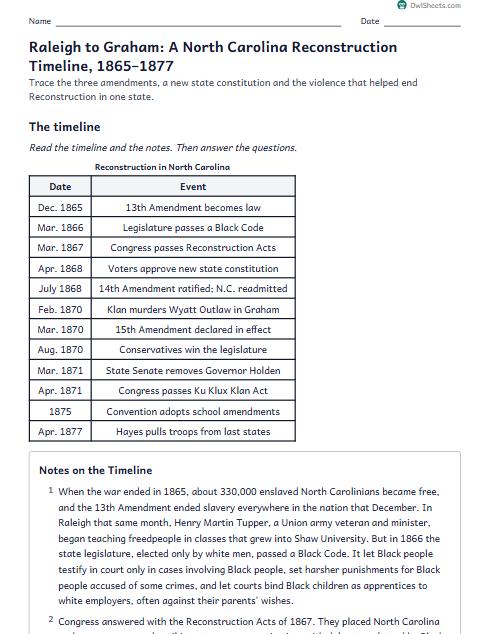
Raleigh to Graham: A North Carolina Reconstruction Timeline, 1865–1877
Grade 8 · HIS.8.7
14 questionsPremium
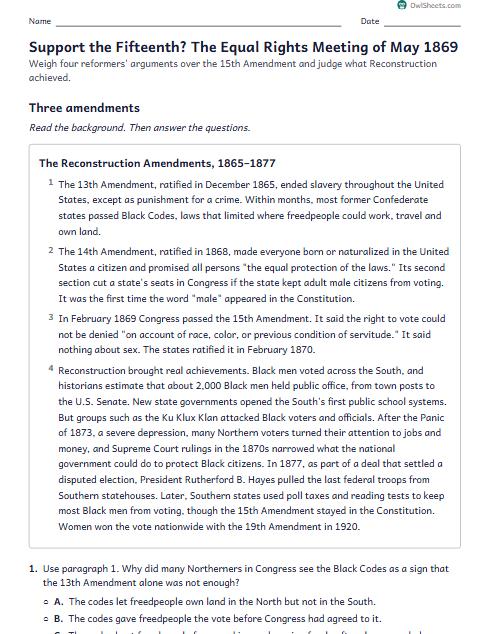
Support the Fifteenth? The Equal Rights Meeting of May 1869
Grade 8 · HIS.8.7
14 questionsPremium
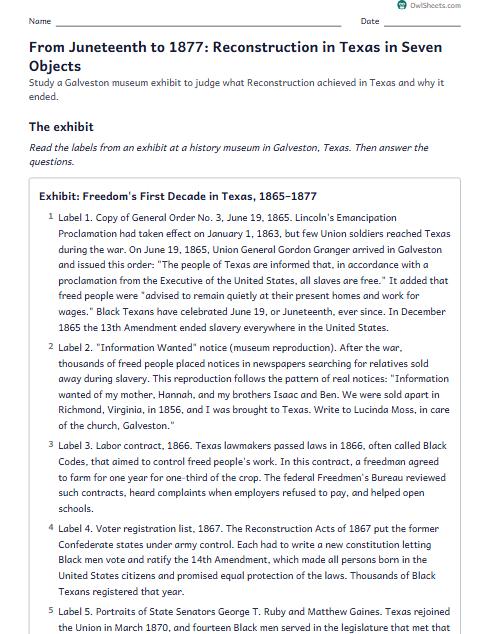
From Juneteenth to 1877: Reconstruction in Texas in Seven Objects
Grade 8 · HIS.8.7
13 questionsPremium
From the Capitol to the Crescent City: Mapping Reconstruction, 1865–1877
Grade 8 · HIS.8.7
13 questionsPremium
"We Simply Ask": Sourcing a Freedpeople's Address, 1865
Grade 8 · HIS.8.7
12 questionsPremium
One Senate Seat, Two Arguments: Hiram Revels and Reconstruction
Grade 8 · HIS.8.7
11 questionsFree