Grade 8 · Social StudiesHIS.8.7Premium
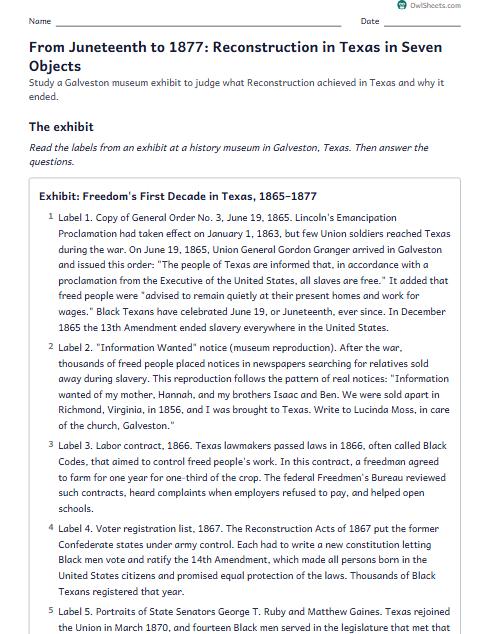
From Juneteenth to 1877: Reconstruction in Texas in Seven Objects
Grade 8 history: seven labeled objects from a Galveston exhibit trace Reconstruction in Texas, the 13th, 14th and 15th Amendments, and why it ended.
Preview
OwlSheets.com
From Juneteenth to 1877: Reconstruction in Texas in Seven Objects
Study a Galveston museum exhibit to judge what Reconstruction achieved in Texas and why it ended.
The exhibit
Read the labels from an exhibit at a history museum in Galveston, Texas. Then answer the questions.
Exhibit: Freedom's First Decade in Texas, 1865–1877
1Label 1. Copy of General Order No. 3, June 19, 1865. Lincoln's Emancipation Proclamation had taken effect on January 1, 1863, but few Union soldiers reached Texas during the war. On June 19, 1865, Union General Gordon Granger arrived in Galveston and issued this order: "The people of Texas are informed that, in accordance with a proclamation from the Executive of the United States, all slaves are free." It added that freed people were "advised to remain quietly at their present homes and work for wages." Black Texans have celebrated June 19, or Juneteenth, ever since. In December 1865 the 13th Amendment ended slavery everywhere in the United States.
2Label 2. "Information Wanted" notice (museum reproduction). After the war, thousands of freed people placed notices in newspapers searching for relatives sold away during slavery. This reproduction follows the pattern of real notices: "Information wanted of my mother, Hannah, and my brothers Isaac and Ben. We were sold apart in Richmond, Virginia, in 1856, and I was brought to Texas. Write to Lucinda Moss, in care of the church, Galveston."
3Label 3. Labor contract, 1866. Texas lawmakers passed laws in 1866, often called Black Codes, that aimed to control freed people's work. In this contract, a freedman agreed to farm for one year for one-third of the crop. The federal Freedmen's Bureau reviewed such contracts, heard complaints when employers refused to pay, and helped open schools.
4Label 4. Voter registration list, 1867. The Reconstruction Acts of 1867 put the former Confederate states under army control. Each had to write a new constitution letting Black men vote and ratify the 14th Amendment, which made all persons born in the United States citizens and promised equal protection of the laws. Thousands of Black Texans registered that year.
5Label 5. Portraits of State Senators George T. Ruby and Matthew Gaines. Texas rejoined the Union in March 1870, and fourteen Black men served in the legislature that met that year. Ruby, a teacher born free in New York, represented Galveston. Gaines, a preacher who had been enslaved, spoke out for public schools. In 1871 the legislature created a statewide system of free public schools.
6Label 6. Print celebrating the 15th Amendment, 1870. Ratified in February 1870, it said no state could deny a citizen the vote because of race. The Reconstruction Acts had covered only the former Confederate states, and in 1868 Black men still could not vote in many Northern states.
7Label 7. Telegram from President Grant, January 1874. In 1873 Democrat Richard Coke defeated Republican Governor Edmund J. Davis. That year a financial panic began a long depression, and many Northern voters turned their attention to jobs and money. Davis claimed the election was illegal and asked Grant to send troops. Grant answered that it would be wiser to accept the voters' verdict. Davis left office, and in 1876 Democrats wrote a new state constitution. In 1877 the last federal troops protecting Republican governments in the South were withdrawn. Over the next decades, Southern states used poll taxes and other rules to keep most Black men from voting. The 14th and 15th Amendments stayed in the Constitution, and civil rights lawyers later relied on them in cases such as Brown v. Board of Education (1954).
- A. The 13th Amendment had made slavery legal again in Texas.
- B. Lincoln had canceled the Proclamation before the war ended.
- C. Freedom depended on Union armies, and few had reached Texas.
- D. Texas had already freed its enslaved people before the war.
The people of Texas are informedin accordance with a proclamation from the Executive of the United Statesall slaves are freeadvised to remain quietly at their present homes and work for wages
The preview shows the first questions. Unlock the worksheet to see all of it.
Related worksheets
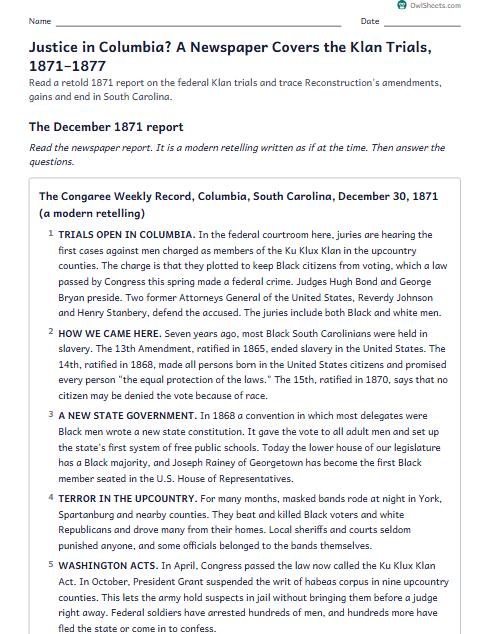
Justice in Columbia? A Newspaper Covers the Klan Trials, 1871–1877
Grade 8 · HIS.8.7
14 questionsPremium
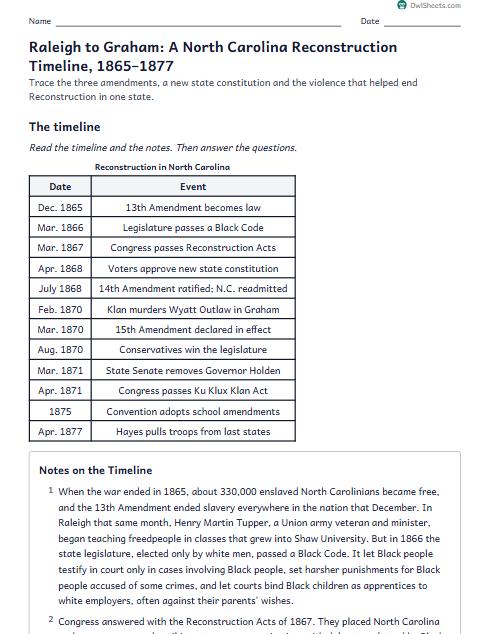
Raleigh to Graham: A North Carolina Reconstruction Timeline, 1865–1877
Grade 8 · HIS.8.7
14 questionsPremium
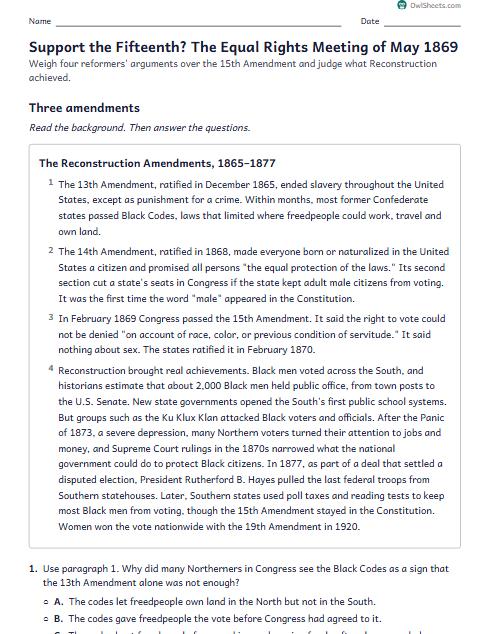
Support the Fifteenth? The Equal Rights Meeting of May 1869
Grade 8 · HIS.8.7
14 questionsPremium
From the Capitol to the Crescent City: Mapping Reconstruction, 1865–1877
Grade 8 · HIS.8.7
13 questionsPremium
"We Simply Ask": Sourcing a Freedpeople's Address, 1865
Grade 8 · HIS.8.7
12 questionsPremium
One Senate Seat, Two Arguments: Hiram Revels and Reconstruction
Grade 8 · HIS.8.7
11 questionsFree