Grade 8 · Social StudiesHIS.8.5Premium
The South Meets at Nashville: A Newspaper Follows the Road to War, 1850–1861
Grade 8 causes of the Civil War: a retold Nashville newspaper follows the 1850 Southern Convention, the failed compromises, the 1860 election and secession.
Preview
OwlSheets.com
The South Meets at Nashville: A Newspaper Follows the Road to War, 1850–1861
Read a retold 1850 report and its later editions to explain sectional conflict, failed compromises and the election of 1860.
The June 1850 report
Read the newspaper report. It is a modern retelling written as if at the time. Then answer the questions.
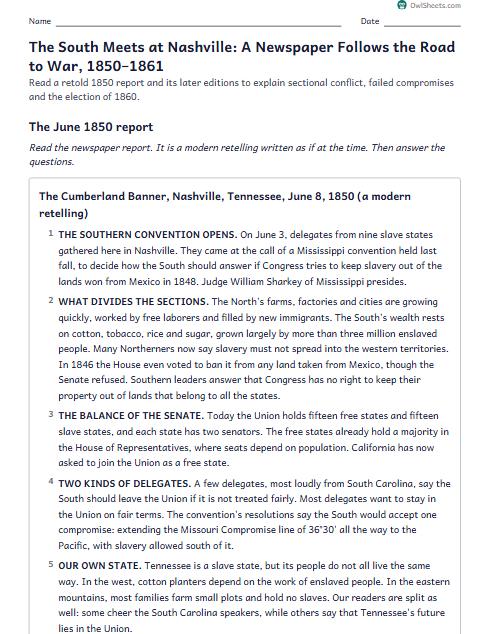
The Cumberland Banner, Nashville, Tennessee, June 8, 1850 (a modern retelling)
1THE SOUTHERN CONVENTION OPENS. On June 3, delegates from nine slave states gathered here in Nashville. They came at the call of a Mississippi convention held last fall, to decide how the South should answer if Congress tries to keep slavery out of the lands won from Mexico in 1848. Judge William Sharkey of Mississippi presides.
2WHAT DIVIDES THE SECTIONS. The North's farms, factories and cities are growing quickly, worked by free laborers and filled by new immigrants. The South's wealth rests on cotton, tobacco, rice and sugar, grown largely by more than three million enslaved people. Many Northerners now say slavery must not spread into the western territories. In 1846 the House even voted to ban it from any land taken from Mexico, though the Senate refused. Southern leaders answer that Congress has no right to keep their property out of lands that belong to all the states.
3THE BALANCE OF THE SENATE. Today the Union holds fifteen free states and fifteen slave states, and each state has two senators. The free states already hold a majority in the House of Representatives, where seats depend on population. California has now asked to join the Union as a free state.
4TWO KINDS OF DELEGATES. A few delegates, most loudly from South Carolina, say the South should leave the Union if it is not treated fairly. Most delegates want to stay in the Union on fair terms. The convention's resolutions say the South would accept one compromise: extending the Missouri Compromise line of 36°30' all the way to the Pacific, with slavery allowed south of it.
5OUR OWN STATE. Tennessee is a slave state, but its people do not all live the same way. In the west, cotton planters depend on the work of enslaved people. In the eastern mountains, most families farm small plots and hold no slaves. Our readers are split as well: some cheer the South Carolina speakers, while others say that Tennessee's future lies in the Union.
6WAITING FOR WASHINGTON. In the Senate, Henry Clay of Kentucky is pressing a group of bills meant to settle every quarrel over slavery at once. The delegates have agreed to meet again after Congress acts.
- A. It would let Congress end slavery in the states where it already existed.
- B. It would end the even split in the Senate, where the South still had equal power.
- C. It would push the Missouri Compromise line north of the state of Tennessee and Kentucky.
- D. It would give California more seats in the House than any slave state had.
| Ready to leave the Union | Stay in the Union on fair terms |
|---|---|
The preview shows the first questions. Unlock the worksheet to see all of it.
Related worksheets
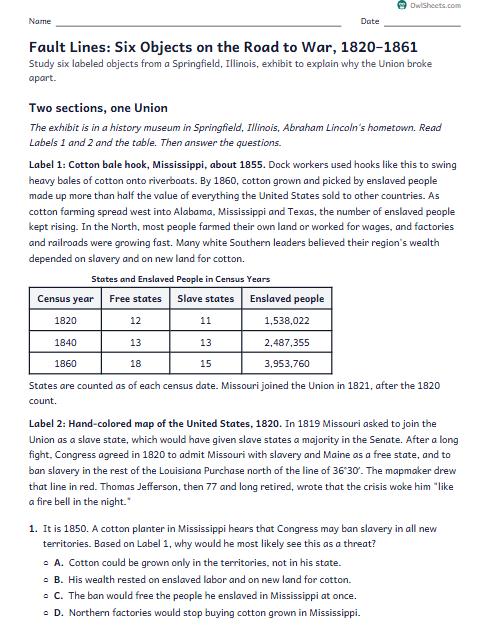
Fault Lines: Six Objects on the Road to War, 1820–1861
Grade 8 · HIS.8.5
14 questionsPremium
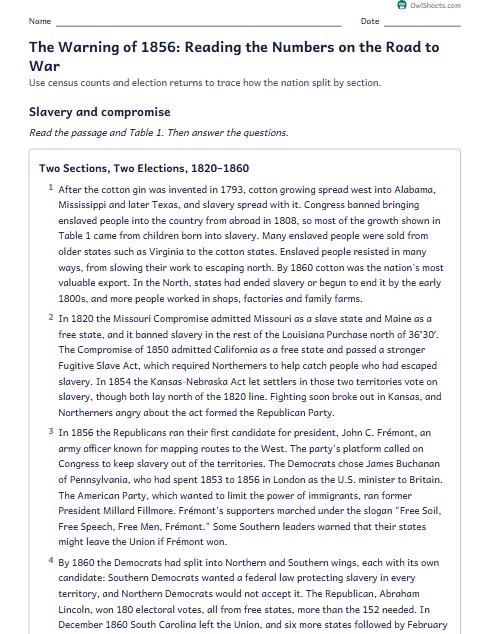
The Warning of 1856: Reading the Numbers on the Road to War
Grade 8 · HIS.8.5
14 questionsPremium
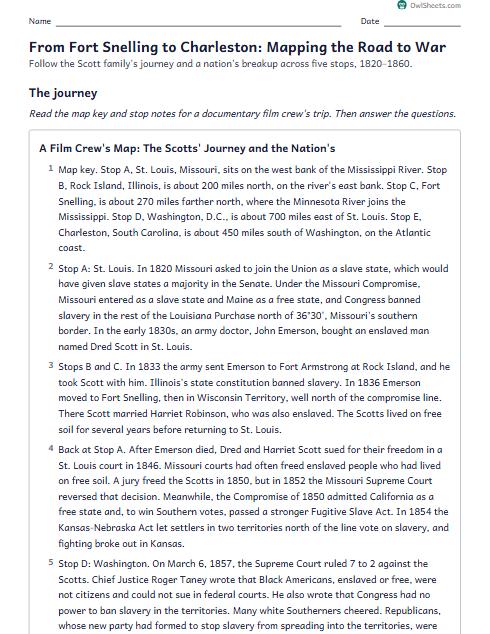
From Fort Snelling to Charleston: Mapping the Road to War
Grade 8 · HIS.8.5
14 questionsPremium
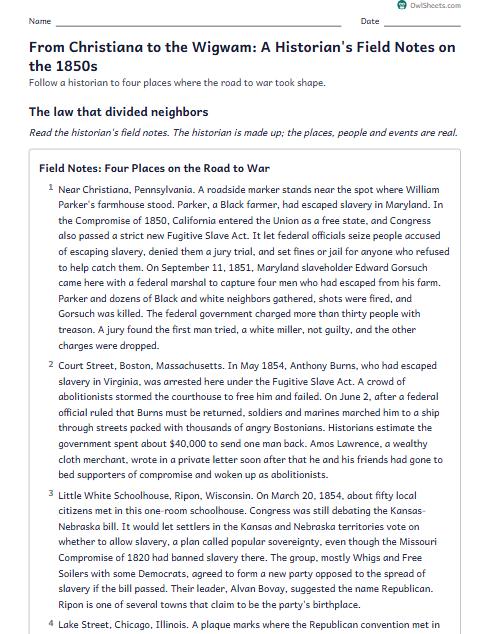
From Christiana to the Wigwam: A Historian's Field Notes on the 1850s
Grade 8 · HIS.8.5
13 questionsPremium
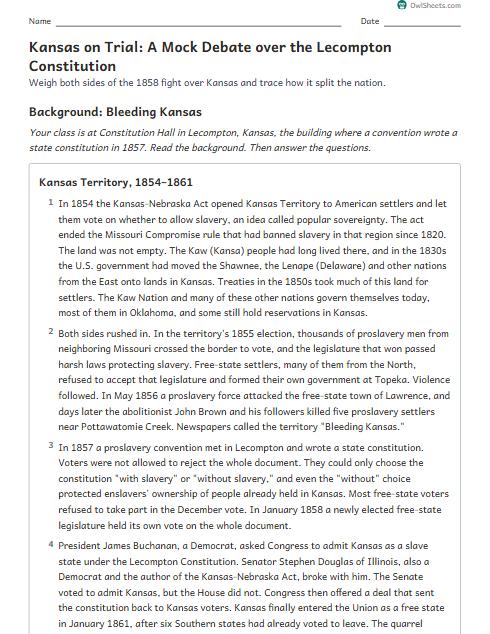
Kansas on Trial: A Mock Debate over the Lecompton Constitution
Grade 8 · HIS.8.5
12 questionsPremium
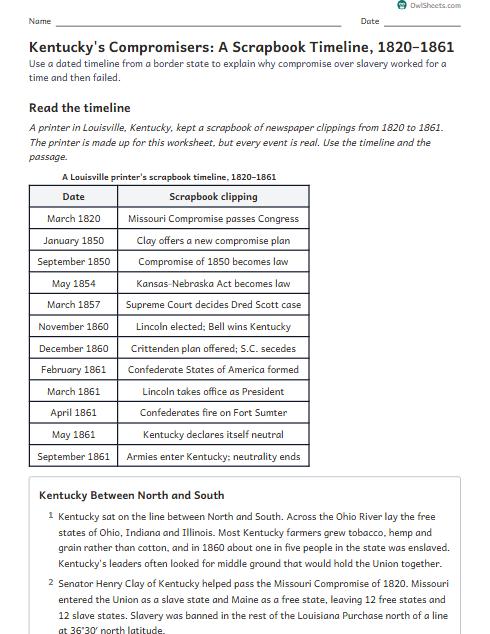
Kentucky's Compromisers: A Scrapbook Timeline, 1820–1861
Grade 8 · HIS.8.5
11 questionsPremium