Grade 8 · Social StudiesHIS.8.5Premium
The Warning of 1856: Reading the Numbers on the Road to War
Grade 8 causes of the Civil War: census counts of enslaved people, failed compromises, and the 1856 and 1860 election returns read as data.
Preview
OwlSheets.com
The Warning of 1856: Reading the Numbers on the Road to War
Use census counts and election returns to trace how the nation split by section.
Slavery and compromise
Read the passage and Table 1. Then answer the questions.
Two Sections, Two Elections, 1820–1860
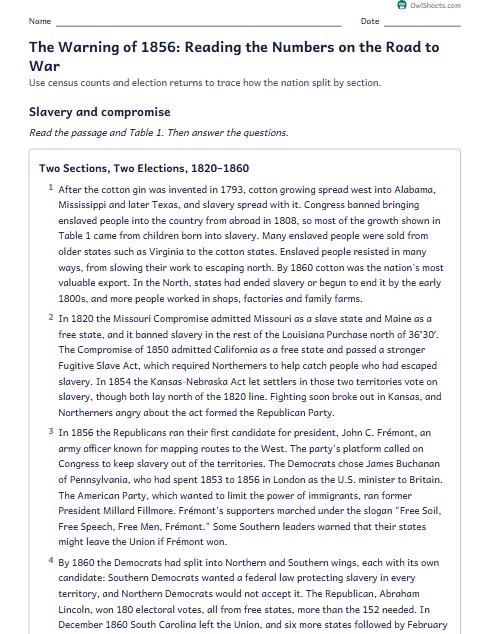
1After the cotton gin was invented in 1793, cotton growing spread west into Alabama, Mississippi and later Texas, and slavery spread with it. Congress banned bringing enslaved people into the country from abroad in 1808, so most of the growth shown in Table 1 came from children born into slavery. Many enslaved people were sold from older states such as Virginia to the cotton states. Enslaved people resisted in many ways, from slowing their work to escaping north. By 1860 cotton was the nation's most valuable export. In the North, states had ended slavery or begun to end it by the early 1800s, and more people worked in shops, factories and family farms.
2In 1820 the Missouri Compromise admitted Missouri as a slave state and Maine as a free state, and it banned slavery in the rest of the Louisiana Purchase north of 36°30′. The Compromise of 1850 admitted California as a free state and passed a stronger Fugitive Slave Act, which required Northerners to help catch people who had escaped slavery. In 1854 the Kansas-Nebraska Act let settlers in those two territories vote on slavery, though both lay north of the 1820 line. Fighting soon broke out in Kansas, and Northerners angry about the act formed the Republican Party.
3In 1856 the Republicans ran their first candidate for president, John C. Frémont, an army officer known for mapping routes to the West. The party's platform called on Congress to keep slavery out of the territories. The Democrats chose James Buchanan of Pennsylvania, who had spent 1853 to 1856 in London as the U.S. minister to Britain. The American Party, which wanted to limit the power of immigrants, ran former President Millard Fillmore. Frémont's supporters marched under the slogan "Free Soil, Free Speech, Free Men, Frémont." Some Southern leaders warned that their states might leave the Union if Frémont won.
4By 1860 the Democrats had split into Northern and Southern wings, each with its own candidate: Southern Democrats wanted a federal law protecting slavery in every territory, and Northern Democrats would not accept it. The Republican, Abraham Lincoln, won 180 electoral votes, all from free states, more than the 152 needed. In December 1860 South Carolina left the Union, and six more states followed by February 1861.
| Census year | Enslaved people |
|---|---|
| 1820 | 1,538,000 |
| 1830 | 2,009,000 |
| 1840 | 2,487,000 |
| 1850 | 3,204,000 |
| 1860 | 3,954,000 |
From 1820 to 1860, the number of enslaved people grew by people.
The preview shows the first questions. Unlock the worksheet to see all of it.
Related worksheets
The South Meets at Nashville: A Newspaper Follows the Road to War, 1850–1861
Grade 8 · HIS.8.5
14 questionsPremium
Fault Lines: Six Objects on the Road to War, 1820–1861
Grade 8 · HIS.8.5
14 questionsPremium
From Fort Snelling to Charleston: Mapping the Road to War
Grade 8 · HIS.8.5
14 questionsPremium
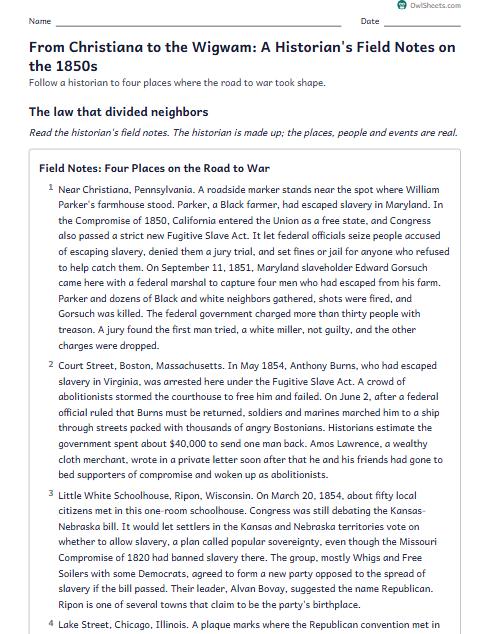
From Christiana to the Wigwam: A Historian's Field Notes on the 1850s
Grade 8 · HIS.8.5
13 questionsPremium
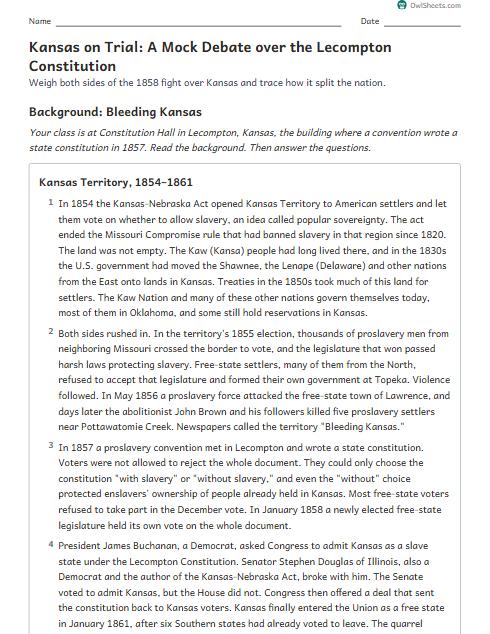
Kansas on Trial: A Mock Debate over the Lecompton Constitution
Grade 8 · HIS.8.5
12 questionsPremium
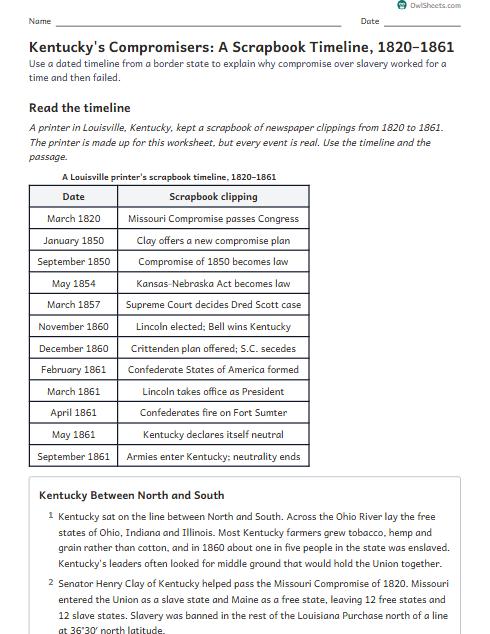
Kentucky's Compromisers: A Scrapbook Timeline, 1820–1861
Grade 8 · HIS.8.5
11 questionsPremium